
CDSCO Import License for Foreign Medical Device Manufacturers is an important regulatory requirement for overseas companies planning to import and market applicable medical devices in India. The Indian regulatory framework for medical devices is primarily governed by the Medical Devices Rules, 2017, along with applicable amendments, notifications, and regulatory requirements.
For a foreign manufacturer, entering the Indian market involves more than simply shipping products to an Indian buyer. The company needs to understand the applicable device classification, appoint the appropriate Indian representative or authorised agent, prepare technical and regulatory documents, and follow the applicable CDSCO import-licensing pathway.
This guide explains the process in simple language so that foreign manufacturers can understand the major steps involved before beginning an Indian medical-device import application.
What Is a CDSCO Import License for Foreign Medical Device Manufacturers?
A CDSCO import licence is the regulatory authorization used for importing applicable medical devices into India under the Medical Devices Rules, 2017.
CDSCO’s medical-device information page states that an applicant seeking an import licence makes an application in MD-14 through the SUGAM online portal, with the import licence granted in MD-15.
Foreign applicants should ensure that all information submitted for the CDSCO Import License for Foreign Medical Device Manufacturers is consistent with the supporting regulatory documents.
The licence identifies the authorised agent, overseas manufacturer, manufacturing site and medical devices covered by the licence.
For foreign manufacturers, the process therefore requires coordination between the overseas manufacturer and the authorised Indian entity handling the application.
Why Do Foreign Medical Device Manufacturers Need an Import License?
A foreign manufacturer cannot treat the Indian market like an ordinary export destination.
Medical devices are subject to Indian regulatory requirements, and the applicable pathway depends on factors such as:
- Device classification
- Intended use
- Product type
- Manufacturing location
- Regulatory status
- Applicable licensing requirements
- Technical documentation
- Labelling and Instructions for Use
- Post-market responsibilities
The purpose of the import-licensing framework is to provide regulatory oversight over medical devices entering the Indian market.
For foreign businesses, understanding the applicable pathway before shipping products can help prevent documentation problems and avoidable regulatory delays.
Who Can Apply for a Medical Device Import License in India?
Foreign manufacturers should understand the CDSCO Import License Medical Device Manufacturers requirements before appointing an authorised Indian agent.
CDSCO’s published FAQ explains that an authorised agent is a person, firm or organisation appointed by an overseas manufacturer through a Power of Attorney to undertake the import of medical devices in India.
The authorised agent acts as the Indian regulatory representative for the overseas manufacturer.
The CDSCO FAQ also states that an entity holding a valid manufacturing licence, wholesale licence, or applicable registration certificate can import medical devices under the Medical Devices Rules, 2017.
Therefore, foreign manufacturers should identify the appropriate Indian regulatory partner before preparing the application.
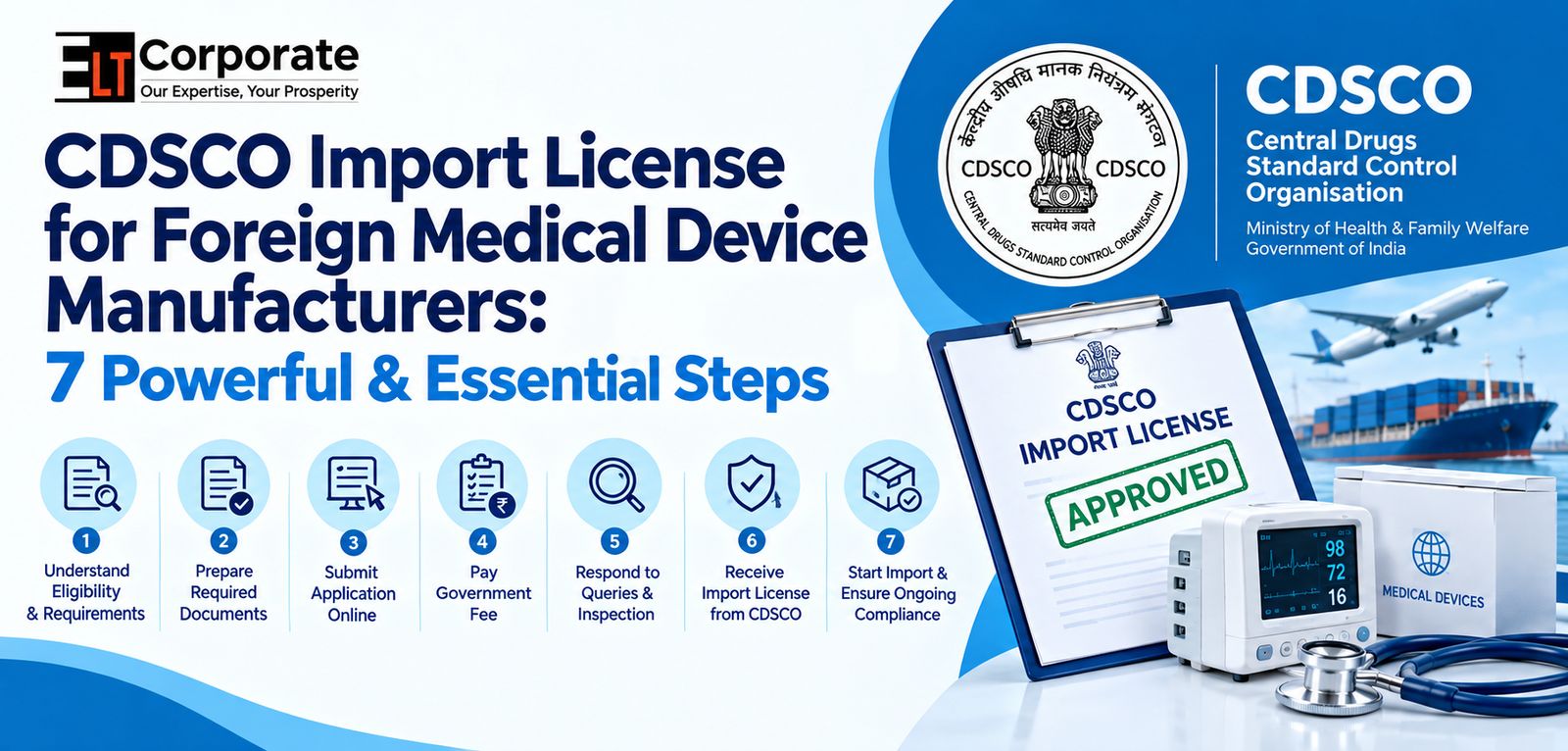
7 Essential Steps for CDSCO Import Licensing
1. Identify the Medical Device and Its Intended Use
The first step is to clearly identify the product.
The manufacturer should prepare information such as:
- Generic name
- Brand name, where applicable
- Model number
- Intended use
- Device description
- Materials of construction
- Sterile or non-sterile status
- Shelf life
- Packaging details
- Accessories
- Manufacturing site
The intended use is particularly important because it can affect how the device is classified and regulated.
The product information submitted to CDSCO should be consistent throughout the technical and regulatory documentation.
2. Determine the Applicable Risk Classification
Medical devices in India are classified according to risk.
CDSCO describes four broad risk classes under the Medical Devices Rules, 2017:
- Class A – Low risk
- Class B – Low-moderate risk
- Class C – Moderate-high risk
- Class D – High risk
The classification can affect the applicable regulatory requirements.
A foreign manufacturer should therefore avoid assuming that a classification used in another country automatically applies in India.
The Indian classification should be assessed using the applicable Indian regulatory framework and current CDSCO information.
Correct classification is an important part of the CDSCO Import License for Foreign Medical Device Manufacturers process because the applicable requirements can depend on the medical device and its risk category.
3. Appoint an Authorised Indian Agent
Choosing the right representative is an important part of the CDSCO Import License for Foreign Medical Device Manufacturers process.
An overseas manufacturer needs an appropriate Indian entity to act as its authorised agent for the applicable import process.
The relationship should be properly documented through the required Power of Attorney and supporting records.
CDSCO’s import-licence checklist specifically requires a Power of Attorney and an undertaking from the authorised agent, with authentication requirements detailed in the checklist.
The authorised agent may also be responsible for regulatory communications and other obligations related to the import licence.
For this reason, foreign manufacturers should choose an Indian representative who understands the medical-device regulatory process.
4. Prepare the Required Regulatory Documents
Documentation is one of the most important parts of the application.
CDSCO’s published checklist for MD-15 applications includes documents such as:
- Form MD-14
- Fee challan
- Power of Attorney
- Authorised agent licence or registration documentation
- Free Sale Certificate or Marketing Authorization, where applicable
- Overseas manufacturing-site registration
- Inspection or audit report, where applicable
- Quality-management documentation
- Declaration of Conformity
- Plant Master File
- Device Master File
- Product information and supporting technical documentation
The exact documentation can vary depending on the device and applicable requirements.
The foreign manufacturer should therefore prepare a document matrix before submission.
5. Submit Form MD-14 Through SUGAM
Once the applicable documentation has been prepared, the import-licence application is submitted through the applicable CDSCO online system.
CDSCO specifically states that an applicant makes an application in MD-14 through the SUGAM online portal for the grant of an import licence in MD-15.
The information entered online should match the supporting documents.
Differences in:
- Manufacturer name
- Manufacturing address
- Device name
- Model number
- Intended use
- Classification
- Product documentation
can create questions during regulatory review.
6. Respond to Regulatory Queries
After submission, the application may be reviewed by the relevant regulatory authority.
If CDSCO raises a query, the applicant should respond with accurate and consistent information within the applicable timeframe.
A response should not introduce new contradictions into the application.
For example, if the original application identifies one manufacturing site but the response refers to another site, the difference may require further clarification.
A systematic query-response process can therefore be useful for foreign manufacturers.
7. Receive and Maintain the MD-15 Import License
After the application is approved, the import licence is issued in Form MD-15.
The original CDSCO form describes MD-15 as the Licence to Import Medical Device and identifies the authorised agent, overseas manufacturer, manufacturing site and covered devices. The licence should not be treated as the end of regulatory compliance.
The manufacturer and authorised agent should continue to maintain applicable documentation, monitor regulatory changes, manage product information, and meet relevant post-market obligations.
Documents Required for CDSCO Import License for Foreign Medical Device Manufacturers
Accurate documentation is essential when preparing a CDSCO Import License for Foreign Medical Device Manufacturers application.
The exact document list depends on the product and applicable regulatory pathway.
However, the CDSCO checklist provides a useful indication of commonly requested documents.
Important documents may include:
Company and Applicant Documents
- Applicant details
- Authorised Indian agent details
- Wholesale licence or applicable registration
- Constitution details of the authorised agent
- Power of Attorney
- Undertaking
Manufacturer Documents
- Overseas manufacturer details
- Manufacturing-site information
- Manufacturing-site registration
- Inspection or audit documentation, where applicable
- Quality-management certification
Product Documents
- Device description
- Intended use
- Product specifications
- Device Master File
- Plant Master File
- Declaration of Conformity
- Labelling
- Instructions for Use
- Shelf-life information
- Sterility information, where applicable
Regulatory Certificates
Depending on the applicable requirements, the application may include Free Sale Certificate or Marketing Authorization documentation and regulatory certificates from the country of origin or other specified jurisdictions. CDSCO’s published checklist sets out examples and authentication requirements.
What Is MD-14 and MD-15?
Understanding these two forms is essential for foreign manufacturers.
| Form | Purpose |
| MD-14 | Application for grant of an import licence |
| MD-15 | Import licence granted by the regulatory authority |
CDSCO’s medical-device page explicitly identifies MD-14 as the application and MD-15 as the import licence.
The distinction is simple:
MD-14 = Application
MD-15 = Licence
This distinction should also be reflected consistently in regulatory documentation and website content.
Role of the Authorised Indian Agent
The authorised Indian agent is an important part of the import framework for an overseas manufacturer.
The agent may coordinate with CDSCO and handle regulatory activities on behalf of the foreign manufacturer.
According to the Medical Devices Rules documentation, the authorised agent acts as the official representative for obtaining the import licence and submits necessary documents for the import licence.
The MD-15 form also states that the authorised agent is responsible for the overseas manufacturer’s business activities in India in the respects covered by the licence.
Therefore, the foreign manufacturer and Indian agent should clearly define responsibilities and maintain accurate regulatory records.
Common Reasons for Import License Delays
Foreign companies should check all submitted information carefully before completing the CDSCO Import License for Foreign Medical Device Manufacturers process.
Missing information can delay the CDSCO Import License for Medical Device Manufacturers application and lead to additional regulatory queries.
Foreign manufacturers should pay attention to documentation consistency.
Common areas that may require additional clarification include:
1. Incorrect Device Classification
Using a foreign classification without checking the applicable Indian classification can create problems.
2. Inconsistent Manufacturer Details
The manufacturer name and address should remain consistent across regulatory documents.
3. Incomplete Power of Attorney
The Power of Attorney should meet the applicable requirements and authentication conditions.
4. Missing Technical Documents
Incomplete Device Master File or Plant Master File information can make the application more difficult to review.
5. Labelling Differences
The submitted label, IFU and product documentation should contain consistent information.
6. Manufacturing Site Mismatch
The manufacturing site in the application should correspond with the supporting documentation.
7. Incomplete Query Response
Regulatory queries should be answered carefully and supported by appropriate documentation.
Labelling Requirements for Imported Medical Devices
Labelling is an important part of the regulatory process.
Imported medical devices should have product information that is consistent with the applicable Indian regulatory documentation.
Depending on the device and applicable provisions, information can include:
- Device name
- Manufacturer details
- Importer or authorised-agent information, where applicable
- Batch or lot number
- Manufacturing information
- Expiry or shelf-life information
- Sterile status
- Storage conditions
- Warnings and precautions
- Instructions for Use
For a detailed explanation of Indian medical-device labelling requirements, you can read our guide. Medical Device Packaging & Labelling Rules in India 2026
CDSCO Import License vs Medical Device Registration
These terms are sometimes used interchangeably online, but businesses should identify the actual regulatory pathway applicable to their product.
A foreign manufacturer importing medical devices may need to follow the specific import-licensing process rather than treating “registration” as a generic single approval.
CDSCO identifies MD-14 and MD-15 specifically for the import-licence pathway.
For a broader overview, see our CDSCO Medical Device Registration Guide
Proper regulatory preparation can make the CDSCO Import License Medical Device Manufacturers process easier to manage and can help reduce avoidable documentation queries.
Careful preparation of documentation and regulatory information can make the CDSCO Import License for Foreign Medical Device Manufacturers process easier to manage and may help reduce avoidable queries during review.
How ELT Corporate Helps Foreign Medical Device Manufacturers
ELT Corporate supports foreign medical device manufacturers and their Indian representatives with regulatory documentation and compliance activities related to the Indian medical-device market.
Our support can include:
- Medical device classification assistance
- Import licence documentation support
- MD-14 application assistance
- MD-15 import licence support
- Authorised Indian agent coordination
- Regulatory document review
- Device Master File support
- Plant Master File coordination
- Labelling and IFU review
- CDSCO query-response support
- Compliance documentation
- Post-approval regulatory support
ELT Corporate also provides broader Medical Device Regulatory Services in India, including manufacturer licensing, importer licensing, certificates and related compliance services. Medical Device Regulatory Services in India
Before submitting the application, foreign companies should confirm that all information required for the CDSCO Import License for Foreign Medical Device Manufacturers is complete and consistent.
Conclusion
Foreign manufacturers should verify the latest requirements before proceeding with the CDSCO Import License Medical Device Manufacturers process.
For a foreign manufacturer, entering the Indian medical-device market requires careful attention to the applicable regulatory pathway, product classification, authorised-agent requirements, and technical documentation.
The CDSCO Import License for Foreign Medical Device Manufacturers process involves more than submitting an online form. Manufacturers should ensure that the device information, manufacturing-site details, regulatory certificates, technical files, labelling and authorised-agent documentation are accurate and consistent.
The CDSCO Import License for Foreign Medical Device Manufacturers pathway uses MD-14 for the application and MD-15 for the resulting import licence, according to CDSCO’s published information.
Foreign manufacturers should also monitor applicable regulatory updates because India’s medical-device framework continues to develop.
Before submitting an application, always verify the latest CDSCO requirements applicable to your specific device.
Frequently Asked Questions
Q1. What is the CDSCO import licence for foreign medical device manufacturers?
The CDSCO Import License for Foreign Medical Device Manufacturers is part of the Indian regulatory pathway for applicable medical devices imported by overseas manufacturers through an authorised Indian agent.
Q2. What is MD-14 in CDSCO medical device licensing?
MD-14 is the application form used for applying for an import licence for medical devices. CDSCO states that the application is submitted through the SUGAM online portal.
Q3. What is MD-15 in medical device imports?
MD-15 is the import licence issued by the Central Licensing Authority after approval of the applicable application.
Q4. Does a foreign medical device manufacturer need an Indian agent?
Foreign manufacturers need an authorised Indian agent for the applicable import-licensing process. CDSCO describes the authorised agent as an Indian person, firm or organisation appointed by the overseas manufacturer through a Power of Attorney.
Q5. What documents are required for a CDSCO medical device import application?
Documents can include the MD-14 application, Power of Attorney, authorised-agent documentation, regulatory certificates, manufacturing-site information, quality certificates, Declaration of Conformity, Plant Master File and Device Master File, depending on the applicable requirements.
Q6. How are medical devices classified in India?
CDSCO describes four risk classes: Class A, Class B, Class C and Class D, ranging from low risk to high risk. The applicable classification should be assessed using the Indian regulatory framework.
7. Can a foreign manufacturer use its FDA or CE approval in India?
Foreign regulatory approvals or certificates may form part of the supporting documentation where applicable, but they do not automatically replace the Indian regulatory process. The CDSCO checklist identifies certain overseas regulatory certificates and Free Sale or Marketing Authorization documents as supporting documents, subject to applicable requirements.
Q8. Is a Power of Attorney required for the Indian authorised agent?
A Power of Attorney is part of the CDSCO checklist for the MD-14/MD-15 import-licence process, with specified authentication requirements.
Q9. What can cause delays in a CDSCO import licence application?
Delays can arise from incomplete documentation, inconsistent manufacturer or product information, classification issues, missing supporting certificates, technical-documentation gaps, or inadequate responses to regulatory queries.
Q10. Who can help with CDSCO import licensing for foreign manufacturers?
A medical-device regulatory consultant can assist with classification, documentation, authorised-agent coordination, MD-14 preparation, regulatory queries, and related compliance work. ELT Corporate provides medical-device import and regulatory support for businesses entering the Indian market.
Comments are closed