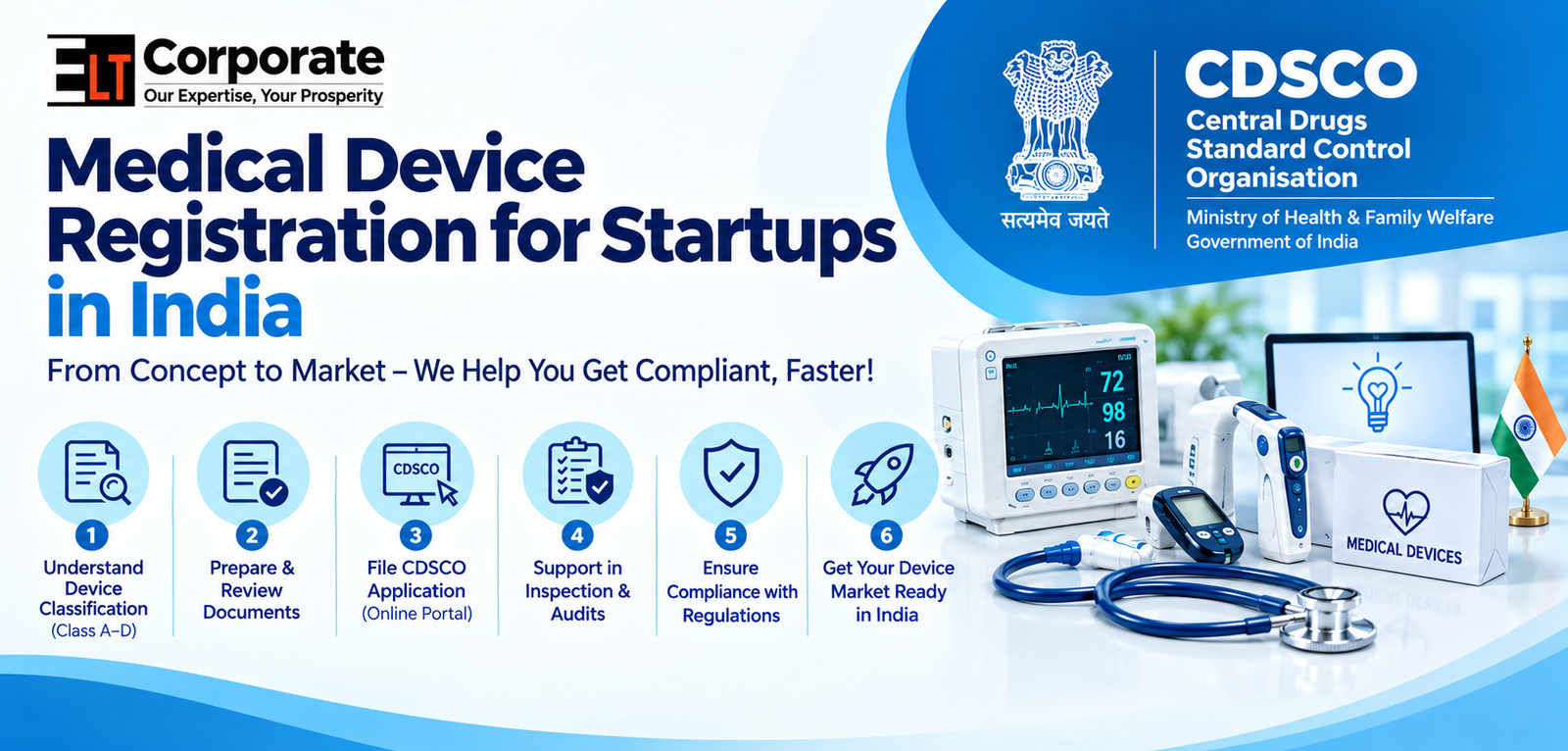
For new businesses, Medical Device Registration for Startups in India should be considered an important part of the product-launch planning process.
Medical Device Registration for Startups in India is an important regulatory step for businesses planning to manufacture, import, distribute, or market medical devices in India. For a startup, understanding the applicable CDSCO requirements at an early stage can make the regulatory process more organised and help avoid unnecessary documentation problems.
India regulates medical devices under the Medical Devices Rules, 2017. CDSCO follows a risk-based classification system in which medical devices are generally placed into Class A, Class B, Class C, or Class D, ranging from low to high risk. The applicable regulatory pathway depends on factors such as the device, intended purpose, risk classification, and whether the business is manufacturing in India or importing the device.
For startups, regulatory planning should ideally begin before commercial launch rather than after the product is ready for the market.
Early planning for Medical Device Registration for Startups in India can help founders organise their regulatory strategy before launching the product.
What Is Medical Device Registration for Startups in India?
Medical Device Registration for Startups in India refers to the regulatory registration, licence, or approval required for a medical device business to legally conduct activities under India’s medical-device regulatory framework.
The exact process is not identical for every startup. A business first needs to understand:
- Whether its product falls within the medical-device regulatory framework
- The intended use of the device
- Applicable risk classification
- Whether the device is manufactured in India or imported
- The appropriate licensing authority
- Required technical documentation
- Applicable testing or evaluation requirements
- Labelling and packaging requirements
- Post-approval compliance obligations
CDSCO provides regulatory information, application forms, checklists, classification resources, and guidance for medical devices through its official regulatory systems.
Why Medical Device Registration for Startups in India Matters
For a startup, regulatory compliance is not only about obtaining a licence. It can influence product development, documentation, manufacturing arrangements, packaging, distribution, and market entry.
A startup that understands the regulatory pathway early can organise its technical and business activities accordingly.
1. Helps Identify the Correct Regulatory Pathway
Different medical devices can follow different regulatory routes. For example, the applicable requirements can differ depending on whether the device is manufactured domestically, imported, or falls within a particular risk class.
CDSCO states that medical devices are classified into Class A, B, C, and D according to risk.
2. Supports Better Product Planning
Startups often develop products while simultaneously working on manufacturing, packaging, marketing, and investment plans. Regulatory requirements should be considered alongside these activities.
For example, the device’s intended purpose, technical specifications, labelling, and supporting documentation should remain consistent.
3. Reduces Documentation Gaps
Incomplete or inconsistent documentation can create additional regulatory queries. Preparing the required information before filing can help the startup understand what needs to be corrected or completed.
4. Supports Market Entry
A startup cannot assume that simply developing a medical product automatically permits commercial sale or import. The applicable regulatory requirements should be assessed before market launch.
7 Steps for Medical Device Registration for Startups in India
Step 1: Determine Whether Your Product Is a Medical Device
The first step is to understand whether your product falls within the applicable medical-device definition and regulatory framework.
Startups should clearly define:
- Product name
- Intended purpose
- Medical indication
- Method of operation
- Technology used
- Whether it is invasive or non-invasive
- Whether it is sterile
- Whether it has a measuring function
- Whether it is reusable or single-use
This information can affect the regulatory assessment and classification.
Step 2: Identify the Medical Device Risk Classification
Correct classification is one of the most important parts of the regulatory process.
Under the MDR framework, medical devices are divided into:
| Class | General risk level |
| Class A | Low risk |
| Class B | Low-moderate risk |
| Class C | Moderate-high risk |
| Class D | High risk |
CDSCO also publishes risk-classification information for specific categories and has stated that classification lists can be updated over time. A 2025 CDSCO notice, for example, specifically addressed Class A non-sterile and non-measuring devices and noted that the classification list is dynamic.
Therefore, startups should check the latest applicable CDSCO classification information instead of relying only on an old product classification.
Step 3: Decide Whether You Will Manufacture or Import
The regulatory pathway can change depending on the business model.
An Indian startup manufacturing its own medical device may require the applicable manufacturing licence, while a startup importing a device from an overseas manufacturer may need the applicable import licence.
CDSCO states that applications for import licences for medical devices are made in Form MD-14, with the import licence issued in Form MD-15.
For manufacturing, the applicable authority and forms depend on the device and classification. CDSCO’s FAQ explains that manufacturing applications for applicable Class A/B devices are handled through the State Licensing Authority, while Class C/D manufacturing falls under the Central Licensing Authority.
Step 4: Prepare the Required Documents
A startup should begin document preparation well before submitting its application.
Depending on the regulatory pathway and device, documentation may include:
- Manufacturer details
- Applicant information
- Device description
- Intended use
- Risk classification information
- Technical specifications
- Device Master File information
- Manufacturing-site information
- Quality-management documentation
- Test reports
- Labels and packaging information
- Instructions for Use (IFU)
- Regulatory status in other countries, where applicable
- Free Sale Certificate or other supporting documents, where applicable
- Authorised-agent information for relevant import pathways
The exact checklist should be verified against the current CDSCO requirements applicable to the specific device.
CDSCO provides application checklists for different medical-device forms and regulatory activities.
Step 5: Prepare the Technical and Quality Documentation
Technical documentation is an important part of the regulatory submission.
Startups should ensure that product information is consistent across:
- Technical documents
- Application forms
- Labels
- IFU
- Test reports
- Product specifications
- Manufacturing information
- Promotional claims
A mismatch between documents can create questions during regulatory review.
For example, if the intended purpose described in a technical document differs from the product label or application, the startup may need to clarify the difference.
Step 6: Submit the Applicable Application
Once the classification and documents are ready, the startup can proceed through the applicable CDSCO regulatory system.
For medical-device applications, CDSCO provides online regulatory processes and relevant forms and checklists. The official CDSCO medical-device page includes resources for MD-7, MD-14, MD-15, and other medical-device regulatory forms.
The application should be reviewed carefully before submission to ensure that:
- Product details are accurate
- Classification is appropriate
- Documents are complete
- Manufacturer information is consistent
- Labels match the submitted information
- Technical information is properly organised
- Required supporting documents are included
Step 7: Maintain Compliance After Approval
Obtaining a licence or approval should not be treated as the end of regulatory responsibility.
A startup may need to maintain appropriate records and address ongoing obligations relating to:
- Product changes
- Manufacturing changes
- Labelling updates
- Safety information
- Complaints
- Post-market activities
- Regulatory communications
- Licence-related requirements
The applicable obligations depend on the product and regulatory pathway.
This is why startups should consider regulatory compliance as an ongoing process rather than a one-time registration activity.
Documents Required for Medical Device Registration for Startups in India
The exact document list varies according to the product and application type. However, startups should generally be prepared to organise information such as:
- Company/applicant details
- Manufacturer details
- Device name and model information
- Intended use and indications
- Device classification information
- Product specifications
- Technical documentation
- Manufacturing-site information
- Quality-management documentation
- Test and evaluation reports
- Labels and packaging artwork
- Instructions for Use
- Regulatory certificates, where applicable
- Authorised-agent documents, where applicable
- Other documents specified by the applicable CDSCO checklist
CDSCO Licence Options Startups Should Understand
The applicable licence depends on the nature of the business and device.
For example, CDSCO’s official information identifies MD-14 → MD-15 as the import-licence pathway for medical devices.
For manufacturing, the applicable forms and authority depend on classification. CDSCO’s FAQ identifies State Licensing Authority involvement for applicable Class A/B manufacturing and Central Licensing Authority involvement for Class C/D manufacturing.
Startups should therefore determine their exact regulatory route before choosing a form.
Common Mistakes Startups Should Avoid
Wrong Risk Classification
Selecting a classification without checking the applicable CDSCO framework can create problems during the application process.
Inconsistent Product Information
The device name, intended purpose, model information, and technical details should be consistent across the application and supporting documents.
Using Outdated Checklists
Medical-device requirements can change through amendments, notifications, and updated regulatory information. CDSCO’s current resources should be checked before filing.
Ignoring Labelling Requirements
Labels and packaging should be reviewed as part of regulatory preparation rather than being treated only as marketing material.
Starting Compliance Too Late
Waiting until immediately before launch can create avoidable pressure if testing, technical documentation or classification questions need additional work.
Cost of Medical Device Registration for Startups in India
There is no single fixed cost applicable to every startup.
The overall expense may depend on:
- Device classification
- Number of devices/models
- Import or manufacturing pathway
- Government fees
- Testing requirements
- Technical documentation
- Quality-system requirements
- Clinical or performance evaluation, where applicable
- Professional consultancy
- Other compliance activities
Proper planning for Medical Device Registration for Startups in India can also help businesses understand their potential documentation, testing, licensing, and compliance expenses before beginning the application.
How Long Does Medical Device Registration Take?
The timeline can vary depending on the device, application type, classification, documentation quality, testing requirements, and regulatory queries.
A startup should avoid relying on a universal approval timeline.
Preparing complete and consistent documentation before filing can help make the application process more organised. However, the actual regulatory timeline remains dependent on the applicable authority and application.
How ELT Corporate Helps Startups
ELT Corporate supports startups with Medical Device Registration for Startups in India, providing practical assistance with classification, documentation, licensing, application preparation, and regulatory compliance.
- Understanding the applicable regulatory pathway
- Preliminary device classification guidance
- Application preparation
- Document checklist support
- Technical document coordination
- CDSCO application assistance
- Import and manufacturing licence support
- Label and documentation review
- Regulatory query support
- Post-approval compliance guidance
For startups, the objective is to make a complex regulatory process easier to understand and organise. ELT Corporate can help businesses identify the appropriate compliance steps based on their product, business model, and regulatory requirements.
Conclusion
Medical Device Registration for Startups in India requires careful planning because the applicable regulatory pathway can differ from one product to another. Startups should begin by
identifying the product’s intended purpose, confirming its applicable classification, determining whether they are importing or manufacturing, preparing the required technical documentation, and submitting the appropriate application.
The Medical Devices Rules, 2017 remain the core framework, while subsequent amendments, notifications and CDSCO updates continue to shape the compliance environment.
A startup should therefore verify the latest official requirements before submitting an application and maintain compliance after receiving the applicable licence or approval.
Frequently Asked Questions
Q1. Is medical device registration mandatory for startups in India?
The requirement depends on the product and applicable regulatory pathway. Startups should first determine whether their product falls under the medical-device framework and then identify the applicable registration, licence or approval.
Q2. How can a startup register a medical device in India?
A startup should identify the device’s intended purpose, determine its risk classification, choose the appropriate manufacturing or import pathway, prepare the required documents, and submit the applicable application through the relevant CDSCO regulatory system.
Q3. What is the CDSCO licence for imported medical devices?
For applicable imported medical devices, the import licence application is made in Form MD-14, and the import licence is issued in Form MD-15.
Q4. What are Class A, B, C and D medical devices?
India follows a risk-based classification system. Class A represents low-risk devices, Class B low-moderate risk, Class C moderate-high risk, and Class D high-risk devices.
Q5. What documents are required for medical device registration?
Documents vary by device and regulatory pathway. They can include technical information, product specifications, manufacturer details, labels, IFU, testing information, quality documentation, and other documents specified by the applicable CDSCO checklist.
Q6. How much does CDSCO registration cost for a startup?
There is no universal cost. Expenses can vary according to the device, classification, application type, government fees, testing, documentation, and other compliance requirements.
Q7. How long does CDSCO medical device registration take?
The timeline varies according to the device, classification, application pathway, document completeness, testing requirements, and regulatory review. A fixed timeline should not be assumed for every application.
Q8. Can a foreign medical device manufacturer sell products in India?
Foreign manufacturers need to follow the applicable Indian regulatory pathway before placing regulated medical devices on the Indian market. For imported devices, the applicable import-licensing requirements should be assessed.
Q9. Do startups need an authorised Indian agent for imported medical devices?
The applicable requirements depend on the regulatory pathway and the applicant’s circumstances. Businesses importing medical devices should verify the current CDSCO requirements before submitting an application.
Q10. Can ELT Corporate help with medical device registration for startups?
Yes. ELT Corporate can assist with regulatory pathway assessment, documentation, application preparation, classification-related guidance, import/manufacturing licence support, and related compliance requirements.
Comments are closed