
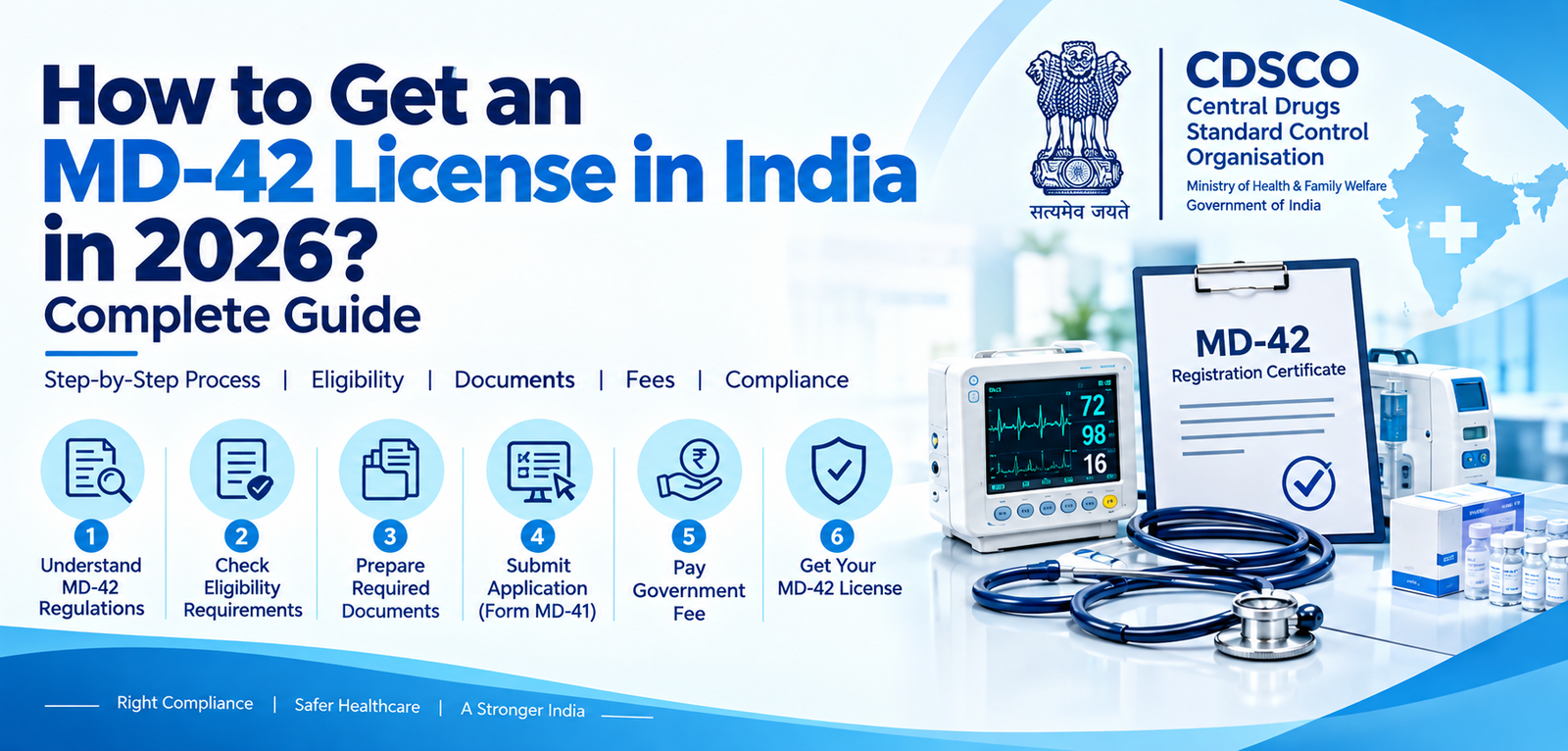
ELT Corporate can guide businesses on How to Get an MD-42 License in India in 2026 by assisting with documentation, application preparation and regulatory compliance.
How to Get an MD-42 License in India in 2026 is an important question for businesses involved in selling, stocking, exhibiting, offering for sale, or distributing medical devices in India. The MD-42 registration certificate is part of the regulatory framework under the Medical Devices Rules, 2017. Businesses should understand the eligibility requirements, documents, application process, fees, premises requirements, technical-person requirements, and post-registration compliance before starting the application.
Obtaining the correct registration can help a medical-device distributor operate in accordance with the applicable regulatory requirements. In this complete 2026 guide, we explain the MD-42 registration process in simple language and also explain how ELT Corporate can assist businesses with documentation and regulatory support.
What Is an MD-42 License?
How to Get an MD-42 License in India in 2026 becomes easier to understand when the application requirements, documents, premises and technical-person requirements are considered step by step.
The MD-42 registration certificate allows an eligible business to sell, stock, exhibit, offer for sale, or distribute medical devices, subject to the applicable regulatory requirements.
The requirement was introduced through the Medical Devices (Fifth Amendment) Rules, 2022, which created a specific registration framework for medical-device sales and distribution. CDSCO’s implementation notice confirms that applicants apply in Form MD-41 to the concerned State Licensing Authority and that the authority issues the registration certificate in Form MD-42 after satisfying the prescribed requirements.
Businesses should not assume that a general business registration, GST registration, or another licence automatically satisfies medical-device regulatory requirements.
Why Is MD-42 Important?
Medical devices are regulated products, and the regulatory framework is designed to ensure that products entering the market are handled through appropriate channels.
An MD-42 registration can be important for:
- Medical-device distributors
- Wholesalers
- Retailers
- Stockists
- Medical equipment suppliers
- Businesses selling notified medical devices
- Certain online sellers
- Businesses distributing devices on behalf of manufacturers or importers
- Businesses that purchase and redistribute medical devices
The exact requirement can depend on the products, business activity, premises, and applicable state requirements.
How to Get an MD-42 License in India in 2026
The process can be understood in a few simple stages:
- Identify the medical devices you intend to sell or distribute.
- Determine the applicable regulatory requirements.
- Confirm that the business premises are suitable.
- Arrange the required technical person or competent personnel.
- Prepare Form MD-41 and supporting documents.
- Submit the application to the appropriate State Licensing Authority.
- Pay the prescribed government fee.
- Respond to any regulatory queries.
- Complete inspection or verification requirements where applicable.
- Receive the MD-42 registration certificate after approval.
The official CDSCO framework states that the State Licensing Authority scrutinises the application and, when satisfied that the requirements have been met, grants the registration certificate in Form MD-42.
For a useful background resource, you can also read the MD-42 License Registration service page on MedicalDeviceRegistration.com.
Eligibility Requirements for MD-42 Registration
Businesses planning How to Get an MD-42 License in India in 2026 should first confirm that their business activity and premises meet the applicable requirements.
Before applying, the applicant should check whether the business, premises, personnel, and proposed activities satisfy the applicable requirements.
The rules require information relating to the applicant or firm, the premises, technical staff, storage arrangements, and other activities conducted at the premises. The application also requires a self-certificate relating to Good Distribution Compliance.
A typical applicant may be:
- A proprietorship
- Partnership firm
- LLP
- Private limited company
- Other eligible business organisation
The business should have a clearly identified premises from which the relevant medical-device activity is conducted.
Technical Person and Competency Requirements
One of the important areas to address is the person responsible for supervising the sales activity.
The rules provide that the competent technical staff should meet prescribed educational or experience criteria. The official provision includes a recognised university/institution degree, registration as a pharmacist, or an intermediate-level qualification with one year of experience in dealing with the sale of medical devices.
Therefore, applicants should not simply appoint a person without checking the qualification and experience requirements applicable to their case.
The supporting documentation may include:
- Educational qualification documents
- Experience documents, where applicable
- Appointment or engagement documentation
- Identity proof
- Other documents requested by the State Licensing Authority
Documents Required for MD-42 License
For How to Get an MD-42 License in India in 2026, documentation is one of the most important parts of the application.
The exact checklist can vary according to the applicant and State Licensing Authority, but the regulatory framework specifically refers to several categories of information and supporting documents.
Common documents can include:
Business Documents
- PAN card
- GST registration, where applicable
- Certificate of incorporation, if applicable
- Partnership deed, if applicable
- Proprietorship/business proof
- Identity and address proof of the applicant
- Constitutional documents of the business
Premises Documents
- Ownership proof, where applicable
- Rent or lease agreement
- Address proof
- Premises details
- Layout or storage details, where required
- Evidence of occupancy
Technical Personnel Documents
- Qualification certificate
- Experience certificate, where applicable
- Identity proof
- Appointment documentation
- Registration documents where applicable
Medical Device Information
Applicants should also maintain appropriate information about the products they intend to handle, including:
- Device name
- Manufacturer details
- Product category
- Applicable risk classification
- Storage requirements
- Supplier details
- Other product information required for the application
CDSCO classifies medical devices according to risk as Class A, Class B, Class C and Class D, ranging from low risk to high risk.
You can also review the Medical Device Registration services for related regulatory requirements.
Premises and Storage Requirements
The premises should be suitable for the medical devices being handled.
The rules require adequate space and proper storage conditions. The registration holder must maintain appropriate temperature and lighting according to the requirements of the medical devices.
For example, depending on the product, the business may need to consider:
- Clean storage areas
- Appropriate temperature
- Proper lighting
- Protection against moisture
- Product segregation where necessary
- Safe handling arrangements
- Stock identification
- Record-keeping systems
- Suitable storage equipment
Businesses should assess the storage requirements of each product rather than assuming that every medical device can be stored in the same conditions.
How to Get an MD-42 License in India in 2026: Step-by-Step Process
The application process should be approached carefully because incorrect information or missing documents can result in queries and delays.
Step 1: Identify Your Business Activity
First determine exactly what your business will do.
For example, you may be:
- A wholesaler
- Distributor
- Retailer
- Stockist
- Medical equipment supplier
- Online seller
- Distributor appointed by a manufacturer
- Distributor appointed by an importer
Your proposed activity should be correctly reflected in the application.
Step 2: Identify the Medical Devices
Prepare a list of the products you intend to sell, stock or distribute.
Check the regulatory status and classification of each product. CDSCO maintains information relating to medical-device regulation and classification.
Step 3: Check the Premises
Review the premises before submitting the application.
Check:
- Address
- Ownership or tenancy documents
- Storage area
- Lighting
- Temperature requirements
- Cleanliness
- Product storage
- Record-keeping arrangements
Step 4: Arrange the Technical Person
Confirm that the person supervising the relevant activity satisfies the applicable qualification or experience requirements.
This step should be completed before filing rather than trying to correct the issue after a regulatory query.
Step 5: Prepare Form MD-41
Form MD-41 is the application used for obtaining the registration certificate for selling, stocking, exhibiting, offering for sale, or distributing medical devices.
Information entered in the form should be consistent with the supporting documents.
Step 6: Upload the Documents
Upload the required documents in the format and manner prescribed by the relevant authority or portal.
Before submission, check:
- Business name
- Address
- Applicant details
- Technical-person details
- Device details
- Premises documents
- Supporting certificates
Step 7: Pay the Prescribed Fee
The applicable government fee should be paid according to the current rules and the relevant authority’s requirements.
Because regulatory fees and procedural requirements can change, applicants should verify the current fee before making payment rather than relying on an old website or third-party article.
Step 8: Regulatory Review
The State Licensing Authority examines the application and documents.
If a deficiency or clarification is identified, the applicant may receive a query.
A complete and properly supported response can help avoid unnecessary delays.
Step 9: Inspection or Verification
Where inspection or premises verification is required, the applicant should ensure that the premises, storage arrangements, records and technical-person requirements are ready.
Step 10: MD-42 Certificate
Once the authority is satisfied that the prescribed requirements have been fulfilled, the registration certificate is granted in Form MD-42.
The certificate should be displayed prominently at the registered premises.
For another useful resource, see this SUGAM Portal medical-device registration guide.
Understanding How to Get an MD-42 License in India in 2026 also requires checking the applicable government fee before submitting the application.
Government Fee for MD-42 Registration
The applicable fee should be checked against the current regulatory schedule and the relevant State Licensing Authority before filing.
This is important because online articles may contain outdated figures. The Medical Devices Rules specifically state that the application is accompanied by the fee specified in the Second Schedule.
Therefore, applicants should verify the amount applicable to their application instead of relying solely on an older fee figure.
MD-42 License Timeline
The regulatory rule provides that, after an application under the relevant provision, the State Licensing Authority may grant the registration certificate after scrutiny when the prescribed requirements are satisfied. The provision refers to a ten-day period for grant or rejection after the application under that sub-rule.
However, actual application timelines can be affected by:
- Document deficiencies
- Regulatory queries
- State-level procedures
- Premises verification
- Inspection requirements
- Applicant response time
- Portal issues
- Additional information requested by the authority
For this reason, businesses should distinguish between a regulatory processing provision and the total practical time needed to complete an application.
Knowing How to Get an MD-42 License in India in 2026 can help applicants prepare their documents correctly and reduce avoidable application delays.
Common Reasons for MD-42 Application Delays
Some common problems include:
- Incorrect business information
- Address mismatch
- Incomplete premises documents
- Missing qualification documents
- Incorrect device information
- Incomplete self-certification
- Poorly organised storage arrangements
- Failure to respond to queries
- Incorrect application details
- Using outdated regulatory information
A careful document review before submission can reduce avoidable problems.
How to Get an MD-42 License in India in 2026: Common Compliance Mistakes
Applicants should avoid treating MD-42 as a one-time paperwork exercise.
Important mistakes to avoid include:
- Selling regulated devices without checking the applicable registration requirement
- Purchasing devices from an inappropriate source
- Failing to maintain purchase and sales records
- Ignoring storage conditions
- Failing to keep the registration certificate available at the premises
- Changing business details without checking whether an amendment is required
- Ignoring regulatory communications
- Allowing records to become incomplete
The rules require purchase records to identify information such as device names, quantities, manufacturers or importers, batch or lot numbers and expiry dates where applicable. These records must also be available for inspection.
How to Get an MD-42 License in India in 2026: Post-Registration Compliance
Getting the certificate is only one part of regulatory compliance.
An MD-42 holder should maintain proper systems for:
- Purchase records
- Sales records
- Stock records
- Supplier verification
- Product traceability
- Storage conditions
- Technical supervision
- Regulatory correspondence
- Product complaints
- Changes to business information
The certificate should also be displayed at a prominent place in the premises, and the holder must maintain appropriate storage conditions.
Businesses should periodically review their compliance system so that a change in products, premises, suppliers or personnel does not unexpectedly create a regulatory issue.
How ELT Corporate Can Help With MD-42 Registration
ELT Corporate can assist businesses with the practical and documentation aspects of MD-42 registration.
Our support can include:
1. Eligibility Assessment
We can review your business activity, premises and proposed medical-device products to identify the applicable registration requirements.
2. Document Checklist
We can help prepare a customised document checklist based on your business structure and application requirements.
3. Form MD-41 Preparation
We can assist with preparing the application information and checking that the details match your supporting documents.
4. Documentation Review
Our team can review documents for common inconsistencies such as:
- Business-name mismatch
- Address mismatch
- Missing qualification proof
- Incomplete premises documents
- Incorrect product information
5. Application Filing Support
ELT Corporate can assist with the relevant application filing and regulatory documentation process.
6. Query Assistance
If the licensing authority raises a query, we can help analyse the issue and prepare an appropriate response.
7. Premises Compliance Guidance
We can help you understand the storage and documentation requirements that may be relevant to your medical-device distribution activity.
8. Post-Registration Support
We can also guide businesses on maintaining regulatory compliance after receiving the registration certificate.
For more information, visit the MD-42 License Registration service.
Why Choose ELT Corporate?
Medical-device regulation can involve technical, legal and documentation requirements. A small mismatch in an application can create unnecessary queries and delays.
ELT Corporate focuses on making the process easier for businesses by providing:
- Regulatory guidance
- Documentation assistance
- Application support
- Compliance review
- Query assistance
- Medical-device regulatory support
You can also read the MD-41 and MD-42 License guide for additional information about the two forms.
For businesses, following the correct steps for How to Get an MD-42 License in India in 2026 can make the registration process more organized and help avoid common compliance mistakes.
Conclusion
Understanding How to Get an MD-42 License in India in 2026 is important for businesses involved in selling, stocking, exhibiting, offering for sale or distributing regulated medical devices.
The basic framework is straightforward: identify the applicable devices and activity, prepare the premises and technical requirements, submit Form MD-41 with the required documents and fee, respond to regulatory queries, and obtain the MD-42 registration certificate from the appropriate authority.
Because medical-device regulations and state procedures can change, businesses should verify the current requirements before filing. CDSCO maintains the official Medical Devices Rules and related regulatory information.
If you want professional assistance, ELT Corporate can help with documentation, application preparation, filing support and regulatory compliance guidance.
Frequently Asked Questions About MD-42 License
Q1. What is MD-42?
MD-42 is the registration certificate issued for the applicable activity of selling, stocking, exhibiting, offering for sale or distributing medical devices under the Medical Devices Rules, 2017.
Q2. What is MD-41?
MD-41 is the application form used to apply for the relevant registration certificate. After approval, the registration certificate is issued in Form MD-42.
Q3. Who needs MD-42 registration?
Businesses involved in selling, stocking, exhibiting, offering for sale or distributing medical devices should assess whether they require MD-42 registration under the applicable rules.
Q4. Is MD-42 different from MD-41?
Yes. MD-41 is the application, while MD-42 is the registration certificate granted after the application is approved.
Q5. Who issues the MD-42 certificate?
The relevant State Licensing Authority issues the registration certificate after reviewing the application and satisfying the prescribed requirements.
Q6. Can a medical-device distributor apply for MD-42?
Yes, eligible distributors can apply subject to the applicable regulatory requirements, documents, premises and technical-person requirements.
Q7. Can retailers require MD-42?
A retailer dealing with regulated medical devices should assess the applicable requirements under the Medical Devices Rules and the relevant State Licensing Authority.
Q8. Can an online seller need MD-42?
An online business selling regulated medical devices should not assume that online sales are outside medical-device regulations. The applicable registration requirements should be assessed based on the activity and products.
Q9. Is a drug licence enough to sell medical devices?
Businesses should not automatically assume that a drug licence covers every medical-device activity. The applicable medical-device requirements should be separately checked.
Q10. What documents are needed for MD-42?
Documents can include business details, identity documents, premises ownership or occupancy proof, technical-person details, Good Distribution Compliance information and other documents required by the authority.
Comments are closed