
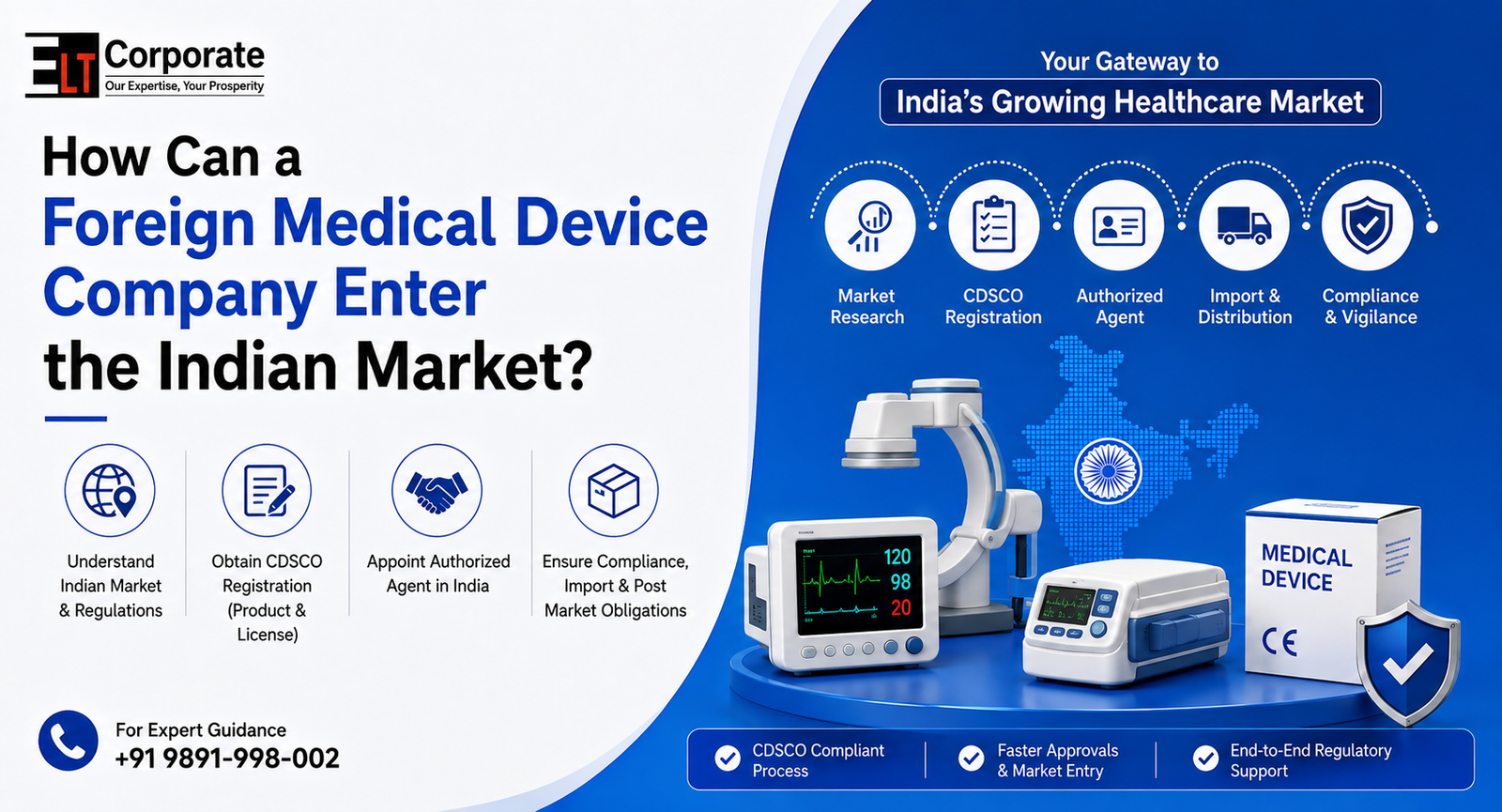
How Can a Foreign Medical Device Company Enter the Indian Market? This is an important question for overseas manufacturers looking to expand their medical device business into India.
India has a regulated framework for medical devices, and a foreign manufacturer generally needs to understand the applicable CDSCO requirements, device classification, requirements for an Indian authorized agent, import licensing, documentation, labeling, and post-market obligations before commercially supplying products in India.
Medical devices in India are regulated primarily under the Drugs and Cosmetics Act, 1940, and the Medical Devices Rules, 2017. CDSCO classifies medical devices according to risk into Class A, B, C and D, ranging from low-risk to high-risk devices.
Therefore, entering India is not simply a matter of finding a distributor and shipping products. A foreign manufacturer should first establish the correct regulatory pathway for its particular device.
How Can a Foreign Medical Device Company Enter the Indian Market?
A foreign medical device company can enter the Indian market by first determining the regulatory status and risk classification of its device, appointing an appropriate Indian authorized agent where required, preparing the prescribed technical and regulatory documentation, obtaining the applicable CDSCO import licence or permission, and then complying with Indian labeling, distribution and post-market requirements.
The exact process can differ depending on factors such as:
- Type of medical device
- Intended purpose
- Risk classification
- Whether the device is a medical device or an IVD
- Manufacturing location
- Existing approvals in the country of origin
- Quality-management certifications
- Whether clinical investigation or additional evidence is required
- Applicable Indian regulatory requirements
CDSCO states that an application for an import licence for medical devices is made in Form MD-14, with the import licence issued in Form MD-15.
Why Is India an Attractive Market for Foreign Medical Device Companies?
India’s healthcare sector offers opportunities for manufacturers of medical devices, diagnostic products, implants, equipment, software-enabled devices and other healthcare technologies.
However, market opportunity should be evaluated alongside regulatory requirements.
A foreign manufacturer entering India should consider:
- Regulatory approval requirements
- Product classification
- Import and customs requirements
- Indian distribution arrangements
- Pricing and reimbursement considerations
- Hospital and institutional procurement
- Product labeling
- Local representation
- After-sales service
- Complaint handling
- Post-market surveillance
A well-planned regulatory strategy can help a company avoid delays caused by incomplete documentation or an incorrect understanding of the applicable licensing pathway.
Step 1: Determine Whether Your Product Is Regulated as a Medical Device
The first step is to establish whether the product falls within India’s medical-device regulatory framework.
The definition of a medical device under the Indian framework covers various instruments, apparatus, appliances, implants, materials, software and accessories intended for specified medical purposes where the primary intended action is not achieved by pharmacological, immunological or metabolic means.
This assessment is important because the regulatory pathway depends on the nature and intended use of the product.
For example, products may include:
- Diagnostic equipment
- Surgical instruments
- Implants
- Monitoring equipment
- Medical software
- Orthopaedic devices
- Cardiovascular devices
- Dental devices
- Laboratory and diagnostic products
- Certain healthcare accessories
A proper regulatory assessment should be conducted before preparing the application.
Step 2: Identify the Medical Device Risk Classification
India follows a risk-based classification system for medical devices.
CDSCO identifies four broad classes:
| Class | General Risk Level |
| Class A | Low risk |
| Class B | Low-moderate risk |
| Class C | Moderate-high risk |
| Class D | High risk |
The classification can influence the applicable regulatory requirements and licensing pathway.
Therefore, a foreign company should not assume that a product’s classification in the United States, the European Union or another country will automatically determine its Indian classification.
Correct classification should be established under the Indian regulatory framework.
Step 3: Appoint an Indian Authorized Agent
For an overseas medical device manufacturer, an Indian authorized agent can play an important role in the regulatory process.
The CDSCO checklist for an import licence application includes documentation relating to the authorized agent, including a Power of Attorney and evidence concerning the agent’s applicable licence/registration.
The authorized agent can assist with regulatory communication and submissions before the Indian authorities.
A foreign manufacturer should therefore carefully select an Indian representative with appropriate regulatory knowledge and the ability to support ongoing compliance.
Step 4: Prepare the Required Regulatory Documents
Documentation is one of the most important parts of medical device registration in India.
Depending on the device and applicable pathway, documents can include:
- Application forms
- Power of Attorney
- Manufacturer information
- Authorized-agent information
- Device details
- Product specifications
- Manufacturing-site information
- Regulatory certificates
- Free Sale Certificate or Marketing Authorization, where applicable
- Overseas manufacturing-site documentation
- Quality-management-system certificates
- Declaration of conformity
- Plant Master File
- Device Master File
- Labeling information
- Technical information
- Clinical or performance-related information, where applicable
CDSCO’s MD-14/MD-15 import-licence checklist specifically identifies items such as regulatory certificates, overseas manufacturing-site information, quality certificates, declaration of conformity, Plant Master File and Device Master File.
The precise document set should be determined according to the product and current CDSCO requirements rather than using a generic checklist for every device.
Step 5: Apply for the Applicable CDSCO Import Licence
For a foreign manufacturer that intends to commercially import medical devices into India, the applicable import-licensing route is a key part of market entry.
CDSCO currently identifies:
Form MD-14 → Application for import licence
Form MD-15 → Import licence
Applications are processed through the SUGAM online portal for the applicable regulatory pathway.
The application should be supported by the required regulatory and technical documentation.
Submitting an incomplete or inconsistent application can create regulatory queries and potentially delay the process.
Step 6: Ensure Technical and Quality Compliance
Regulatory approval is not limited to filling out an application form.
A foreign medical device manufacturer should ensure that its technical documentation accurately reflects:
- Product design
- Intended use
- Manufacturing process
- Risk information
- Performance characteristics
- Safety information
- Quality controls
- Manufacturing site
- Applicable certifications
- Labeling and packaging
CDSCO‘s import-licence checklist includes quality-management-system documentation and other certificates applicable to the actual manufacturing site.
This means that the documentation submitted in India should be consistent with the manufacturer’s actual regulatory and quality records.
Step 7: Review Indian Labeling Requirements
Before placing a medical device on the Indian market, the manufacturer should review the applicable labeling and packaging requirements.
Important information may include details relating to:
- Product identification
- Manufacturer
- Importer/authorized entity
- Batch or lot information
- Manufacturing information
- Expiry or use-by information, where applicable
- Instructions for use
- Warnings and precautions
- Regulatory/licence information
- Other information required under the applicable Indian rules
Labeling should be reviewed specifically for the Indian market rather than simply using packaging prepared for another jurisdiction.
Step 8: Establish Import, Distribution and Supply Arrangements
Obtaining regulatory approval is only one part of entering the Indian market.
A foreign medical device company should also develop a practical commercial structure covering:
Distribution
Identify distributors with experience in the relevant medical-device segment.
Logistics
Establish reliable procedures for:
- Import documentation
- Warehousing
- Inventory management
- Product traceability
- Transportation
Sales
Consider whether the target market includes:
- Hospitals
- Clinics
- Diagnostic laboratories
- Government institutions
- Private healthcare groups
- Medical distributors
- Online or specialized channels, where legally appropriate
After-Sales Support
For many medical devices, customers expect:
- Installation
- Training
- Maintenance
- Technical support
- Warranty services
- Complaint handling
A successful India entry strategy should address these operational requirements alongside regulatory approval.
Step 9: Understand Post-Market Compliance
Regulatory compliance does not necessarily end after receiving an import licence.
A foreign manufacturer should establish procedures for ongoing compliance, including applicable requirements concerning:
- Product complaints
- Adverse events
- Safety issues
- Product recalls
- Regulatory reporting
- Changes to approved information
- Manufacturing-site changes
- Labeling changes
- Post-approval changes
CDSCO‘s medical-device framework includes functions relating to complaints, post-approval changes and inspection of manufacturing sites for applicable quality-management requirements.
Therefore, foreign manufacturers should have an India-specific compliance system rather than treating regulatory approval as a one-time exercise.
Documents a Foreign Medical Device Company May Need
Although requirements vary by product and regulatory pathway, a foreign manufacturer may need documents such as:
- Manufacturer details
- Indian authorized-agent documents
- Power of Attorney
- Product information
- Device classification information
- Free Sale Certificate/Marketing Authorization, where applicable
- Manufacturing-site registration or certification
- Quality management system certificate
- Declaration of conformity
- Plant Master File
- Device Master File
- Product specifications
- Labeling and packaging information
- Clinical/performance documentation, where applicable
- Other documents requested under the applicable CDSCO pathway
CDSCO‘s published MD-14 checklist provides a useful regulatory reference for the documentation expected in an import licence application.
What Challenges Can Foreign Medical Device Companies Face in India?
Entering a new regulatory market can create several challenges.
1. Incorrect Device Classification
A company may incorrectly assume that the classification used in another country automatically applies in India.
2. Incomplete Documentation
Missing technical, manufacturing or regulatory documents can result in queries or delays.
3. Choosing the Wrong Indian Representative
The authorized agent can be important to the regulatory process, so selection should be undertaken carefully.
4. Differences in Regulatory Requirements
Approval in another country does not necessarily mean that all Indian requirements have been satisfied.
5. Labeling Issues
Packaging prepared for another jurisdiction may require changes for Indian compliance.
6. Post-Market Responsibilities
Manufacturers should understand their continuing responsibilities after market entry.
Can a Foreign Manufacturer Sell Medical Devices in India Without CDSCO Approval?
A foreign manufacturer should not assume that it can commercially import and sell a medical device in India simply because the product has already been approved in another country.
CDSCO states that medical devices are regulated under the Medical Devices Rules, 2017 and identifies an import-licensing process through MD-14 and MD-15.
The exact requirement can depend on the device, its classification and applicable exemptions or regulatory provisions. For example, CDSCO‘s FAQ notes a specific exemption for certain Class A non-sterile and non-measuring medical devices from the licensing regime.
Accordingly, a product-specific regulatory assessment should be completed before commercial importation.
How Long Does It Take to Enter the Indian Medical Device Market?
There is no single timeline that applies to every foreign medical device company.
The overall timeline may depend on:
- Device classification
- Completeness of documentation
- Existing foreign approvals
- Technical documentation
- Regulatory queries
- Whether additional evidence is required
- Application processing
- Manufacturing-site considerations
- Product-specific requirements
Companies can reduce avoidable delays by preparing their documentation and regulatory strategy before submitting the application.
How ELT Corporate Can Help Foreign Medical Device Companies
Entering the Indian medical device market involves both regulatory and commercial considerations. ELT Corporate can assist foreign medical device businesses in understanding the Indian regulatory framework and developing a structured market-entry approach.
Our support can include:
- Regulatory requirement assessment
- Medical device classification support
- CDSCO registration and licensing guidance
- Import licence documentation support
- Authorized-agent coordination
- Regulatory document review
- Application preparation support
- Compliance strategy
- Regulatory query assistance
- Post-approval compliance guidance
- India market-entry advisory
For foreign manufacturers, the objective is to create a clear, compliant and practical pathway for entering the Indian market while reducing avoidable regulatory complications.
Key Takeaways for Foreign Medical Device Manufacturers
If you are asking, “How Can a Foreign Medical Device Company Enter the Indian Market?”, the process can be summarized as:
Identify the product → Determine Indian classification → Assess regulatory pathway → Appoint an Indian authorized agent where required → Prepare technical and regulatory documents → Apply through the applicable CDSCO process → Obtain the applicable licence/permission → Complete import and distribution arrangements → Maintain ongoing compliance.
India’s medical-device framework is regulated and product-specific. Therefore, foreign manufacturers should assess their individual product before importing or commercializing it.
Frequently Asked Questions
1. How can a foreign medical device company enter the Indian market?
A foreign medical device company can enter India by determining its product’s Indian regulatory classification, appointing an appropriate Indian authorized agent where required, preparing the required technical documents and applying for the applicable CDSCO import licence or permission.
2. Is CDSCO registration mandatory for foreign medical device manufacturers?
The requirement depends on the device and applicable regulatory provisions. For regulated imports, CDSCO identifies an import-licensing pathway using Form MD-14 and Form MD-15. Certain exemptions may apply to specified devices.
3. What is the CDSCO import licence for medical devices?
The CDSCO import licence is the regulatory authorization applicable to the import of medical devices under the relevant framework. CDSCO identifies MD-14 as the application form and MD-15 as the import licence.
4. Does a foreign medical device manufacturer need an Indian authorized agent?
An overseas manufacturer applying through the applicable import-licensing route needs to address the authorized-agent requirements prescribed under the Medical Devices Rules. CDSCO’s MD-14 checklist includes Power of Attorney and authorized-agent documentation.
5. Can FDA or CE approval replace CDSCO approval in India?
Not necessarily. Existing approvals such as FDA or CE-related documentation can be relevant supporting evidence, but they do not automatically replace applicable Indian regulatory requirements.
6. What documents are required for CDSCO medical device registration?
Depending on the device, documents can include manufacturer information, Power of Attorney, regulatory certificates, quality certificates, declaration of conformity, Plant Master File, Device Master File and other technical documentation.
7. How are medical devices classified in India?
Medical devices are classified according to risk into Class A, Class B, Class C and Class D, from low risk to high risk.
8. Can a foreign company import medical devices into India without an Indian distributor?
The regulatory structure and commercial arrangement should be assessed separately. A foreign manufacturer should ensure that the required Indian regulatory representation and import arrangements are properly established before commercial supply.
9. Is a Free Sale Certificate required for importing medical devices into India?
A Free Sale Certificate or Marketing Authorization may form part of the supporting regulatory documentation where applicable. CDSCO’s MD-14 checklist specifically lists such documents above the regulatory-certification section.
10. How can a foreign medical device company get CDSCO approval in India?
The company should first assess the device and its classification, identify the applicable regulatory pathway, appoint the required Indian authorized agent, prepare the supporting documentation, and submit the applicable application through the CDSCO process.
Comments are closed