
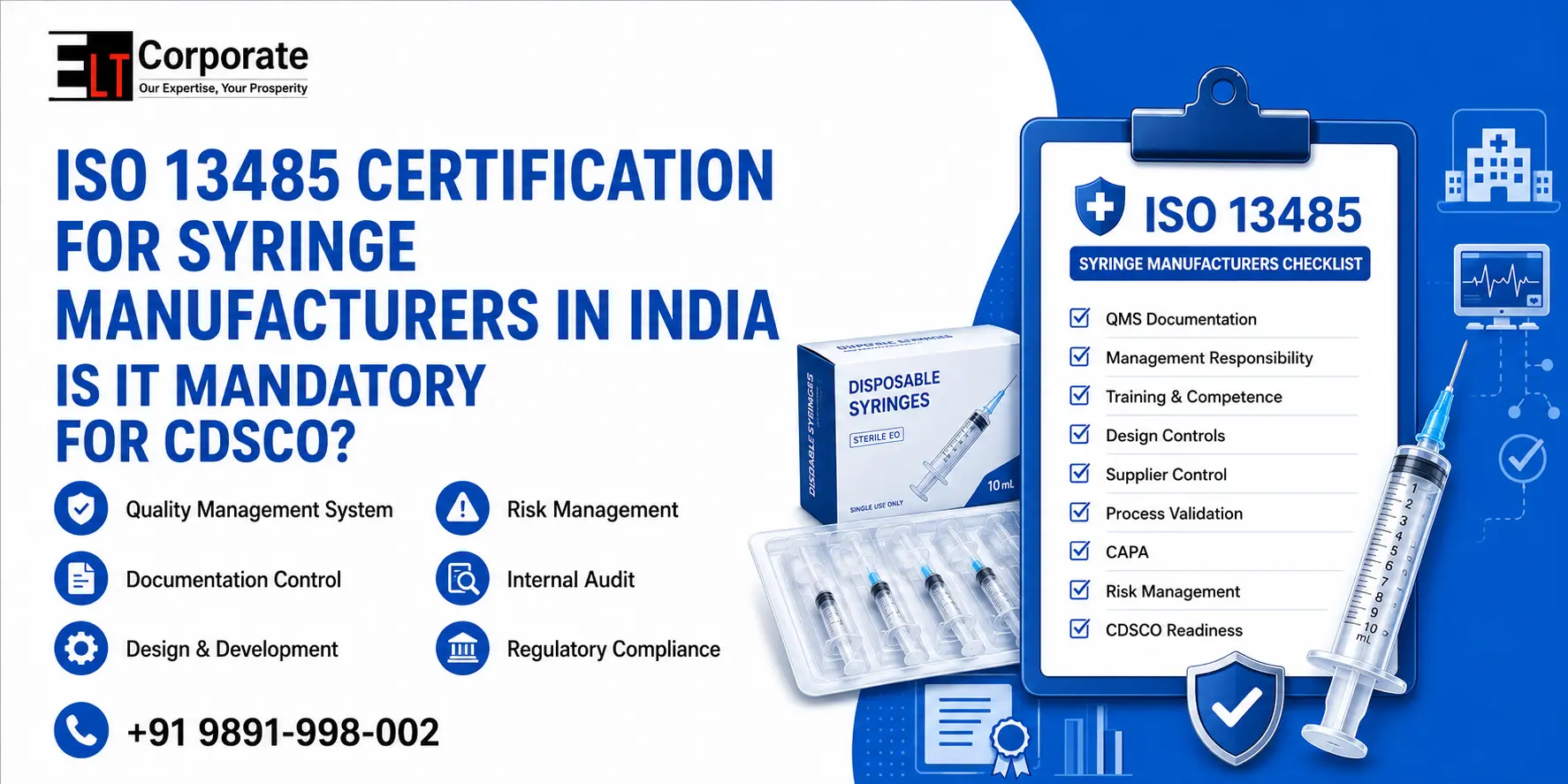
Here’s the thing that surprises a lot of first-time applicants. If you go strictly by the text of the Medical Devices Rules, 2017 (MDR 2017), ISO 13485 is not explicitly written in as a legal requirement. What the rules actually demand is that your quality management system comply with the Good Manufacturing Practices (GMP) laid out under those rules.
Where Syringes Actually Fall in the Classification System
One correction worth making upfront: syringes aren’t a toss-up between Class B and Class C. They’re consistently classified as Class B — the “low-to-moderate risk” tier, alongside things like surgical instruments and blood glucose monitors. Class A covers genuinely low-risk items like gloves and elastic bandages, while Class C and D are reserved for higher-risk devices like implants.
Which License, and Who Issues It
For a standard hypodermic syringe (Class B), you’re looking at:
- Form MD-5 — the manufacturing license application
- State Licensing Authority (SLA)—not the central CDSCO office—issues the license
- License validity of 5 years, after which renewal is required
Class C and D devices go through the Central Licensing Authority (CLA) instead, using Form MD-9, and typically involve steeper fees and more scrutiny.
Comparison Table: ISO 13485 vs. CDSCO License
| Feature | ISO 13485 Certification | Class | CDSCO Manufacturing License |
| What it is | International quality management standard | Class B | Legal government authorization |
| Who issues it | Independent, accredited third-party certification bodies | Class C | CDSCO (via the State Licensing Authority) |
| Validity | Typically 3 years, subject to surveillance audits | Class D | Central Licensing Authority for Class C/D |
Why Manufacturers Get ISO 13485 Anyway
Even without a hard legal mandate, there are practical reasons the certificate keeps showing up on every documentation checklist:
- It signals to inspectors that your quality systems already meet an internationally recognized bar, which tends to smooth over the SLA facility inspection
- It reduces the odds of your application being sent back for deficiencies
- It’s increasingly treated as the “de facto baseline” as India’s medical device framework converges with global standards like the GHTF/IMDRF classification conventions
What You’ll Need Alongside It
If you do go the ISO 13485 route (and most manufacturers do), expect your application packet to also include the following:
- Device Master File and Plant Master File
- Facility layout and building dimensions
- Proof of legal ownership or lease of the manufacturing site
- Records showing your team is qualified to manufacture and test the devices
- A medical device test license, if pre-launch testing is needed
What CDSCO Actually Requires on the Quality Side
This is where the real requirement sits. Under MDR 2017, manufacturers must maintain a documented Quality Management System that satisfies the Good Manufacturing Practices (GMP) laid out in the rules—covering things like design controls, incoming material checks, in-process quality checks, calibration, traceability, complaint handling, and corrective/preventive actions.
When your facility is inspected—whether by the SLA directly for lower-risk devices or by an accredited notified body for Class C/D devices—the auditors assess your QMS against criteria that are, in substance, the same criteria ISO 13485 was written to satisfy. So the inspection you’ll go through looks and feels almost identical to an ISO 13485 audit, even without the certificate.
Why Do Most Syringe Manufacturers Get ISO 13485 Anyway?
A few practical reasons keep coming up across the industry:
1.It Smooths the CDSCO inspection.
If your QMS is already certified to ISO 13485, the SLA or Notified Body auditor is largely confirming what an accredited third party has already verified. Facilities without it often face more documentation queries and longer inspection cycles.
2.It’s Expected for Exports and Tenders
Government tenders, hospital procurement panels, and export markets (EU, US, Gulf, and Southeast Asia) routinely list ISO 13485 as a baseline supplier qualification—regardless of what CDSCO strictly requires.
The Practical Takeaway for Syringe Manufacturers
You can technically obtain a CDSCO manufacturing license without holding ISO 13485 certification, as long as your QMS meets the GMP requirements in the Fifth Schedule of MDR 2017.
In practice, building your QMS to the ISO 13485 standard—certified or not—is the most efficient path through the CDSCO inspection process.
If you plan to sell to government hospitals, export, or bid on tenders, ISO 13485 stops being optional in any commercial sense, even if it remains legally non-mandatory.
ISO 13485 & CDSCO Documentation for Syringe Manufacturers (India)
Reference guide—verify current requirements on the CDSCO SUGAM portal before filing, as forms and annexures are periodically updated.
Is It Mandatory?
Short answer: yes, in practice. The Medical Devices Rules, 2017 (MDR 2017) don’t name “ISO 13485 certification” word-for-word as a blanket legal requirement—they set out essential principles of safety and performance instead. But CDSCO’s licensing process closes that gap in practice:
- Site inspections for Class B and above benchmark your QMS against ISO 13485-equivalent standards.
- An accredited ISO 13485 certificate is accepted as direct evidence of QMS compliance, which is why almost every manufacturer treats it as a prerequisite.
- Most syringe types fall in Class B or C, both of which trigger this expectation. A plain hypodermic syringe is generally Class B; specialized/prefilled or safety-engineered syringes can be Class C—confirm your specific product’s classification on SUGAM before proceeding.
Here’s the Step-by-step process.
Step 1 — Confirm Device Classification
Check your specific syringe type on the SUGAM portal. A plain hypodermic syringe is usually Class B; safety-engineered or prefilled syringes can be Class C. This determines whether you file MD-3→MD-5 (State Licensing Authority) or MD-7→MD-9 (Central Licensing Authority).
Step 2 — Build Your QMS
Set up the quality management system itself: SOPs, document control, risk management (ISO 14971-aligned), CAPA process, internal audit, and management review procedures. This has to exist and be running, not just written, before certification.
Step 3—Get ISO 13485 Certified
Engage an accredited/notified certification body to audit your facility against ISO 13485:2016 and issue the certificate. Close out any non-conformities they raise.
Step 4 — Compile the Plant Master File (PMF)
Facility layout, environmental controls, equipment and calibration records, utilities, and personnel qualifications.
Conclusion
Treat ISO 13485 for what it functionally is in India’s syringe manufacturing space: not a legal box CDSCO forces you to tick, but the de facto quality benchmark CDSCO inspectors measure you against and the credential your customers will expect regardless. Manufacturers who build their QMS around it from day one—rather than retrofitting it later—consistently report smoother, faster licensing.
Frequently Asked Questions
Q1. Is ISO 13485 Certification Legally Mandatory to Get a CDSCO Manufacturing License for Syringes?
Not as a standalone legal requirement in MDR 2017’s text, ISO 13485 is not mandatory, but your QMS must comply with the GMP specified in the rules. In practice, without it, passing the site inspection is very difficult.
Q2. What License Form Applies to Syringe Manufacturing?
Devices are classified into four risk classes (A, B, C, D), and the license form differs accordingly — MD-5 for Class A/B and MD-9 for Class C/D. Most standard hypodermic syringes fall under Class A or B.
Q3. Which Documents Does CDSCO Ask for Alongside/Instead of ISO 13485?
Key documents include the Device Master File (DMF), Plant Master File (PMF), ISO 13485 certificate, Free Sale Certificate (for importers), test reports, and labeling.
Q4. Does ISO 13485 Matter If I Only Sell in India and Never Export?
Yes, indirectly—CDSCO site inspections for Class C/D licenses assess the QMS against standards substantially equivalent to ISO 13485, and import license applications for Class C/D devices expect quality system evidence consistent with ISO 13485 principles. If you plan to export later, it becomes effectively mandatory since most importers and regulators in the EU, US, Canada, and Australia require it.
Comments are closed