
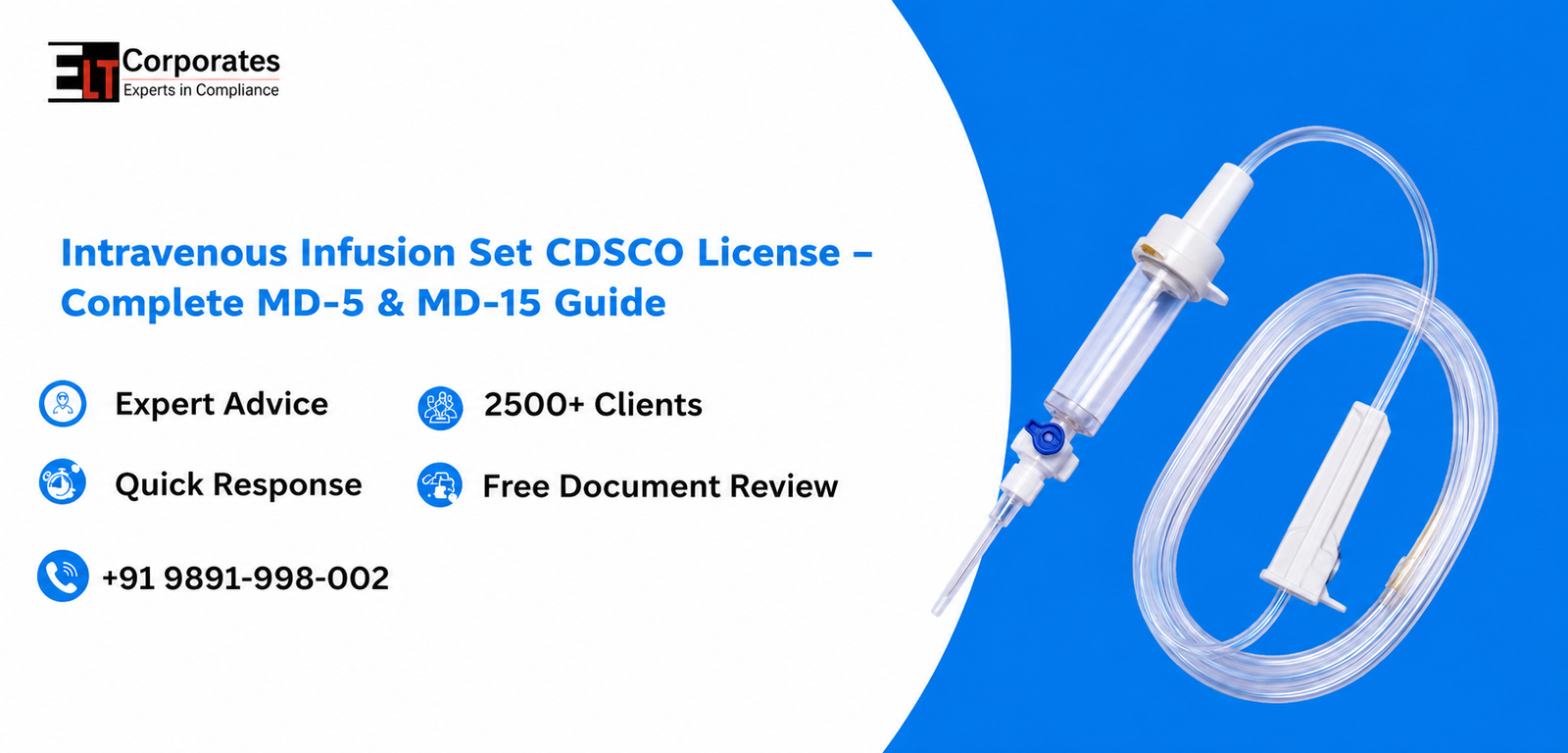
Intravenous (IV) infusion sets are widely used medical devices for administering fluids, medicines, blood components and other solutions to patients. Because these devices are used in healthcare settings and may form part of a fluid or blood pathway, manufacturers and importers need to understand the applicable regulatory requirements in India.
The CDSCO licensing process for Intravenous Infusion Sets depends on whether the device is manufactured in India or imported from another country. The applicable requirements can include device classification, technical documentation, quality management information, testing evidence, labelling, and other documents prescribed under the Medical Devices Rules, 2017 (MDR 2017).
For domestic Class A or Class B medical-device manufacturing, CDSCO’s regulatory framework provides for applications in Form MD-3 and MD-4, with the corresponding manufacturing licences issued in Form MD-5 and MD-6. For imported medical devices, an application for an import licence is made in Form MD-14, with the licence issued in Form MD-15.
What Is an Intravenous Infusion Set CDSCO License?
An intravenous infusion set is generally a single-use device designed to deliver fluids or medicines from a container to a patient’s vascular access device.
Depending on the product design, an infusion set may contain components such as:
- Tubing
- Drip chamber
- Roller clamp or flow regulator
- Injection port
- Spike or piercing device
- Connector
- Filter, where applicable
- Burette chamber, where applicable
- Protective caps
The exact regulatory pathway should be determined from the device’s intended purpose, design, specifications and applicable classification rules.
Intravenous Infusion Set CDSCO Classification in India
CDSCO uses a risk-based classification system under the Medical Devices Rules, 2017, with medical devices grouped into Class A, B, C and D according to risk.
CDSCO’s published classification material lists measured-volume IV sets and transfusion or perfusion sets for single use under disposable perfusion sets as Class B. It also lists extension sets and IV flow regulators as Class B.
However, classification should not be assumed solely from the product’s commercial name. The final classification should be checked against the actual intended use, design and applicable CDSCO classification provisions.
Types of IV Infusion Sets
Gravity IV Administration Sets
These sets use gravity to deliver fluids through tubing into the patient’s vascular access device. They commonly include a drip chamber and flow regulator.
Burette or Paediatric Infusion Sets
These products include a graduated chamber designed for controlled delivery of smaller fluid volumes, where applicable to the intended clinical use.
Blood Transfusion Sets
Blood transfusion sets are specifically designed for administration of blood or blood components and may include filtration components appropriate to their intended use.
Pump-Compatible Infusion Sets
These sets are designed for use with specified infusion pumps and must be assessed according to their intended compatibility and performance claims.
Extension Sets
Extension sets provide additional tubing length and may include connectors, injection ports or other components.
Multi-Port Infusion Sets
These devices may include Y-connectors or multiple ports for administering more than one fluid or medication through an infusion system.
Note: Different configurations should be assessed individually where their intended use, components or performance characteristics differ.
Why Is CDSCO Compliance Important for IV Infusion Sets?
IV infusion sets are used directly in healthcare delivery, so manufacturers and importers need to pay close attention to:
- Material safety
- Sterility, where the product is supplied sterile
- Packaging integrity
- Flow performance
- Connector performance
- Biocompatibility
- Chemical compatibility
- Labelling
- Risk management
- Manufacturing quality controls
The applicable evidence will depend on the product’s characteristics and intended use rather than a single universal document list.
Who Needs an Intravenous Infusion Set CDSCO License?
The regulatory requirements may apply to businesses such as:
- Indian manufacturers of IV infusion sets
- Foreign manufacturers supplying IV infusion sets to India
- Indian importers
- Indian Authorised Agents for foreign manufacturers
- OEM manufacturers
- Contract manufacturers
- Medical-device distributors involved in regulated activities
- Businesses supplying infusion sets through institutional procurement
For imported medical devices, the importer/authorised-agent structure and applicable CDSCO requirements should be established before commercial importation.
Documents Required for IV Infusion Set CDSCO Registration
The exact documents depend on the application route and product. Common documentation can include the following.
Applicant and Legal Documents
- Business registration documents
- GST registration, where applicable
- Import Export Code for relevant import activities
- Authorisation documents
- Indian Authorised Agent documents for applicable foreign-manufacturer applications
- Power of Attorney, where applicable
Device Documents
- Device name
- Catalogue/model numbers
- Intended use
- Device description
- Product specifications
- Component details
- Materials of construction
- Sterilisation information
- Shelf-life information
- Packaging information
- Product variants and configurations
Technical Documentation
Depending on the device and regulatory pathway, technical documentation may include:
- Essential Principles checklist
- Risk management documentation
- Performance data
- Biocompatibility information
- Sterilisation validation
- Packaging validation
- Stability/shelf-life evidence
- Applicable test reports
- Clinical or performance evidence, where applicable
Quality Management Documents
Relevant documents may include:
- Quality management system documentation
- ISO 13485 certificate, where applicable
- Manufacturing-site information
- Quality-control procedures
- Post-market surveillance documentation
- Complaint-handling procedures
Standards and Testing for IV Infusion Sets
The applicable standards depend on the particular product and its design.
Potentially relevant standards may include:
- ISO 8536 series for infusion equipment
- ISO 1135 series for applicable transfusion equipment
- ISO 10993 series for biological evaluation
- ISO 11135 for applicable ethylene oxide sterilisation processes
- ISO 11137 series for applicable radiation sterilisation processes
- ISO 11607 series for sterile barrier packaging
- ISO 14971 for medical-device risk management
- Applicable connector and usability standards where relevant
The manufacturer should establish which standards and test requirements actually apply to its specific product rather than using a generic standards list.
MD-5 and MD-15 for IV Infusion Sets
The terms MD-5 and MD-15 should not be treated as interchangeable.
MD-5
For Class A/B domestic manufacturing, the application is made through the applicable manufacturing route, including Form MD-3, and the manufacturing licence for Class A/B devices is issued in Form MD-5.
MD-15
For imported medical devices, the application for an import licence is made in Form MD-14, and the resulting import licence is issued in Form MD-15.
Therefore, an importer should not describe MD-15 as a manufacturing licence, and a domestic manufacturer should not use MD-14/MD-15 as its manufacturing route.
Step-by-Step CDSCO Process for IV Infusion Sets
Step 1: Identify the Product
Establish the exact product name, intended purpose, configurations, components, and manufacturer details.
Step 2: Confirm Classification
Review the applicable CDSCO classification provisions and determine the device class.
Step 3: Select the Correct Regulatory Route
Determine whether the product requires an import licence or domestic manufacturing licence.
Step 4: Prepare Technical Documentation
Compile the applicable device description, specifications, risk documentation, testing information and other technical evidence.
Step 5: Prepare Quality Documents
Ensure the manufacturer’s quality system and manufacturing information meet the applicable requirements.
Step 6: Prepare Labelling and IFU
Review product labels, packaging, and instructions for use against applicable MDR requirements.
Step 7: Submit the Application
Submit the applicable application and supporting documents through the relevant online regulatory system.
Step 8: Respond to Regulatory Queries
If the authority raises deficiencies or queries, provide appropriate supporting explanations and documents.
Step 9: Complete Applicable Inspection or Audit
Where required, complete the applicable manufacturing-site audit or inspection process.
Step 10: Obtain the Licence
After regulatory review and satisfaction of applicable requirements, the relevant licence may be issued.
How ELT Corporate Helps With IV Infusion Set CDSCO License
ELT Corporate can assist manufacturers, importers, and businesses with the regulatory preparation required for IV infusion sets.
Our support can include:
- Device classification support
- Regulatory pathway assessment
- Document checklist preparation
- Technical document review
- Application preparation
- CDSCO/SUGAM filing support
- Manufacturer and IAA document coordination
- Labelling and IFU review
- Query-response support
- Manufacturing compliance guidance
- Post-licence regulatory support
The objective is to make the regulatory process easier to understand and help businesses organize their documentation according to the applicable requirements.
Common Issues That Can Delay CDSCO Applications
Businesses should carefully review their applications for issues such as:
Incorrect Device Classification
Using the wrong classification can affect the entire regulatory pathway.
Incomplete Technical Documents
Missing specifications, test reports, or device information can lead to regulatory deficiencies.
Inconsistent Product Information
The model number, manufacturer name, intended use, and product description should remain consistent across the dossier.
Incomplete Sterilisation Evidence
Where the product is supplied sterile, applicable sterilisation validation and supporting evidence should be properly documented.
Labelling Issues
Product labels and IFUs should be reviewed against applicable regulatory requirements.
Missing Risk Documentation
The risk-management documentation should address hazards relevant to the actual product design and intended use.
Post-Licence Compliance for IV Infusion Sets
Obtaining a licence is not necessarily the end of the compliance process. Manufacturers and importers should continue to manage applicable:
- Product quality controls
- Complaint handling
- Post-market surveillance
- Adverse-event/vigilance obligations
- Labelling compliance
- Change-control requirements
- Manufacturing/QMS requirements
- Licence-related regulatory obligations
Any significant product, manufacturing or regulatory change should be assessed to determine whether a regulatory notification or approval is required.
Conclusion
Obtaining an Intravenous Infusion Set CDSCO License requires careful attention to product classification, regulatory pathway, technical documentation, quality requirements, testing evidence, and applicable labelling requirements. For domestic Class A/B manufacturing, the
MDR framework uses the MD-3/MD-5 route, while imported medical devices follow the MD-14/MD-15 import-licence route.
Because IV infusion sets can have different configurations and intended uses, businesses should assess the specific product before deciding which documents, standards, and regulatory pathway apply. Proper preparation can make the application process more organized and reduce avoidable documentation deficiencies.
ELT Corporate can assist businesses in understanding the applicable CDSCO requirements and preparing their IV infusion set regulatory documentation and applications.
Frequently Asked Questions
Q1. Is an Intravenous Infusion Set CDSCO License required in India?
The applicable CDSCO licensing requirement depends on the device and regulatory pathway. CDSCO’s framework regulates notified medical devices through risk-based classification and licensing requirements.
Q2. What class is a standard IV infusion set?
CDSCO’s published classification list identifies measured-volume IV sets and single-use transfusion/perfusion sets as Class B. The exact classification should nevertheless be confirmed against the specific product and current applicable classification provisions.
Q3. What is MD-15 for medical devices?
MD-15 is the import licence issued following an application in Form MD-14 for importing medical devices.
Q4. What is MD-5 for medical devices?
MD-5 is the manufacturing licence form used for applicable Class A/B domestic medical device manufacturing after the relevant manufacturing application process.
Q5. Is MD-14 the licence for an IV infusion set?
No. MD-14 is the application form for an import licence, while MD-15 is the import licence.
Q6. What documents are needed for IV infusion set registration?
Documents vary according to the device and route but may include legal, technical, quality, testing, labelling and manufacturing information.
Q7. Can a foreign manufacturer sell IV infusion sets in India without the applicable import licence?
Businesses should complete the applicable Indian medical-device regulatory requirements before placing a regulated device on the Indian market.
Q8. Does an ISO 13485 certificate alone provide CDSCO approval?
No. An ISO 13485 certificate relates to the manufacturer’s quality-management system and does not by itself replace the applicable Indian medical-device licence.
Q9. Is CE certification the same as CDSCO approval?
No. CE certification under the European framework and Indian CDSCO licensing are separate regulatory matters.
Q10. Can ELT Corporate help with IV infusion set CDSCO licensing?
Yes. ELT Corporate can provide regulatory assistance with classification, documentation, application preparation, submission support, and regulatory query handling for applicable medical-device licensing pathways.
Comments are closed