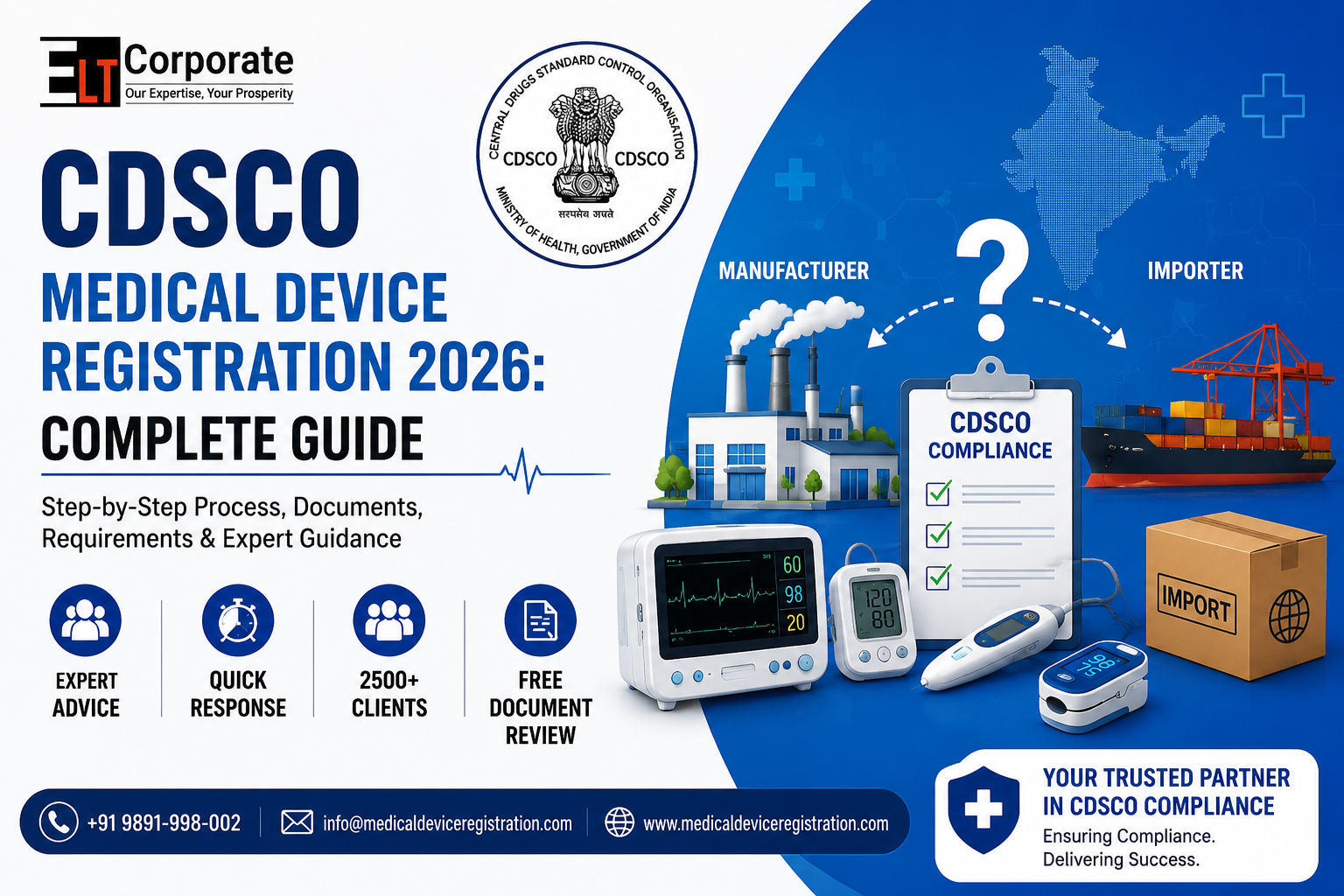
If you manufacture, import, or sell medical devices in India, one word decides whether your business runs smoothly or gets stuck at customs: CDSCO. Every notified medical device sold in India — from a simple thermometer to a heart valve — must carry valid approval from the Central Drugs Standard Control Organization before it reaches the market.
2026 has brought several important updates to this process — tighter application timelines, new classification rules for software and AI-based devices, and an extended deadline for BIS certification. This guide breaks the entire CDSCO Medical Device Registration 2026 process into plain, easy-to-follow language, so you know exactly what to do next.
What Is CDSCO Medical Device Registration?
CDSCO Medical Device Registration is the government approval process that allows a company to legally manufacture, import, or sell a medical device in India. It is issued under the Medical Devices Rules, 2017, by the Central Drugs Standard Control Organization, which functions under India’s Ministry of Health & Family Welfare.
Without this registration, selling or importing a notified device in India is treated as an offence — devices can be seized at ports, and the business may face penalties. This is why every manufacturer, importer, or authorised agent needs to plan their CDSCO Registration well before launching a product in India.
Why CDSCO Registration Matters More in 2026
Regulators have sharpened enforcement this year. A few changes stand out:
- Faster rejection of incomplete applications – CDSCO has started auto-rejecting SUGAM applications that sit unanswered for 90 days, so incomplete dossiers now carry a real cost.
- New categories added to classification – AI-based diagnostic tools, clinical health-monitoring apps, and machine-learning imaging software have been formally brought under risk-based classification this year.
- BIS Scheme X deadline extended – Devices falling under BIS’s notified scope now have until September 1, 2026 to complete Scheme X certification.
- Draft Amendment Rules, 2026 – Proposed changes may make a Quality Management System (QMS) audit by a Notified Body mandatory before a manufacturing licence is granted, along with clearer approval timelines.
These shifts mean a dossier that was “good enough” in 2023 may not clear scrutiny in 2026 without a review.
Who Needs CDSCO Registration?
- Domestic manufacturers of medical devices and IVDs
- Importers of medical devices, IVDs, or cosmetics
- Foreign manufacturers selling into India
- Indian subsidiaries of foreign device companies
- Authorised agents representing an overseas manufacturer
The Four Risk-Based Device Classes
CDSCO classifies every device by patient risk, and your class decides how much clinical evidence and scrutiny your application needs:
| Class | Risk Level | Example Devices |
|---|---|---|
| Class A | Low Risk | Surgical dressings, tongue depressors |
| Class B | Low-Moderate Risk | Hypodermic needles, suction equipment |
| Class C | Moderate-High Risk | Lung ventilators, bone fixation plates |
| Class D | High Risk | Heart valves, implantable defibrillators |
Class A and B devices generally need little to moderate clinical evidence, while Class C and D devices typically require detailed clinical investigation data unless substantial equivalence to an already-approved device can be shown.
Step-by-Step CDSCO Medical Device Registration 2026 Process
- Identify your device classification – Confirm whether your product falls under Class A, B, C, or D based on intended use and risk.
- Prepare your technical dossier – Compile the Device Master File, labelling, and supporting evidence for your class.
- Register on the SUGAM portal – All applications are filed online through CDSCO’s official SUGAM system.
- Submit the application with fees – File the correct form (registration, import licence, or manufacturing licence) along with prescribed fees.
- Respond to queries promptly – Under the 2026 rules, applications with unanswered queries are auto-rejected after 90 days, so track your SUGAM dashboard closely.
- Receive your certificate – Once CDSCO is satisfied with the dossier, the registration or licence is granted.
Documents Required for CDSCO Registration
- Clinical Evaluation Report
- Labels and Instructions for Use (IFU)
- Performance Evaluation Report (for IVDs)
- ISO 13485 Certificate
- Device Master File (DMF)
- Plant Master File (PMF)
- Risk Management Plan
- Certificate of Incorporation of the applicant entity
Missing or inconsistent documents are the single biggest reason applications get delayed or queried.
How Long Does CDSCO Registration Take?
Timelines vary by device class:
- Non-notified Class C and D devices can currently be registered through the e-portal.
- Class A and B devices typically take around 6 to 9 months for approval.
- Devices with reference-country approval (already approved by a recognised regulator abroad) usually move faster.
Benefits of Getting Your Medical Device Registered
- Legal Compliance – Avoid penalties, seizure at ports, and legal trouble.
- Market Access – Sell confidently across India and use it as a reference for other markets.
- Credibility – A registered device builds trust with hospitals, distributors, and patients over unregistered competitors.
Common Mistakes That Delay CDSCO Approval
- Filing under the wrong device class
- Submitting an outdated or non-accredited ISO 13485 certificate
- Ignoring SUGAM queries until the 90-day deadline is close
- Incomplete labelling that doesn’t match the 2026 labelling clauses (such as sterilization site licence details)
- Applying without first checking whether the device falls under new classification categories
How ELT Corporate Helps
At ELT Corporate, our regulatory team — attorneys, engineers, and compliance specialists — has supported over 2,500 licence approvals. We handle classification, dossier preparation, SUGAM filing, and query responses so your device reaches the Indian market without avoidable delays. If your device also needs BIS certification, our BIS ISI & Foreign Manufacturer Certifications team can run both processes in parallel.
Explore related services: Manufacturer Registration | Free Sale Certificate
Frequently Asked Questions About CDSCO Medical Device Registration 2026
Q1. What is CDSCO Medical Device Registration?
CDSCO medical device registration refers broadly to the regulatory process required for applicable medical devices to be manufactured, imported, or otherwise commercialised in India under the Medical Devices Rules, 2017. The exact approval or registration route depends on the product and its classification.
Q2. Is CDSCO registration mandatory for medical devices in India?
The applicable regulatory requirement depends on the device classification and activity. Some Class A non-sterile and non-measuring devices follow a registration route, while other devices may require manufacturing or import licences.
Q3. How are medical devices classified in India?
Medical devices are generally classified into Class A, B, C, and D based on risk, with Class A representing low risk and Class D representing high risk.
Q4. What is the CDSCO medical device registration process in 2026?
The process generally involves product assessment, classification, identification of the regulatory pathway, preparation of technical documents, online application, regulatory review, response to queries, inspection where applicable, and grant of the applicable registration or licence.
Q5. What is Form MD-14 used for?
Form MD-14 is used to apply for an import licence for medical devices under the applicable CDSCO regulatory pathway. The corresponding import licence is issued in Form MD-15.
Q6. What is Form MD-15?
MD-15 is the import licence issued for applicable medical devices under the Medical Devices Rules, 2017.
Q7. What is Form MD-5 in medical devices?
MD-5 is the manufacturing licence for applicable Class A or Class B medical devices.
Q8. What is Form MD-9?
MD-9 is the manufacturing licence for applicable Class C and Class D medical devices.
Q9. Is ISO 13485 mandatory for CDSCO registration?
ISO 13485 should not be treated as a universal standalone prerequisite for every medical device licence. The exact requirements depend on the applicable regulatory pathway and current CDSCO requirements.
Q10. How much does CDSCO medical device registration cost?
There is no single fixed cost. Government fees, testing, audits, technical documentation, clinical requirements, and professional consultancy costs can vary according to the device and regulatory path
Q11. How long does CDSCO medical device registration take?
The timeline varies according to the type of application, device class, documentation, review, inspection, and regulatory queries. Applicants should avoid assuming one standard timeline for all medical devices.
Q12. Can a foreign manufacturer sell medical devices in India without CDSCO approval?
A foreign manufacturer should not assume that approval in another country automatically permits commercialisation in India. The applicable Indian regulatory requirements must be completed before the device is legally marketed through the relevant pathway.
Q13. Does every Class A medical device need a licence?
Not necessarily. Class A non-sterile and non-measuring medical devices have a specific registration pathway and are exempt from certain licensing provisions under MDR 2017.
Q14. What documents are required for CDSCO medical device registration?
Depending on the product, documents may include the Device Master File, Plant Master File, product specifications, risk-management information, labels, IFU, quality documents, regulatory certificates, clinical/performance evidence, and other documents prescribed for the applicable application.
Q15. Can ELT Corporate help with CDSCO medical device registration?
Yes. ELT Corporate provides regulatory consultancy and documentation support for medical device manufacturers, importers and businesses seeking CDSCO-related compliance in India.
Comments are closed