
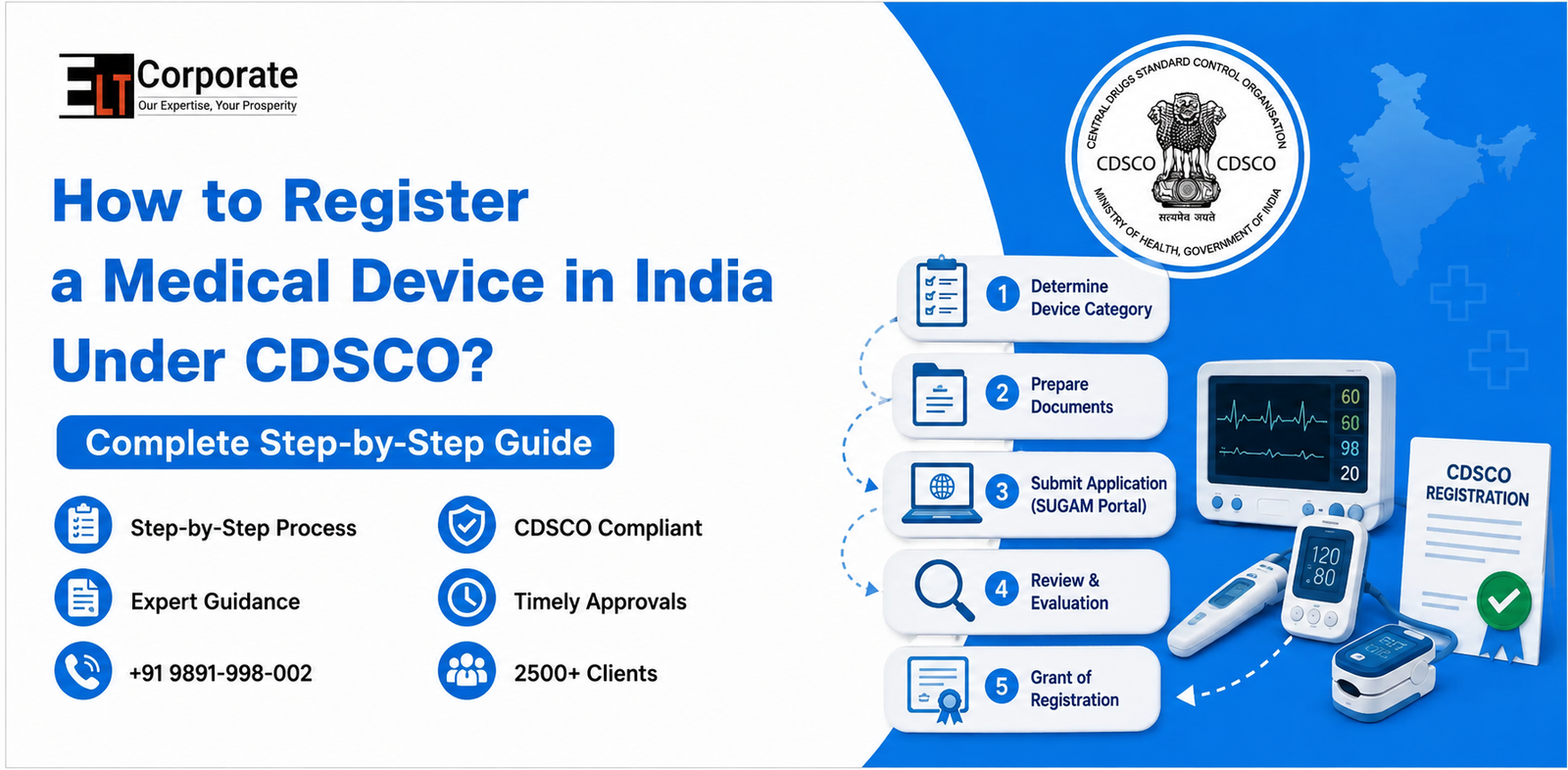
Introduction
Planning to manufacture, import, or sell a medical device in India? One of the first things you need to understand is the medical device registration and licensing framework.
The regulatory process can appear complicated because the requirements depend on factors such as the type of medical device, intended use, risk classification, whether the product is manufactured in India or imported, and the applicable licensing authority.
In India, medical devices are regulated primarily under the Medical Devices Rules, 2017 (MDR 2017). The Central Drugs Standard Control Organization (CDSCO) oversees the regulatory framework, while licensing responsibilities can vary according to the device and its risk class.
This guide explains the process in simple terms—from identifying whether your product is a medical device to determining its class, preparing documents, applying through the relevant online system, and maintaining compliance after approval.
Important: Medical-device regulations can change through amendments, notifications and CDSCO updates. Always verify the latest applicable requirements before filing an application.
What Is CDSCO Medical Device Registration?
CDSCO stands for the Central Drugs Standard Control Organization, India’s national regulatory authority for drugs and medical devices under the Ministry of Health & Family Welfare.
Medical devices are regulated under the Medical Devices Rules, 2017. The framework covers areas including manufacturing, import, sale, distribution, clinical investigation and other regulatory requirements.
However, “medical device registration” is not always a single registration applicable to every product.
Depending on your situation, you may need a particular manufacturing licence, loan licence, import licence, registration or other regulatory approval.
For example, CDSCO states that an applicant seeking an import licence for medical devices applies in Form MD-14 through the SUGAM online portal, with the import licence issued in Form MD-15.
Therefore, the first step is not simply filling out an application—it is determining which regulatory pathway applies to your device.
Which Medical Devices Are Regulated in India?
India follows a risk-based regulatory system for medical devices.
The CDSCO framework classifies medical devices into four risk categories:
| Class | Risk Level |
| Class A | Low Risk |
| Class B | Low-Moderate Risk |
| Class C | Moderate-High Risk |
| Class D | High Risk |
The classification is based on parameters specified in the First Schedule of the Medical Devices Rules, 2017. CDSCO also publishes risk-classification lists, which can be updated over time.
Why Is Risk Classification Important?
Your device’s classification can affect:
- Applicable licence
- Regulatory authority
- Documentation
- Testing requirements
- Quality management requirement
- Audit or inspection requirements
- Clinical/performance evidence where applicable
- Post-market compliance
For this reason, correct classification should be established before preparing the application.
Step 1: Determine Whether Your Product Is a Medical Device
Before starting CDSCO registration, determine whether your product falls within India’s medical-device regulatory framework.
Consider the product’s:
- Intended purpose
- Intended user
- Mode of action
- Technology
- Claims made by the manufacturer
- Whether it is used for diagnosis, prevention, monitoring, treatment or other medical purposes
The regulatory classification is connected to the intended use of the device. CDSCO guidance explains that classification is based on intended purpose and other prescribed parameters.
Example
Suppose a company develops a device intended to monitor a patient’s vital parameters.
The company should not determine its regulatory pathway simply by looking at the product’s commercial name. The intended use, technical characteristics and applicable classification rules need to be evaluated.
Step 2: Identify the Risk Class of the Device
Once you establish that the product is a medical device, identify its applicable risk class.
The four broad categories are:
Class A → Class B → Class C → Class D
with increasing regulatory risk.
CDSCO maintains published classification information, and the classification lists are dynamic. Therefore, businesses should check the current CDSCO classification information rather than relying solely on an old classification document or an online article.
What If Your Device Is Not Clearly Listed?
If the device does not appear straightforwardly in the available classification information, you may need to assess the applicable classification rules and, where appropriate, seek regulatory clarification.
Do not simply select a class based on a similar product without evaluating your own device’s intended use and characteristics.
Step 3: Determine Whether You Are Manufacturing or Importing
The next major question is:
Are you manufacturing the medical device in India or importing it from another country?
The regulatory pathway can be different.
If You Are an Indian Manufacturer
You need to follow the applicable manufacturing-licence pathway based on the device’s classification and regulatory requirements.
If You Are Importing a Medical Device
The importer needs to follow the applicable import-licensing requirements.
For medical-device imports, CDSCO identifies Form MD-14 as the application for an import licence through the SUGAM online portal, with the licence granted in Form MD-15.
This distinction is important because an overseas manufacturer and an Indian importer may have different responsibilities in the regulatory process.
Step 4: Prepare the Required Technical and Regulatory Documents
Documentation is one of the most important parts of a medical-device application.
Depending on the regulatory pathway and device, documentation can include information relating to:
- Applicant/importer/manufacturer details
- Manufacturing-site information
- Device description
- Intended use
- Device specifications
- Product variants
- Labelling
- Packaging
- Instructions for Use (IFU)
- Essential principles of safety and performance
- Risk management
- Quality management system
- Testing and evaluation
- Clinical/performance evidence, where applicable
- Manufacturing process
- Post-market surveillance
- Existing approvals or certificates, where applicable
CDSCO provides specific checklists and application-related documents for different medical-device forms, including MD-7, MD-8, MD-12, MD-14, MD-16 and others.
Don’t Prepare Documents at the Last Minute
A common mistake is to start the online application first and think about documentation later.
A better approach is to create a regulatory document checklist before filing and ensure that the information is consistent across:
- Application forms
- Technical documents
- Labels
- IFU
- Certificates
- Manufacturer information
- Product specifications
Inconsistencies can create avoidable regulatory queries and delays.
Step 5: Understand the Applicable Licensing Authority
Not every medical device follows exactly the same licensing route.
CDSCO’s framework distinguishes responsibilities according to device class and regulatory pathway. For example, CDSCO’s medical-device information states that applications for manufacturing licences/loan licences for Class C and Class D devices are made in Forms MD-7 and MD-8, with licences in MD-9 and MD-10 respectively.
The applicable authority and procedure should therefore be confirmed for the specific device before submission.
Why This Matters
Submitting an application to the wrong authority or using an incorrect form can result in unnecessary delays.
Always confirm:
- Device category
- Risk class
- Manufacturing vs import status
- Applicable authority
- Applicable form
- Current submission portal/process
Step 6: Submit the Application Through the Applicable Online System
For applicable medical-device regulatory applications, CDSCO provides online processes through its regulatory portals, including the SUGAM system.
For example, the CDSCO medical-device page specifies that an applicant seeking an import licence applies in MD-14 through the SUGAM online portal.
Before submitting:
- Check all mandatory fields.
- Upload the correct documents.
- Ensure documents are readable.
- Verify manufacturer details.
- Check product names and model numbers.
- Confirm that the intended use is consistent throughout the submission.
- Verify applicable fees and current submission requirements.
Step 7: Regulatory Review and Queries
After submission, the application may undergo regulatory scrutiny.
The authority may review information such as:
- Device classification
- Technical documentation
- Safety and performance information
- Manufacturing details
- Quality systems
- Testing information
- Labelling
- Clinical/performance evidence, where applicable
If the regulator raises a query, the applicant needs to respond with appropriate clarification and supporting documentation.
How to Reduce Regulatory Queries
Before submission, perform a consistency check.
For example, the device’s:
Intended use → product description → label → IFU → technical documentation
should tell the same regulatory story.
If these documents describe the device differently, it can create questions during review
Step 8: Licence or Approval
If the application satisfies the applicable regulatory requirements, the relevant licence or approval can be issued.
For imported medical devices, for example, the CDSCO framework identifies MD-15 as the import licence corresponding to an MD-14 application.
For manufacturing, the applicable licence form depends on the regulatory pathway and device classification.
The approval should not be treated as the end of compliance. Medical-device businesses generally need to continue meeting applicable requirements after entering the market.
Step 9: Maintain Post-Market Compliance
Obtaining a licence is only one part of medical-device regulatory compliance.
Businesses should establish systems for ongoing compliance, including where applicable:
- Complaint handling
- Adverse-event reporting
- Corrective and preventive actions
- Product traceability
- Post-market surveillance
- Change control
- Record maintenance
- Regulatory reporting
- Licence maintenance
CDSCO has also issued guidance/circulars concerning adverse-event reporting by medical-device licence holders under the Materiovigilance Programme of India.
Therefore, regulatory compliance should be treated as an ongoing lifecycle process, not a one-time registration exercise.
Manufacturing vs Importing: What Is the Difference?
| Factor | Manufacturing in India | Importing into India |
| Main activity | Manufacture device in India | Bring device manufactured outside India into India |
| Regulatory focus | Manufacturing facility + product | Importer + overseas manufacturer + product |
| Licence pathway | Depends on class/pathway | Import licence pathway |
| Technical documentation | Required as applicable | Required as applicable |
| Quality requirements | Applicable requirements based on pathway | Applicable requirements based on pathway |
| Online submission | Applicable regulatory portal | SUGAM for applicable import process |
| Post-market compliance | Required | Required |
The exact requirements depend on the device, classification and applicable provisions of MDR 2017
What Documents Are Usually Important for CDSCO Medical Device Registration?
There is no single universal document list that applies identically to every medical device.
However, applicants should be prepared to provide relevant information such as:
Company and Applicant Documents
- Applicant details
- Manufacturer details
- Indian authorised representative/importer details, where applicable
- Manufacturing-site information
Product Documents
- Product name
- Model/variant information
- Device description
- Intended use
- Specifications
- Product photographs/drawings, where applicable
Technical Documents
- Design and manufacturing information
- Risk-management documentation
- Testing reports
- Safety and performance information
- Quality-management documentation
- Clinical/performance evidence, where applicable
Labelling Documents
- Labels
- Packaging information
- Instructions for Use
- Warnings and precautions
- Storage requirements
The exact checklist should be confirmed against the current CDSCO application form and checklist applicable to your device. CDSCO publishes form-specific checklists and guidance documents.
How Long Does CDSCO Medical Device Registration Take?
There is no single processing time that can be guaranteed for every medical device application.
The timeline can depend on factors such as:
- Device classification
- Type of application
- Completeness of documentation
- Testing requirements
- Clinical/performance evidence
- Regulatory queries
- Inspection or audit requirements
- Applicant response time
- Changes in regulatory requirements
Therefore, businesses should avoid relying on a generic “X days” claim without checking the applicable regulatory pathway and current CDSCO requirements.
Common Mistakes to Avoid
1. Choosing the Wrong Risk Class
Incorrect classification can affect the entire regulatory application.
Always evaluate the device against the applicable classification rules and current CDSCO information.
2. Using Outdated Information
Medical-device regulations and regulatory procedures can change.
For example, CDSCO continues to publish new circulars and regulatory updates concerning medical devices. (CDSCO)
Always check the latest official information before filing.
3. Treating Every Device the Same
A low-risk device and a high-risk device may have substantially different regulatory requirements.
Don’t copy the regulatory strategy of another product without assessing your own device.
4. Inconsistent Product Information
Different product descriptions across the application, label, IFU and technical documents can create unnecessary queries.
5. Ignoring Post-Market Requirements
Compliance doesn’t necessarily end when the licence is issued.
Establish complaint, vigilance and change-control processes from the beginning.
6. Relying Only on Third-Party Websites
Consultants and regulatory websites can be useful for understanding the process, but the official CDSCO notifications, rules, forms and guidance should be treated as the primary regulatory reference.
Where Can You Find Official CDSCO Medical Device Information?
The CDSCO Medical Device & Diagnostics section provides resources including:
- Medical Devices Rules
- Classification information
- Regulatory pathway guidance
- Application forms
- Application checklists
- FAQs
- Grouping guidelines
- SUGAM-related information
- Other medical-device regulatory documents
Conclusion
Registering a medical device in India under CDSCO is not simply a matter of submitting one form. The correct approach starts with understanding whether the product is regulated as a medical device, determining its risk classification, identifying whether it is manufactured or imported, selecting the correct regulatory pathway, preparing appropriate technical documentation, submitting through the applicable portal, and maintaining compliance after approval.
The four risk classes—A, B, C and D—play an important role in determining the regulatory framework, while specific forms and licensing requirements depend on the applicable activity and device.
Because CDSCO requirements can be updated through amendments, notifications and circulars, businesses should verify the latest official requirements before submitting an application.
For a real-world application, particularly for Class C/D devices, novel devices, imported devices, or products requiring clinical/performance evidence, professional regulatory advice can help identify the correct pathway and reduce avoidable compliance issues.
Q1. Is CDSCO registration mandatory for medical devices in India?
Medical devices are regulated under the applicable Indian regulatory framework, but the exact registration/licensing requirement depends on the product, classification and applicable pathway. Businesses should determine the specific requirement rather than assuming that one registration applies to every device.
Q2. What are the four medical-device risk classes in India?
Medical devices are classified as Class A, B, C and D, ranging from low risk to high risk.
Q3. What is Form MD-14 used for?
For applicable medical-device imports, Form MD-14 is used to apply for an import licence through the SUGAM online portal. The corresponding import licence is issued in Form MD-15.
Q4. What is the Medical Devices Rules, 2017?
The Medical Devices Rules, 2017 provide India’s regulatory framework for medical devices, covering areas such as import, manufacture and other regulatory requirements.
Q5. Do Class A, B, C and D devices have the same registration process?
No. Regulatory requirements can differ according to the risk classification and applicable pathway. CDSCO identifies different licensing arrangements and forms for different classes and activities.
Q6. Can a foreign manufacturer sell a medical device directly in India?
A foreign manufacturer generally needs to follow the applicable Indian import and regulatory requirements. The specific requirements depend on the device and its regulatory pathway.
Q7. Is a medical device licence enough for lifelong compliance?
No. Medical-device compliance can continue after approval through requirements relating to complaints, vigilance, changes, records and other post-market obligations, as applicable.
Q8. Where should I check the latest CDSCO requirements?
The official CDSCO Medical Device & Diagnostics resources, Medical Devices Rules and current notifications/circulars are the best starting points. CDSCO’s website provides forms, checklists, FAQs and other regulatory resources.
Comments are closed