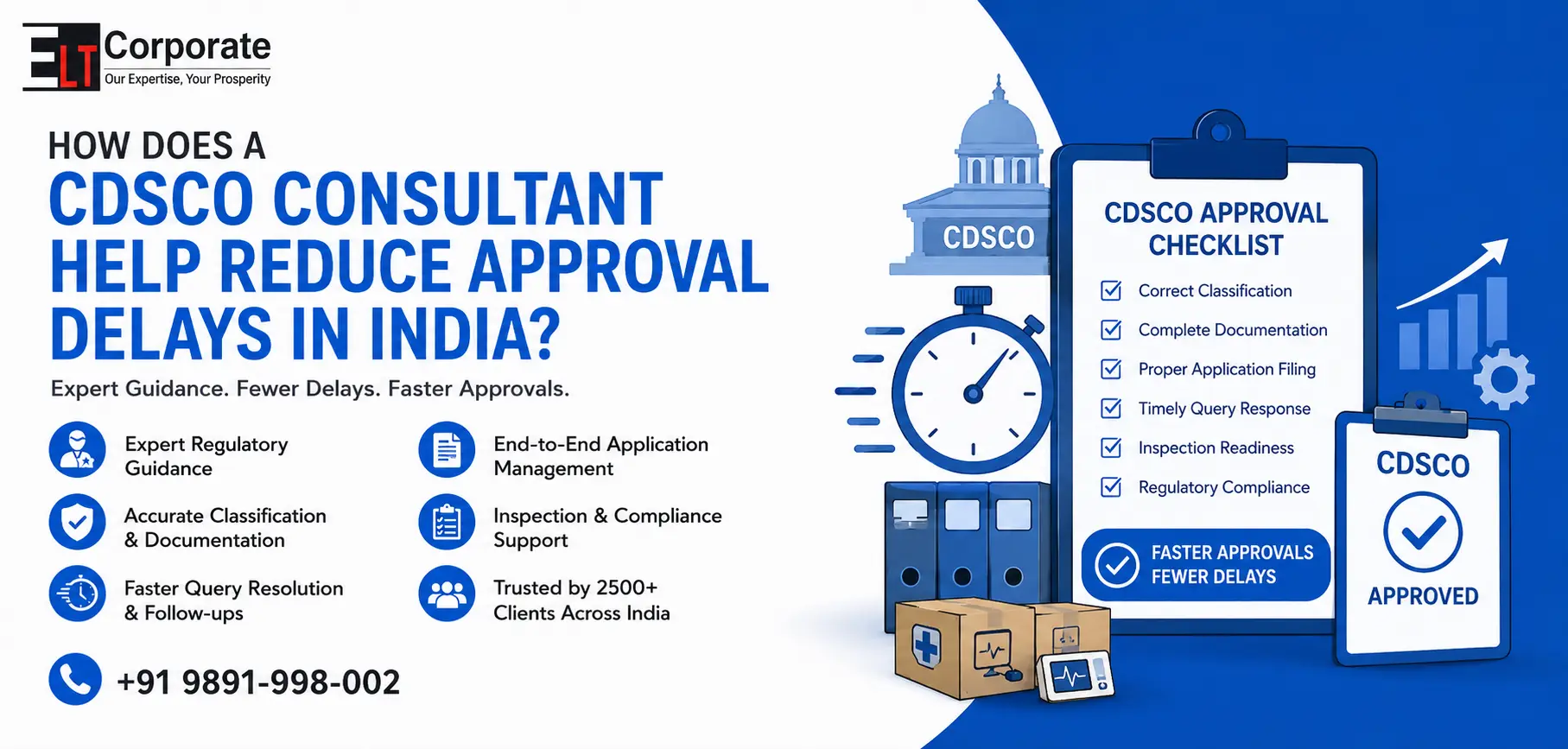
A CDSCO Consultant in India helps medical device manufacturers, importers, pharmaceutical companies and other healthcare businesses navigate the regulatory approval process with fewer avoidable errors. CDSCO applications can involve product classification, technical documentation, regulatory forms, government fees, online submissions, inspections and responses to regulatory queries.
A delay does not always mean that CDSCO is taking unusually long to process an application. In many cases, additional time can arise when documentation is incomplete, information across documents is inconsistent, the wrong regulatory pathway is selected, or deficiencies have to be corrected after submission.
An experienced CDSCO regulatory consultant helps identify these issues before the application reaches the authority, thereby reducing unnecessary back-and-forth during the approval process.
CDSCO itself operates the SUGAM online system for activities including import registration and licensing of drugs and medical devices, cosmetics registration, clinical-trial permissions and several other regulatory services.
Why Do CDSCO Applications Get Delayed?
A regulatory application contains much more than simply an application form.
Depending on the product and licence being applied for, CDSCO may examine documents relating to the manufacturer, manufacturing facility, product, quality management system, safety, performance, testing, labelling and regulatory status.
For example, CDSCO’s official checklist for an MD-14 application for a medical-device import licence includes documents such as the covering letter, fee challan, Power of Attorney, regulatory certificates, quality certificates, Plant Master File and Device Master File.
Therefore, even a small inconsistency can result in a regulatory deficiency or clarification request.
Some common causes of CDSCO approval delays include:
- Incorrect medical device classification
- Filing under the wrong application form
- Incomplete Device Master File
- Incomplete Plant Master File
- Missing test or validation reports
- Incorrect product grouping
- Differences between label, IFU and technical documentation
- Incorrect manufacturer or manufacturing-site details
- Invalid or improperly executed Power of Attorney
- Missing regulatory certificates
- Incomplete Free Sale Certificate documentation
- Improper payment of government fees
- Poorly drafted responses to CDSCO queries
- Delay in arranging additional information from the manufacturer
- Manufacturing-site deficiencies identified during inspection
A CDSCO registration consultant works on preventing these problems rather than attempting to correct everything after filing.
How Can a CDSCO Consultant in India Reduce Approval Delays?
1. Identifying the Correct Regulatory Pathway Before Filing
The first step is determining exactly what approval the business requires.
For medical devices, the pathway may differ according to whether the company is:
- Manufacturing the device in India
- Importing the device into India
- Manufacturing devices only for testing or evaluation
- Importing devices for testing or evaluation
- Applying for a new or investigational medical device
- Adding products to an existing licence
For example, CDSCO specifies Form MD-14 as the application for grant of an import licence in Form MD-15 for medical devices.
For Class C and Class D medical-device manufacturing, the Medical Devices Rules provide for applications in Form MD-7 or MD-8, with the manufacturing licence or loan licence being granted in Form MD-9 or MD-10, as applicable.
Choosing the wrong pathway at the beginning can result in substantial rework later.
2. Confirming Medical Device Classification
Medical-device classification is one of the most important preliminary regulatory exercises.
Before filing, the consultant should verify:
- Intended use
- Device description
- Technology
- Whether the product is invasive
- Duration of use
- Whether it is active or non-active
- Sterility
- Measuring function
- Software functionality
- Applicable CDSCO classification
- Applicable risk class
The applicable class determines the regulatory route, documentation requirements and licensing authority.
A consultant therefore performs a classification assessment before preparing the application, rather than simply relying on the product’s commercial name.
This is particularly important for innovative devices, medical software, accessories and products whose intended use may place them in a different risk category.
3. Creating a Complete CDSCO Document Checklist
A good CDSCO Consultant in India does not begin by randomly collecting documents.
The process should begin with a regulatory checklist customised to the actual application.
For an imported medical device, for example, the checklist may include:
- Covering letter
- Application form
- Government fee receipt
- Power of Attorney
- Authorized Indian Agent documents
- Free Sale Certificate or Marketing Authorization
- Overseas manufacturing-site registration
- Quality Management System certificate
- Applicable international regulatory certificates
- Declaration of Conformity
- Plant Master File
- Device Master File
- Labels
- Instructions for Use
- Risk-management documentation
- Verification and validation documents
- Sterilization validation, where applicable
- Software validation, where applicable
- Stability information, where applicable
- Clinical evidence, where applicable
- Post-market surveillance information
- Batch release or Certificate of Analysis documentation, as applicable
The CDSCO MD-15 checklist itself includes extensive technical information within the Device Master File, including descriptive information, grouping justification, specifications, labelling, design and manufacturing information, risk analysis, validation information, clinical evidence and post-market surveillance information.
Preparing these documents systematically reduces the risk of discovering major documentation gaps only after filing.
4. Reviewing the Device Master File Before Submission
The Device Master File (DMF) is one of the most important parts of a medical-device application.
The consultant should cross-check information such as:
- Device name
- Model numbers
- Variants
- Accessories
- Intended use
- Indications
- Contraindications
- Product specifications
- Manufacturing process
- Essential Principles
- Risk management
- Verification and validation
- Biocompatibility
- Electrical safety
- Software validation
- Sterilization
- Shelf-life
- Clinical evidence
- Post-market surveillance
CDSCO’s manufacturing checklist for Class C and D medical devices specifically includes a Device Master File with these types of technical elements.
The consultant’s role is not merely to upload documents but to ensure that the technical story told by all the documents is consistent.
For example, the intended use stated in the DMF should not contradict the intended use mentioned in the IFU, Free Sale Certificate, test reports or product labels.
5. Reviewing the Plant Master File and Manufacturing Information
For manufacturing-related approvals, another important document is the Plant Master File (PMF).
The CDSCO checklist for Class C and Class D manufacturing applications includes information regarding the manufacturing facility, personnel, premises, plant layout, equipment, sanitation, production, quality assurance, storage and documentation.
A regulatory consultant can review whether:
- Manufacturing activities match the submitted process
- Equipment is appropriate for the proposed products
- Quality-control facilities are adequately documented
- Manufacturing and testing personnel meet applicable requirements
- Facility layout matches actual operations
- Environmental controls are addressed
- QMS documentation supports the proposed manufacturing activity
Resolving these issues before inspection can prevent avoidable observations later.
6. Checking the Quality Management System
For medical-device manufacturing licences, documentation and implementation of the Quality Management System are important parts of regulatory compliance.
The CDSCO manufacturing checklist specifically calls for QMS-related documentation, including quality manuals, control of documents, control of records, management responsibility, resource management, production controls, internal audits, non-conforming product controls and corrective and preventive actions.
A CDSCO consultant can conduct a pre-submission QMS gap review to identify inconsistencies before the regulatory process advances to inspection.
This is particularly useful for newly established manufacturing units.
7. Filing the Application Correctly on the SUGAM Portal
CDSCO uses online systems including SUGAM for various regulatory activities such as import registration and licensing of drugs and medical devices.
Errors during online filing can create practical complications even when technical documents are available.
A consultant assists with:
- Applicant profile preparation
- Manufacturer details
- Manufacturing-site details
- Product details
- Correct selection of application type
- Document uploads
- Government fee mapping
- Application review
- Final submission
- Tracking regulatory communication
Before the final submission, the application should ideally undergo an internal regulatory quality check.
8. Preventing Inconsistencies Between Documents
One of the most overlooked causes of regulatory queries is inconsistency.
For example:
Free Sale Certificate: Product Name ABC-100
Label: ABC100 Plus
DMF: ABC-100 Series
Application: ABC Medical System
Even though these names may refer to commercially related products, the regulatory authority may require clarification regarding whether they represent one product, multiple models or a device family.
A regulatory consultant creates a model and document mapping sheet before filing.
The same principle should be applied to:
- Manufacturer name
- Manufacturing-site address
- Legal manufacturer
- Brand name
- Model numbers
- Intended use
- Shelf life
- Sterilization method
- Product classification
- Applicable standards
Consistency dramatically improves dossier clarity.
9. Preparing Regulatory Justifications Before CDSCO Asks for Them
Certain products require explanations rather than simple documents.
Examples may include:
- Device grouping justification
- Predicate-device justification
- Classification justification
- Shelf-life justification
- Clinical evidence justification
- Testing justification
- Applicability or non-applicability of biocompatibility studies
- Applicability of sterilization validation
- Software validation strategy
- Model or variant grouping
A competent CDSCO regulatory consultant anticipates these questions and prepares scientifically and legally supported explanations before submission whenever appropriate.
This helps prevent multiple rounds of clarification.
10. Handling CDSCO Queries Effectively
Receiving a CDSCO query does not automatically mean that an application will be rejected.
The important question is how the query is handled.
CDSCO’s medical-device rules specifically contemplate situations where deficiencies capable of rectification are identified. For Class C and D manufacturing applications, the prescribed scrutiny period may effectively restart from the date the identified deficiencies are removed.
That makes efficient query handling extremely important.
A consultant should:
- Analyse every observation.
- Identify the regulatory issue behind the question.
- Allocate the required information to the relevant technical team.
- Draft a point-by-point response.
- Attach supporting evidence.
- Cross-reference documents clearly.
- Review the response before submission.
- Maintain consistency with the original application.
Submitting incomplete responses may simply generate another round of queries.
11. Coordinating With Foreign Manufacturers
For imported medical devices, one of the biggest practical challenges is obtaining documents from overseas manufacturers.
Documents may come from:
- Regulatory affairs
- Quality assurance
- Manufacturing
- R&D
- Clinical affairs
- Authorized signatories
- Notified Bodies
- Foreign regulatory authorities
Without clear instructions, document collection may continue for weeks or months.
A CDSCO consultant should send the foreign manufacturer a structured regulatory document request identifying:
- Document name
- Required format
- Signing requirement
- Notarisation requirement
- Authentication/apostille requirement, where applicable
- Regulatory purpose
- Product/model coverage
- Whether the document needs updating
CDSCO’s official MD-15 checklist, for example, expressly includes requirements concerning the Power of Attorney and regulatory/quality documents.
This structured approach can significantly reduce document-collection delays.
12. Preparing the Manufacturing Site for Inspection
For certain licensing pathways, regulatory review extends beyond documents.
Under the Medical Devices Rules, for Class C and D manufacturing applications, once documents are found complete and in order, the Central Licensing Authority may cause an inspection of the manufacturing site.
Therefore, a regulatory consultant may assist with an inspection-readiness exercise covering:
- Manufacturing premises
- Equipment
- Testing facilities
- QMS records
- SOPs
- Calibration records
- Validation reports
- Batch documentation
- Training records
- Internal audits
- CAPA records
- Risk-management records
- Document control
The objective is to identify gaps internally rather than discovering them for the first time during the regulatory inspection.
CDSCO Approval Delay: Problem vs Consultant’s Role
| Common Issue | Possible Impact | How a Consultant Helps |
| Wrong product classification | Incorrect regulatory pathway | Conducts classification assessment |
| Wrong application form | Refiling or clarification | Selects correct CDSCO form |
| Incomplete DMF | Regulatory query | Performs technical dossier review |
| PMF deficiencies | Manufacturing query/inspection observation | Reviews facility documentation |
| Inconsistent model names | Clarification required | Creates model mapping |
| Missing test reports | Technical deficiency | Identifies applicable testing requirements |
| Incorrect labels | Regulatory query | Performs label compliance review |
| Poor query response | Multiple query rounds | Drafts point-by-point response |
| Missing foreign documents | Filing delay | Coordinates structured document collection |
| Inspection gaps | Approval delay | Conducts inspection-readiness review |
Can a CDSCO Consultant Guarantee Faster Approval?
No genuine CDSCO consultant should promise a guaranteed approval date.
The decision to grant a regulatory licence rests with the applicable licensing authority, and processing may depend on factors including technical review, deficiencies, inspections and the complexity of the application.
A consultant cannot legally bypass the regulatory process.
What a professional consultant can do is reduce avoidable delays by ensuring that the application is correctly structured, sufficiently documented and properly managed from the beginning.
This distinction is important.
The objective should be:
Right Classification → Right Documentation → Right Application → Right Response → Faster Regulatory Readiness
rather than claiming that regulatory scrutiny itself can be bypassed.
When Should You Engage a CDSCO Consultant?
Businesses should ideally involve a consultant before preparing the final dossier, especially when:
- Launching a medical device in India
- Importing a medical device for the first time
- Establishing a new manufacturing facility
- Applying for Class C or D manufacturing approval
- Registering several device models
- Introducing medical software
- Dealing with complex IVDs
- Adding products to an existing CDSCO licence
- Receiving repeated CDSCO queries
- Preparing for manufacturing-site inspection
- Changing the manufacturing site, device design or regulatory documentation
Early regulatory planning is generally more efficient than attempting to fix a poorly structured application after submission.
How to Choose the Right CDSCO Consultant in India
Before appointing a CDSCO Consultant in India, businesses should evaluate whether the consultant understands both regulatory procedures and technical documentation.
Look for experience in:
- Medical Devices Rules, 2017
- CDSCO/SUGAM application procedures
- Medical-device classification
- Device Master Files
- Plant Master Files
- Quality Management Systems
- Import licences
- Manufacturing licences
- Regulatory query responses
- Inspection support
- Device testing and validation documentation
A consultant should also explain why a particular document or regulatory pathway is required, rather than simply collecting files.
How ELT Corporate Can Help With CDSCO Approval
ELT Corporate assists medical-device businesses with the complete CDSCO regulatory lifecycle, from preliminary regulatory assessment to licence approval and post-approval compliance.
Support can include:
- Medical-device classification
- Regulatory pathway assessment
- CDSCO licence strategy
- SUGAM application support
- Device Master File preparation and review
- Plant Master File preparation and review
- Document gap analysis
- MD-14/MD-15 import licence support
- MD-7/MD-9 manufacturing licence support
- Test licence applications
- Product grouping assessment
- Labelling review
- QMS documentation support
- Query-response drafting
- Inspection readiness
- Post-approval changes and endorsements
The aim is not to bypass CDSCO scrutiny but to make the application complete, technically defensible and regulator-ready at the earliest possible stage.
Conclusion
A CDSCO Consultant in India can play an important role in reducing avoidable approval delays by planning the regulatory pathway correctly before an application is submitted.
Most efficient CDSCO projects begin with correct classification, followed by structured document collection, technical dossier review, careful SUGAM submission, proactive query management and inspection preparation where applicable.
For manufacturers and importers, professional regulatory support can save substantial time that may otherwise be lost in correcting documents, obtaining missing information and responding repeatedly to regulatory deficiencies.
In regulatory approvals, preparing the application correctly the first time is usually far more efficient than fixing it after submission.
Frequently Asked Questions
1. What does a CDSCO consultant do?
A CDSCO consultant helps manufacturers and importers understand the applicable regulatory pathway, prepare technical documentation, submit applications, manage regulatory queries and support the licensing process.
2. Can a CDSCO consultant speed up approval?
A consultant cannot control or bypass the CDSCO review process. However, experienced regulatory support can reduce avoidable delays caused by incorrect classification, missing documentation, inconsistent information and poorly prepared regulatory responses.
3. What are the main reasons for CDSCO approval delays?
Common reasons include incomplete dossiers, incorrect application pathways, missing testing or validation documents, inconsistencies between documents, product-grouping issues, manufacturing-site deficiencies and incomplete responses to regulatory queries.
4. Which portal is used for CDSCO applications?
CDSCO operates the SUGAM online portal for several regulatory activities, including import registration and licensing of drugs and medical devices.
5. What is the difference between MD-14 and MD-15?
For medical devices, Form MD-14 is the application used to seek an import licence, while Form MD-15 is the import licence granted by the authority under the Medical Devices Rules, 2017.
Comments are closed