
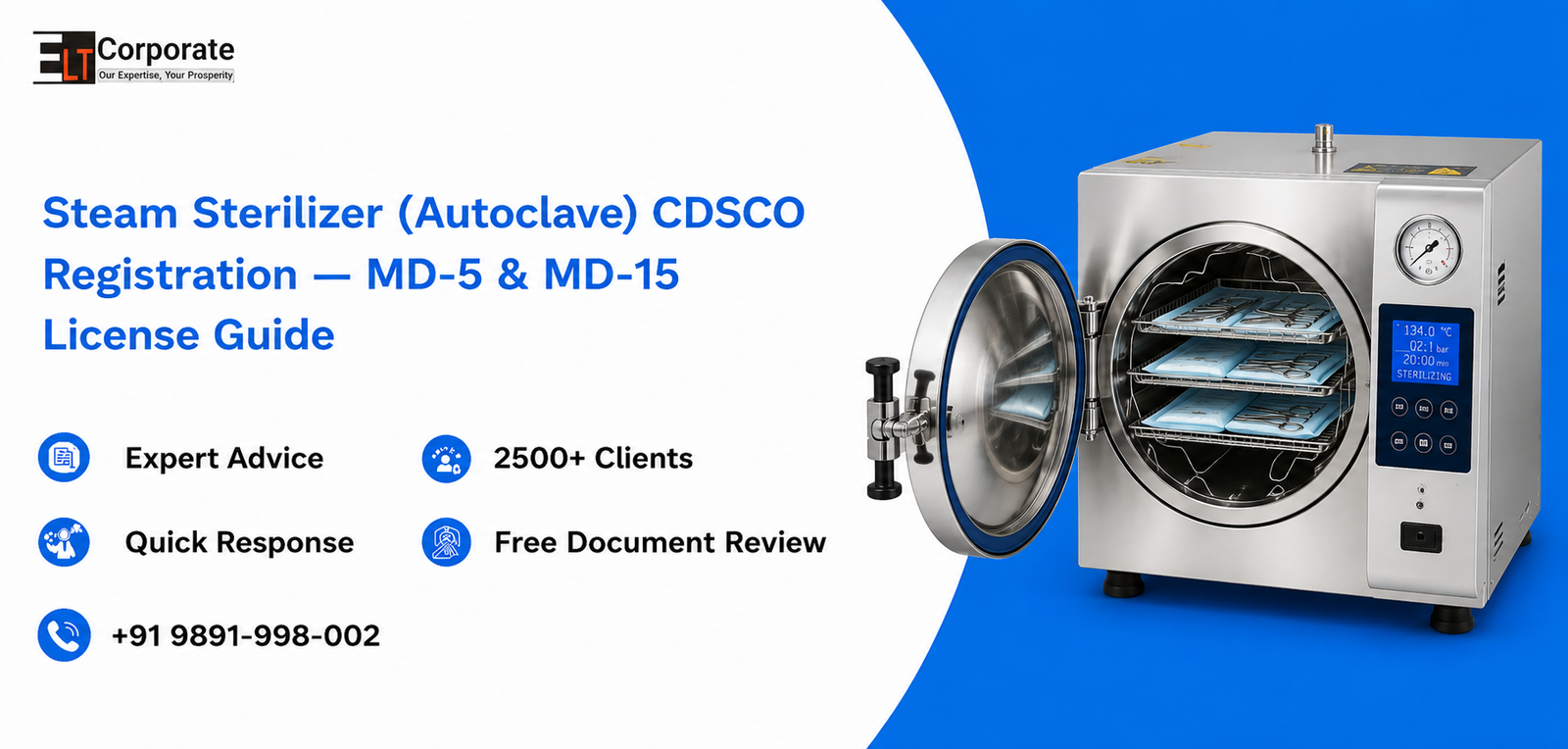
Steam sterilizers — commonly known as autoclaves — are among the most widely used and indispensable pieces of equipment in healthcare, dentistry, laboratories, and medical device manufacturing across India. From small tabletop autoclaves used in dental clinics and diagnostic labs to large industrial steam sterilizers used in hospital central sterile supply departments (CSSDs) and medical device manufacturing plants, steam sterilization remains the gold-standard method for ensuring sterility of reusable medical instruments and many manufactured products.
Whether you are a foreign manufacturer seeking to export autoclaves to India, an Indian importer of international steam sterilizer brands, or a domestic manufacturer of sterilization equipment, CDSCO registration is a mandatory legal requirement under the Medical Devices Rules, 2017 (MDR 2017). Selling, importing, distributing, or manufacturing a steam sterilizer without a valid CDSCO licence is a criminal offence under the Drugs and Cosmetics Act, 1940.
We provide complete CDSCO registration services for steam sterilizers and autoclaves — covering both the import licence pathway (Form MD-14 / MD-15) and the manufacturing licence pathway (Form MD-5 / MD-6) — with end-to-end expert support from device classification through licence issuance and post-market compliance.
What is CDSCO Registration for Steam Sterilizers?
CDSCO registration is the formal process through which the Central Drugs Standard Control Organisation (CDSCO), functioning under the Ministry of Health and Family Welfare, Government of India, evaluates a steam sterilizer and grants a Market Authorisation (Medical Device Licence) permitting its commercial manufacture or import for sale in India.
All applications are filed through the CDSCO SUGAM online portal:
- Form MD-14 — Application for Import Licence (for steam sterilizers manufactured outside India)
- Form MD-5 — Application for Manufacturing Licence (for steam sterilizers manufactured in India)
Upon successful evaluation and approval:
- Form MD-15 — Import Licence is issued
- Form MD-6 — Manufacturing Licence is issued
Both licence types are device-specific, manufacturer-specific, and valid for 5 years from the date of issue.
How Steam Sterilization Works — Quick Overview
Steam sterilization uses saturated steam under pressure to achieve sterilization through a combination of heat and moisture. The process relies on achieving and maintaining specific temperature, pressure, and exposure time combinations to kill microorganisms, including resistant bacterial spores. Common cycle parameters include:
- 121°C at 15 psi for 15–20 minutes (gravity displacement cycle)
- 134°C at 30 psi for 3–4 minutes (pre-vacuum / Class B cycle, for faster turnaround)
Unlike ETO (ethylene oxide) sterilization, steam sterilization does not involve toxic gas, making it simpler from an occupational safety standpoint — but it cannot be used for heat-sensitive devices, which require alternative methods like ETO or low-temperature plasma sterilization.
Steam Sterilizer / Autoclave Types Covered Under CDSCO Registration
The CDSCO registration requirement spans the full range of steam sterilization equipment used in India:
Tabletop / Benchtop Autoclaves (Class N)
Small-capacity autoclaves (typically 10 to 25 litres) using gravity displacement steam cycles, suitable for sterilizing solid, unwrapped instruments. Commonly used in dental clinics, small diagnostic labs, and veterinary practices. These are Class N (Naked load) autoclaves under EN 13060 classification — not suitable for sterilizing wrapped, porous, or hollow items.
Tabletop Vacuum Autoclaves (Class B and Class S)
Tabletop autoclaves with pre-vacuum and post-vacuum cycles, capable of sterilizing wrapped instruments, porous loads, and hollow items (such as dental handpieces). Class B autoclaves (per EN 13060) can sterilize all load types including wrapped and hollow instruments; Class S autoclaves are validated for specific load types as declared by the manufacturer.
Hospital CSSD Steam Sterilizers
Larger capacity autoclaves (typically 100 to 800 litres) installed in hospital Central Sterile Supply Departments — used to sterilize surgical instrument sets, linens, and other reusable hospital materials. These are vacuum-assisted, fully automated systems with comprehensive cycle monitoring and documentation capabilities.
Industrial / Bulk Steam Sterilizers
Large-scale steam sterilization systems (1,000 litres and above) used in medical device manufacturing facilities for terminal sterilization of packaged medical devices and pharmaceutical processing equipment.
Pass-Through Steam Sterilizers
Steam sterilizers with double-door (pass-through) configuration — allowing loading from a “dirty” / non-sterile side and unloading from a “clean” / sterile side, maintaining physical separation between the CSSD’s decontamination and sterile storage zones. Standard in modern hospital CSSDs.
Portable / Mobile Steam Sterilizers
Compact, often pressure-cooker-style steam sterilizers used in smaller healthcare facilities, rural health centres, and field/mobile healthcare units.
Steam Sterilizer Accessories
Sterilization indicators (chemical indicators, biological indicators), sterilization pouches and wraps, and sterilization containers used with steam sterilizers may have independent regulatory considerations depending on their classification.
Regulatory Classification of Steam Sterilizers Under MDR 2017
| Equipment Type | Risk Class | Licensing Authority | TPA Required |
| Tabletop Class N autoclave (small clinic / dental) | Class B | CDSCO (Central) | Generally not required |
| Tabletop Class B / Class S vacuum autoclave | Class B / C | CDSCO (Central) | Borderline — assessed case by case |
| Hospital CSSD steam sterilizer | Class C | CDSCO (Central) | Yes — TPA mandatory |
| Industrial / bulk steam sterilizer | Class C | CDSCO (Central) | Yes — TPA mandatory |
| Pass-through steam sterilizer | Class C | CDSCO (Central) | Yes — TPA mandatory |
| Portable / mobile steam sterilizer | Class B | CDSCO (Central) | Generally not required |
Classification note: Classification depends on the intended use, load types the sterilizer is validated for, and the clinical/industrial context. A small tabletop dental autoclave is typically Class B, while a hospital CSSD sterilizer handling complex surgical instrument loads for critical procedures is typically Class C. Our regulatory team conducts a formal, device-specific classification analysis for every application.
Who Needs CDSCO Steam Sterilizer Registration?
- Foreign OEMs exporting steam sterilizers to India — international brands such as Tuttnauer, Getinge, Steris, Matachana, Belimed, MMM Group, Melag, and others must appoint an Indian Authorised Agent (IAA) to file the import licence application
- Indian importers and distributors of international autoclave brands
- Domestic manufacturers of steam sterilizers and autoclaves manufactured in India
- Dental equipment companies distributing tabletop autoclaves to dental clinics
- Hospital equipment suppliers supplying CSSD sterilization systems
- Laboratory equipment companies distributing autoclaves for laboratory and research use
- Medical device manufacturers importing or operating industrial steam sterilization systems for their own production processes
- Hospitals and CSSDs procuring sterilization equipment — must purchase only CDSCO-registered devices
- MedTech startups developing innovative sterilization solutions for the Indian market
Complete Document Checklist for Steam Sterilizer CDSCO Registration
SECTION A — Indian Applicant / IAA Documents
1. Application in Form MD-14 (Import) or Form MD-5 (Manufacturing) Accurately completed application filed through the CDSCO SUGAM portal with correct applicant, manufacturer, and device details.
2. Business Registration Certificate Certificate of Incorporation, Partnership Deed, LLP Agreement, or equivalent proof of the Indian entity’s legal existence.
3. Import Export Code (IEC) Valid IEC from DGFT — mandatory prerequisite for import licence applications.
4. GST Registration Certificate Valid GSTIN of the applicant entity.
5. Authorisation Letter from Foreign Manufacturer Formally notarised and apostilled letter from the overseas manufacturer appointing the Indian entity as Indian Authorised Agent (IAA), explicitly listing all steam sterilizer models and capacities covered.
6. Indian Authorised Agent (IAA) Agreement Formal agreement defining the IAA’s regulatory roles and responsibilities under MDR 2017 in India — covering vigilance reporting, label compliance, and post-market obligations.
7. Affidavit / Undertaking by Indian Applicant Sworn affidavit by proprietor / directors declaring compliance with MDR 2017 and accuracy of all submitted information.
8. Power of Attorney (if filing through regulatory consultant) Duly executed POA authorising the consultant to file and manage the application.
SECTION B — Device Technical Documents
9. Device Description and Intended Use Comprehensive document covering:
- Full device name, model number(s), and variants in the application
- Chamber volume and load capacity
- Sterilization classification (Class N, Class B, or Class S per EN 13060, where applicable)
- Cycle types offered — gravity displacement, pre-vacuum, and any specialised cycles
- Intended use — dental clinic, hospital CSSD, laboratory, industrial manufacturing
- Intended users — dental assistants, CSSD technicians, biomedical engineers, lab personnel
- Load types the sterilizer is validated for — solid unwrapped instruments, wrapped instruments, porous loads, hollow instruments (e.g., dental handpieces, endoscopic instruments)
- Description of all system components — chamber, control system, steam generator, vacuum system, door locking mechanism, drying system
- Description of safety features — door interlocks, pressure relief valves, over-temperature protection
10. Technical Specifications Detailed performance specifications including:
- Chamber volume (litres) and dimensions
- Chamber material (stainless steel grade)
- Maximum operating temperature and pressure
- Sterilization cycle parameters — temperature, pressure, exposure time for each offered cycle
- Cycle time (total, including drying phase)
- Steam generation method — built-in steam generator or external steam supply connection
- Vacuum system specifications (for Class B / vacuum autoclaves)
- Control system specifications — display type, programmability, data recording and printing capability
- Door type and locking mechanism — safety interlock specifications
- Drying system specifications
- Water quality requirements (feed water specifications)
- Electrical specifications — voltage, frequency, power consumption
- Physical dimensions and weight
- Noise level
- Environmental operating conditions
11. Essential Principles Checklist (Schedule III — MDR 2017) Demonstration of how the steam sterilizer satisfies each applicable Essential Principle of Safety and Performance under Schedule III of MDR 2017 — with references to standards, test reports, and technical evidence for each principle.
12. Risk Management File (ISO 14971:2019) Complete risk management documentation covering:
- Risk management plan
- Hazard identification specific to steam sterilizers:
- Incomplete sterilization cycle (sterilization failure — patient/user safety risk)
- Door opening during pressurised cycle (severe burn/scald risk)
- Pressure vessel failure / explosion risk
- Scalding from steam release
- Electrical hazards
- Control system failure leading to incorrect cycle parameters
- Water quality issues affecting sterilizer function and instrument damage
- Door seal failure
- Risk estimation and evaluation for each hazard
- Risk control measures and verification of effectiveness — particularly door interlock systems and pressure safety devices
- Residual risk assessment
- Benefit-risk analysis
13. Software Documentation (IEC 62304) For steam sterilizers with PLC-based or microprocessor-based control systems:
- Software description and architecture (cycle control, monitoring, alarm management, data logging, printing)
- Software safety classification per IEC 62304
- Software verification and validation records
- Cybersecurity assessment (for networked sterilizers with data connectivity to hospital information systems)
14. Sterilization Process Validation Documentation A critical requirement specific to sterilization equipment — documentation demonstrating that the steam sterilizer is capable of delivering a validated sterilization process achieving the required Sterility Assurance Level (SAL):
- Installation Qualification (IQ) documentation
- Operational Qualification (OQ) documentation — demonstrating repeatable cycle performance (temperature distribution, pressure profile, steam penetration)
- Performance Qualification (PQ) documentation — demonstrating effective sterilization of representative load configurations
- Biological indicator data — using Geobacillus stearothermophilus spore biological indicators, demonstrating 10⁻⁶ SAL achievement
- Reference to ISO 17665-1 (Sterilization of health-care products — Moist heat) for industrial/bulk sterilizers, or EN 13060 for small steam sterilizers
15. Usability Engineering File (IEC 62366-1) Usability documentation covering:
- Intended user analysis — dental staff, CSSD technicians, lab personnel (varying levels of technical training)
- Use-related hazard identification — incorrect cycle selection, improper loading, premature door opening, failure to verify cycle completion
- Formative and summative usability evaluations
- Residual use-related risk assessment
SECTION C — Test Reports and Standards Compliance
All test reports must be issued by NABL-accredited or internationally accredited laboratories (ILAC MRA members).
16. IEC 61010-1 — Safety Requirements for Electrical Equipment for Measurement, Control, and Laboratory Use General safety standard applicable to the electrical and control systems of steam sterilizers.
17. IEC 61010-2-040 — Particular Requirements for Sterilizers and Washer-Disinfectors Specific safety requirements for sterilizers used in healthcare and laboratory settings — covering electrical safety, pressure safety, thermal safety, and mechanical safety specific to steam sterilization equipment. This is a key safety standard for steam sterilizer CDSCO registration.
18. EN 13060 — Small Steam Sterilizers The primary product-specific standard for tabletop / benchtop steam sterilizers — defining the classification system (Class N, Class B, Class S) and specifying performance requirements, test methods, and validation criteria for small steam sterilizers used in clinics, dental practices, and small laboratories. Compliance with EN 13060 — including the correct class declaration — is essential for tabletop autoclave registration.
19. EN 285 — Large Steam Sterilizers The primary product-specific standard for large steam sterilizers used in hospitals and healthcare facilities — specifying requirements for sterilizer performance, control systems, safety devices, cycle validation, and documentation for hospital CSSD and industrial-scale steam sterilizers.
20. ISO 17665-1 — Sterilization of Health-Care Products — Moist Heat Requirements for development, validation, and routine control of a moist heat (steam) sterilization process for medical devices. Critical for demonstrating that the sterilization process achieves the required sterility assurance for the intended load types — particularly relevant for industrial/bulk steam sterilizers used in manufacturing.
21. IEC 60601-1 — General Safety and Essential Performance (where applicable) For steam sterilizers that incorporate electrical patient-adjacent functions or are classified with reference to general medical electrical equipment safety requirements.
22. IEC 60601-1-2 — Electromagnetic Compatibility (where applicable) For steam sterilizers with digital control systems operating in healthcare facility environments.
23. IEC 62304 — Medical Device Software For steam sterilizers with embedded control software and data logging/printing systems.
24. IEC 62366-1 — Usability Engineering Evidence of usability validation.
25. Pressure Vessel / Boiler Certification Steam sterilizer chambers are pressure vessels and are typically subject to the Indian Boilers Act / Indian Boiler Regulations (IBR) — requiring certification from the relevant state boiler inspection authority, in addition to CDSCO registration. This applies particularly to larger CSSD and industrial steam sterilizers operating at elevated pressures.
SECTION D — Quality Management System Documents
26. ISO 13485:2016 Certificate Valid ISO 13485 QMS certificate from an accredited certification body — scope must cover sterilization equipment.
27. QMS Overview Summary of the manufacturer’s quality management system.
28. Post-Market Surveillance (PMS) Plan Documented plan for collecting and reviewing real-world performance data — particularly important given the patient safety consequences of sterilization failure.
29. Vigilance Procedures Procedures for detecting and reporting serious incidents — including sterilization cycle failures, door safety incidents, pressure vessel failures, and any device recalls related to sterilization performance.
30. Periodic Safety Update Report (PSUR) — if available For devices already marketed internationally.
SECTION E — Performance Evaluation Documents
31. Performance Evaluation Report A comprehensive document demonstrating:
- Sterilization efficacy — achievement of required SAL (10⁻⁶) for the validated load types
- Cycle repeatability and consistency across multiple validation runs
- Temperature distribution and steam penetration data within the chamber for various load configurations
- Comparison with EN 13060 / EN 285 performance requirements and any relevant clinical/field performance data
32. Biological and Chemical Indicator Compatibility Data Documentation confirming the sterilizer’s compatibility with standard biological indicators (BIs) and chemical indicators (CIs) used to verify sterilization cycle effectiveness.
SECTION F — Labelling and Instructions for Use
33. Device Label (Schedule V — MDR 2017) Compliant label including:
- Device name and model
- Manufacturer’s name and address
- Country of manufacture
- IAA’s name and address
- UDI
- Manufacturing date
- Serial number
- Applicable symbols
- Electrical specifications
- Pressure vessel rating and certification details
- Sterilizer classification (Class N / B / S per EN 13060, where applicable)
34. Instructions for Use (IFU) / Technical Manual Comprehensive documentation covering:
- Safety warnings — pressure vessel hazards, scalding risk, door interlock importance
- Installation requirements — water supply, drainage, electrical supply, ventilation
- Commissioning and qualification procedures (IQ/OQ/PQ guidance)
- Cycle operation guide — cycle selection for different load types, loading guidelines, door operation
- Biological and chemical indicator use guidance
- Alarm management — alarm descriptions, causes, corrective actions
- Routine maintenance schedule — descaling, door seal inspection, filter replacement
- Annual service, calibration, and pressure vessel inspection requirements
- Water quality maintenance guidance
- Troubleshooting guide
- Spare parts list
SECTION G — Documents from Foreign Manufacturer (Import Applications)
35. Free Sale Certificate (FSC) / Market Authorisation From the competent authority in the manufacturer’s home country:
- USA: FDA 510(k) clearance for steam sterilizers
- European Union: CE Certificate under EU MDR 2017/745 from an EU Notified Body
- Australia: TGA ARTG registration
- Canada: Health Canada Medical Device Licence
Must be apostilled / legalised by the Indian Embassy.
36. Manufacturing Licence of Foreign Facility Proof of manufacturing site authorisation.
37. GMP Compliance Certificate ISO 13485 certificate or equivalent.
38. Site Master File (SMF) Comprehensive manufacturing facility description.
39. Declaration of Conformity Formal manufacturer declaration of MDR 2017 conformity and Essential Principles compliance.
Step-by-Step CDSCO Registration Process for Steam Sterilizers
Step 1 — Free Regulatory Assessment and Classification
Our team reviews your steam sterilizer’s specifications, intended use, chamber volume, and validated load types to determine the correct MDR 2017 classification and confirm whether EN 13060 or EN 285 is the applicable product standard.
Step 2 — Documentation Gap Analysis
We systematically compare available documents against CDSCO requirements — identifying missing test reports, incomplete process validation documentation, or labelling gaps.
Step 3 — Sterilization Validation Documentation Review
We specifically review IQ/OQ/PQ documentation and biological indicator data to confirm the sterilizer’s validated sterilization performance meets ISO 17665-1 / EN 13060 / EN 285 requirements.
Step 4 — Pressure Vessel Compliance Check
We assess whether your steam sterilizer chamber requires Indian Boiler Regulations (IBR) compliance in addition to CDSCO registration, and guide you through the applicable state boiler inspection authority process if required.
Step 5 — Foreign Manufacturer Document Coordination
We coordinate with the overseas manufacturer to obtain FSC, SMF, ISO 13485 certificate, Declaration of Conformity, and apostille/legalisation of foreign documents.
Step 6 — Technical Dossier Preparation
We prepare or review the complete dossier — Essential Principles Checklist, Risk Management File, software documentation, usability file, and labelling review.
Step 7 — SUGAM Portal Application Filing
We manage the complete SUGAM portal submission — Form MD-14 / MD-5, document upload, and government fee payment.
Step 8 — TPA Coordination (Class C devices)
For Class C steam sterilizers (hospital CSSD and industrial systems), we prepare the dossier for Third Party Audit review and manage the audit process.
Step 9 — CDSCO Query Response
Our regulatory experts prepare technically precise, well-documented written responses to all CDSCO queries.
Step 10 — Licence Issuance and Post-Licence Onboarding
Upon approval, we deliver the MD-15 or MD-6 licence with a complete post-licence compliance briefing.
Government Fee for Steam Sterilizer CDSCO Registration
| Application Type | Government Fee |
| Import Licence — Class B steam sterilizer (Form MD-14) | ₹5,000 per device |
| Import Licence — Class C steam sterilizer (Form MD-14) | ₹50,000 per device |
| Manufacturing Licence — Class B steam sterilizer (Form MD-5) | ₹5,000 |
| Manufacturing Licence — Class C steam sterilizer (Form MD-5) | ₹50,000 |
| Renewal of Import / Manufacturing Licence | 50% of original fee |
| Amendment to existing licence | ₹2,500 – ₹10,000 |
Government fees are paid online through the SUGAM portal and are subject to revision by the Government of India.
Estimated Timeline for Steam Sterilizer CDSCO Registration
| Device Type | Estimated Timeline |
| Tabletop Class N autoclave (Class B device) | 3 – 5 months |
| Tabletop Class B / Class S vacuum autoclave | 4 – 8 months |
| Hospital CSSD steam sterilizer (Class C) | 6 – 12 months |
| Industrial / bulk steam sterilizer (Class C) | 8 – 14 months |
| Pass-through steam sterilizer (Class C) | 8 – 14 months |
Timelines depend on documentation completeness, CDSCO workload, TPA scheduling (for Class C), and query resolution speed.
Post-Registration Compliance Obligations
Label Compliance Every steam sterilizer unit sold in India must bear an MDR 2017 Schedule V compliant label with IAA details, UDI, pressure vessel certification information, and all mandatory elements.
Vigilance Reporting Serious incidents — sterilization cycle failures, door safety incidents, pressure vessel failures, scalding injuries — must be reported to CDSCO within prescribed timeframes.
Software Update Notifications Control system software updates affecting cycle parameters or safety interlocks must be notified to CDSCO before deployment.
PSURs Class C steam sterilizers require periodic Periodic Safety Update Reports.
Pressure Vessel Inspection Ongoing compliance with Indian Boiler Regulations (IBR) inspection schedules — typically annual inspection by the state boiler inspection authority — for steam sterilizers classified as pressure vessels.
Renewal MD-15 / MD-6 licences are valid for 5 years and must be renewed before expiry.
Common Reasons for Application Delay or Rejection
Incorrect EN 13060 classification declaration Declaring a Class N (naked load only) autoclave as suitable for wrapped or hollow instrument sterilization without the test data to support Class B or Class S claims.
Missing process validation data (IQ/OQ/PQ) Absence of structured installation, operational, and performance qualification documentation demonstrating validated sterilization performance.
No biological indicator data Lack of biological indicator (spore test) results demonstrating achievement of the required sterility assurance level.
Pressure vessel certification gaps Failure to address Indian Boiler Regulations (IBR) compliance for sterilizer chambers that qualify as pressure vessels under Indian law.
Generic risk management file Risk management documentation that does not specifically address steam sterilizer-specific hazards — door interlock failure, scalding, pressure vessel risks.
FSC not covering the specific model/capacity Free Sale Certificate that covers a general product line without specifically listing the model numbers and chamber capacities included in the Indian application.
Why Choose Our CDSCO Registration Services for Steam Sterilizers?
Sterilization Equipment Specialisation We have specific experience registering steam sterilizers across the full range — tabletop dental autoclaves, hospital CSSD systems, and industrial bulk sterilizers — understanding the unique classification and documentation nuances of each category.
EN 13060, EN 285, and ISO 17665-1 Expertise The primary standards for steam sterilizers — EN 13060 for small sterilizers and EN 285 for large sterilizers, alongside ISO 17665-1 for process validation — require specialised technical knowledge that our team brings to every application.
Sterilization Process Validation Support We understand IQ/OQ/PQ documentation requirements and biological indicator data expectations — helping you assemble a complete, CDSCO-ready validation package.
Pressure Vessel and IBR Compliance Guidance We advise on Indian Boiler Regulations compliance requirements alongside CDSCO registration — ensuring your steam sterilizer meets all applicable Indian regulatory frameworks, not just MDR 2017.
TPA Process Management For Class C steam sterilizers, we have experience preparing technically robust dossiers that withstand Third Party Audit scrutiny and managing the audit process efficiently.
End-to-End Accountability From free initial assessment through licence issuance and ongoing post-market compliance — we provide complete, accountable service throughout the registration lifecycle.
Frequently Asked Questions
Q1. Is CDSCO registration required for all steam sterilizers / autoclaves sold in India — even small tabletop dental autoclaves?
Yes. Steam sterilizers of all sizes and types — from small tabletop dental autoclaves to large industrial systems — are notified medical devices under Schedule I of the Medical Devices Rules, 2017. All require CDSCO import licence (MD-15) or manufacturing licence (MD-6) before commercial sale.
Q2. What is the difference between EN 13060 and EN 285, and which one applies to my steam sterilizer?
EN 13060 applies to small steam sterilizers — typically tabletop or benchtop units used in dental clinics, small labs, and similar settings. EN 285 applies to large steam sterilizers — typically hospital CSSD and industrial-scale systems. The applicable standard is determined by the sterilizer’s size, capacity, and intended use context, not simply its chamber volume in isolation. Our team determines the correct applicable standard for each device.
Q3. What is the Class N / Class B / Class S classification under EN 13060?
This classification (specific to small steam sterilizers under EN 13060) indicates the load types the sterilizer is validated to sterilize: Class N — solid, unwrapped instruments only; Class B — all load types including wrapped, porous, and hollow (lumened) instruments; Class S — specific load types as declared and validated by the manufacturer (a defined subset between N and B). The classification must be accurately declared and supported by validation test data in the CDSCO dossier.
Q4. Is Indian Boiler Registration required in addition to CDSCO registration for steam sterilizers?
Steam sterilizer pressure vessels may be subject to the Indian Boilers Act / Indian Boiler Regulations (IBR) depending on their operating pressure and volume — this is particularly relevant for larger CSSD and industrial steam sterilizers. Compliance with IBR — including registration and periodic inspection by the relevant state boiler inspection authority — may be required in addition to, and independent of, CDSCO registration. Our team assesses applicability for your specific equipment.
Q5. My steam sterilizer is CE-marked under EU MDR. Do I still need separate CDSCO registration?
Yes. The CE certificate is submitted as the Free Sale Certificate (FSC) supporting your CDSCO import licence application — but it does not substitute for a separate Indian CDSCO registration. All medical devices, including steam sterilizers, require their own CDSCO import licence for the Indian market.
Q6. How is sterilization efficacy demonstrated for CDSCO registration?
Sterilization efficacy is demonstrated through process validation documentation — Installation Qualification (IQ), Operational Qualification (OQ), and Performance Qualification (PQ) — including biological indicator (spore test) data showing achievement of the required Sterility Assurance Level (typically 10⁻⁶), in accordance with ISO 17665-1, EN 13060, or EN 285 as applicable to the device type.
Q7. Can a small steam sterilizer manufacturer in India apply for a manufacturing licence without TPA?
Class B steam sterilizers (such as basic tabletop Class N autoclaves) generally do not require Third Party Audit. However, if your tabletop autoclave is classified as Class C (which can occur depending on intended use and validated load types), TPA becomes mandatory. Our team conducts the classification analysis to confirm the applicable pathway before application.
Q8. What happens if we sell an unregistered steam sterilizer in India?
Importing, distributing, or selling an unregistered medical device is a criminal offence under the Drugs and Cosmetics Act, 1940. Consequences include product seizure and destruction, cancellation of IEC and business licences, financial penalties, imprisonment of up to 3 years, and reputational damage. Hospitals, dental clinics, and laboratories procuring unregistered sterilizers also face regulatory exposure.
Comments are closed