
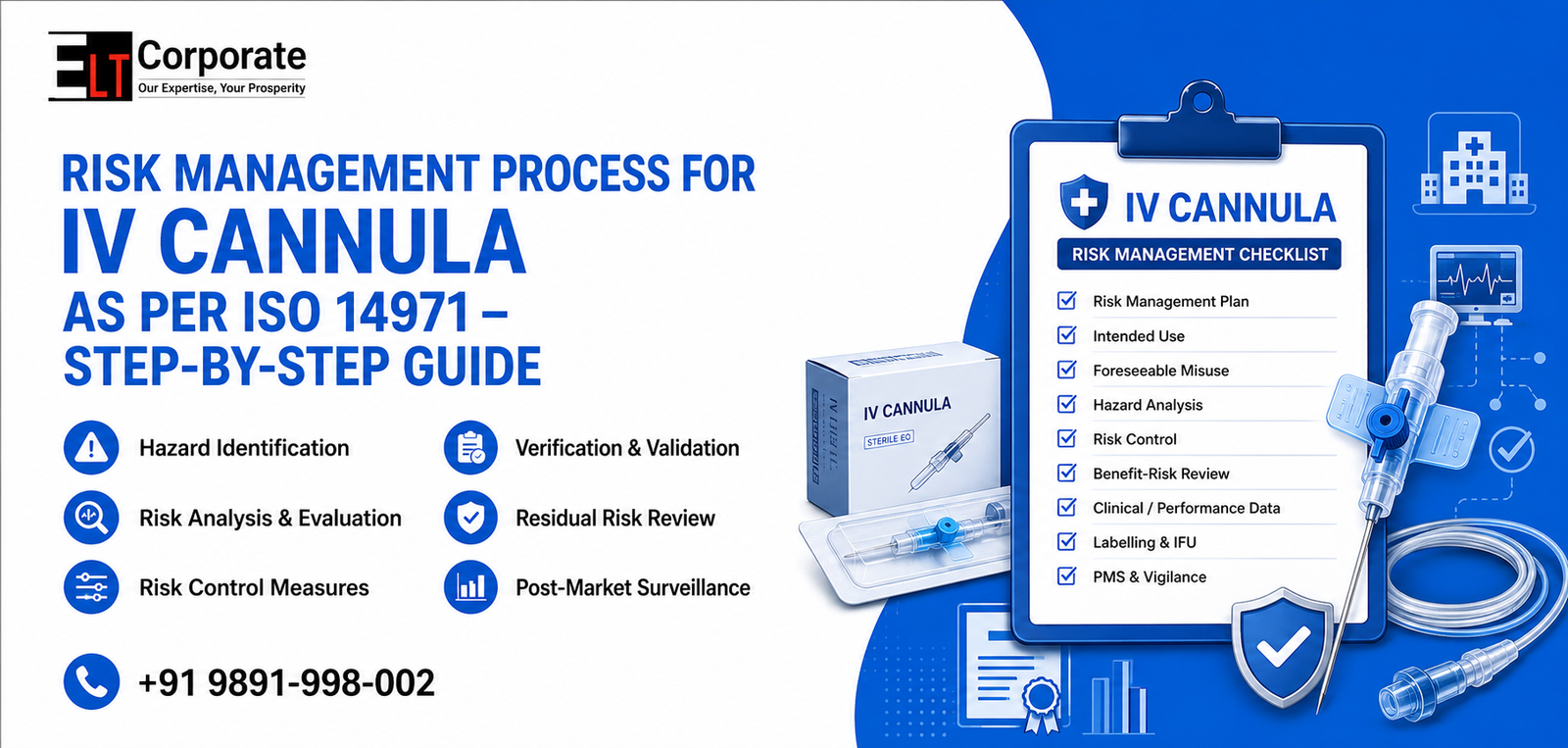
An Intravenous Cannula, commonly known as an IV Cannula, is a sterile, single-use medical device used to obtain temporary access to a patient’s peripheral vascular system. It allows healthcare professionals to administer medicines, fluids, blood products and other intravenous therapies.
Although an IV Cannula appears to be a simple device, its failure may result in infection, blood leakage, infiltration, extravasation, phlebitis, needle-stick injury, interrupted therapy or catheter breakage.
ISO 10555-5 specifically applies to sterile, single-use over-needle peripheral intravascular catheters, while ISO 10555-1 establishes general requirements for sterile, single-use intravascular catheters.
ISO 14971:2019 provides the internationally recognised process for identifying hazards, estimating and evaluating risks, implementing controls and monitoring their effectiveness throughout the medical device life cycle. ISO/TR 24971:2020 provides additional practical guidance for implementing this process.
What Is Risk Management for an IV Cannula?
Risk management is a continuous process used to identify potential sources of harm associated with a medical device and reduce those risks to an acceptable level.
For an IV Cannula, risk management must cover the complete device, including:
- Introducer needle
- Catheter tube
- Catheter hub
- Flashback chamber
- Injection port, where applicable
- Wings and protective cap
- Needle-safety mechanism
- Lubricants and colourants
- Sterile packaging
- Sterilisation process
The process begins during product design and continues through material selection, manufacturing, sterilisation, packaging, transportation, clinical use and post-market surveillance.
ISO 14971 does not provide a universal risk matrix or a fixed acceptable-risk level. The manufacturer must establish objective risk-acceptability criteria appropriate to the device, intended use and applicable regulatory requirements.
Step 1: Prepare the Risk Management Plan
The manufacturer should prepare a product-specific Risk Management Plan before beginning the formal risk analysis.
The plan should define:
- Scope of the IV Cannula and covered variants
- Responsibilities of the risk-management team
- Competence requirements
- Risk-analysis methodology
- Risk-acceptability criteria
- Risk-control verification requirements
- Review and approval responsibilities
- Production and post-production monitoring methods
Different gauge sizes, catheter lengths, ported models, non-ported models and safety variants may be included in one plan only when their differences and associated risks are properly evaluated.
Step 2: Define Intended Use and Foreseeable Misuse
The manufacturer must clearly define how, where and by whom the IV Cannula will be used.
The intended-use description should cover:
- Intended medical purpose
- Target patient population
- Intended users
- Clinical environment
- Insertion site
- Expected duration of use
- Permitted flow rate and pressure
- Compatible infusion systems
- Intended medicines or fluids
Reasonably foreseeable misuse should also be assessed. Examples include reuse of a single-use cannula, reinsertion of a partially withdrawn needle, excessive bending, use beyond the recommended duration, connection with incompatible equipment or failure to maintain aseptic technique.
Step 3: Identify Safety-Related Characteristics
The manufacturer should identify every device characteristic that may affect patient or user safety.
Important characteristics include:
- Catheter material
- Needle sharpness and bevel geometry
- Catheter-tip design
- Catheter-to-hub bond strength
- Flow rate
- Leakage resistance
- Pressure resistance
- Flashback visibility
- Kink resistance
- Connection compatibility
- Sterility
- Sterilisation residuals
- Packaging integrity
- Shelf life
- Needle-safety feature performance
Biological safety should be evaluated as part of the overall risk-management process. ISO 10993-1:2025 requires biological safety to be assessed by considering materials, body contact, exposure duration and available scientific evidence.
Step 4: Identify Hazards and Hazardous Situations
A hazard is a potential source of harm. However, harm normally occurs through a sequence of events that exposes a patient or user to a hazardous situation.
For example:
Hazard: Microbial contamination
Sequence of events: Sterile packaging becomes damaged during transportation and the damage is not detected.
Hazardous situation: A contaminated cannula is inserted into the patient.
Possible harm: Local infection, bloodstream infection or sepsis.
Major IV Cannula hazard categories include:
- Biological hazards
- Mechanical hazards
- Chemical hazards
- Sterility-related hazards
- Packaging hazards
- Functional failure
- Use-related hazards
- Labelling and information hazards
Step 5: Estimate the Initial Risk
For every identified hazardous situation, the manufacturer should estimate:
- The severity of possible harm; and
- The probability of occurrence of that harm.
Available information may include:
- Product verification data
- Manufacturing-process data
- Complaint history
- Published clinical information
- Experience with similar devices
- Supplier information
- Expert judgement
Where probability cannot be accurately calculated, a justified qualitative method may be used. Any uncertainty in the available information should also be documented.
Step 6: Evaluate the Risk
The estimated risk must be compared with the risk-acceptability criteria defined in the Risk Management Plan.
A typical risk matrix may classify risks as:
- Acceptable
- Conditionally acceptable
- Unacceptable
Unacceptable risks require further risk-control measures. Conditionally acceptable risks may require additional reduction, justification or benefit-risk analysis.
The manufacturer should not modify its acceptance criteria simply to make an existing risk appear acceptable.
Step 7: Implement Risk-Control Measures
ISO 14971 requires risk controls to be considered in the following priority:
- Inherent safety through design
- Protective measures in the device or manufacturing process
- Information for safety
For an IV Cannula, risk controls may include:
Inherent Safety by Design
- Smooth and atraumatic catheter tip
- Sufficient catheter tensile strength
- Secure catheter-to-hub bonding
- Leak-resistant connections
- Kink-resistant catheter material
- Passive needle-safety mechanism
Manufacturing and Protective Controls
- Validated moulding process
- Validated bonding process
- Automated visual inspection
- Sterilisation validation
- Packaging seal inspection
- Batch-release testing
- Supplier and material controls
Information for Safety
- Single-use warning
- Aseptic insertion instructions
- Pressure and flow limitations
- Safe disposal instructions
- Replacement recommendations
- Contraindications and precautions
Warnings should not be used as a substitute for a reasonable and practicable design improvement.
Step 8: Verify the Risk Controls
Every risk-control measure must be supported by objective verification evidence.
Depending on the IV Cannula design, verification may include:
- Dimensional testing
- Flow-rate testing
- Leakage testing
- Pressure testing
- Tensile and bond-strength testing
- Penetration-force testing
- Kink-resistance testing
- Safety-mechanism activation testing
- Sterility validation
- Packaging validation
- Shelf-life testing
ISO 11607-1 specifies requirements for sterile-barrier and packaging systems intended to maintain the sterility of terminally sterilised medical devices until the point of use.
The manufacturer must also confirm that a risk-control measure has not introduced a new hazard. For example, a needle-safety shield should not interfere with insertion or increase the possibility of catheter displacement.
Step 9: Evaluate Residual Risk
After implementing the controls, the remaining or residual risk must be re-estimated.
When an individual residual risk remains unacceptable and no additional practicable control is available, the manufacturer should conduct a benefit-risk analysis.
The analysis should consider:
- Intended medical benefit
- Seriousness of the patient’s condition
- Available alternative devices or treatments
- Current clinical practice
- State of the art
- Nature and severity of residual harm
A benefit-risk statement should not be used to avoid implementing additional feasible controls.
Residual risks that users need to understand must be communicated through the label, Instructions for Use or training material.
Step 10: Evaluate Overall Residual Risk
Even when individual risks are acceptable, the manufacturer must evaluate whether the overall residual risk of the complete IV Cannula remains acceptable when compared with its medical benefit.
This evaluation should consider:
- Interaction between different risks
- Cumulative risk
- Uncertainty in available information
- Combined effect of device failures
- Risk differences between product variants
Step 11: Complete the Risk Management Review
Before commercial release, authorised personnel should review the entire risk-management process.
The review should confirm that:
- The Risk Management Plan has been implemented
- All identified risks have been evaluated
- Risk controls have been verified
- Overall residual risk is acceptable
- Post-production monitoring arrangements are available
The results should be recorded in a Risk Management Report.
Step 12: Monitor Production and Post-Production Information
Risk management does not end after product approval or market launch. ISO 14971 applies throughout the complete device life cycle and requires production and post-production information to be reviewed.
The manufacturer should monitor:
- Customer complaints
- Adverse events
- Needle-stick incidents
- Catheter breakage reports
- Hub leakage
- Packaging failures
- Sterilisation trends
- Returned products
- Nonconformities
- Supplier changes
- Recalls and field safety actions
- Scientific literature
New information should be evaluated to determine whether the risk analysis, controls, labelling or benefit-risk conclusion requires revision.
Example Risk Analysis for IV Cannula
| Hazardous Situation | Possible Harm | Typical Risk Controls |
| Loss of sterility before use | Infection or sepsis | Validated sterilisation, packaging validation and seal inspection |
| Catheter separates from hub | Retained fragment or embolisation | Bond design, validated bonding and tensile testing |
| Needle damages catheter | Catheter splitting or retained fragment | Tip design, dimensional control and insertion simulation |
| Loose or leaking connection | Blood loss, contamination or under-infusion | Leak testing, pressure testing and connection verification |
| Catheter kinking or blockage | Interrupted therapy | Material optimisation, kink-resistance and flow testing |
| Needle-stick after use | User injury and blood-borne infection | Passive safety feature and activation testing |
| Biological reaction | Irritation, sensitisation or toxicity | Material characterisation and biological evaluation |
| Reuse of cannula | Infection or device failure | Single-use labelling and clear disposal instructions |
This table is illustrative. Severity, probability and acceptability ratings must be established under the manufacturer’s approved risk-management procedure.
Documents Included in the Risk Management File
A complete IV Cannula Risk Management File generally includes:
- Risk Management Procedure
- Risk Management Plan
- Intended-use statement
- Safety-characteristics checklist
- Hazard analysis
- FMEA or equivalent analysis
- Risk-control records
- Verification-test references
- Residual-risk evaluations
- Benefit-risk analyses
- Overall residual-risk evaluation
- Risk Management Report
- Production and post-production review records
Common Risk Management Mistakes
Common deficiencies include:
- Copying hazards from another medical device
- Using an unexplained numerical risk matrix
- Confusing device failure with patient harm
- Using warnings as the only risk control
- Failing to verify risk-control effectiveness
- Ignoring packaging and sterilisation risks
- Excluding foreseeable misuse
- Failing to assess new risks created by controls
- Not updating the file after complaints or design changes
Conclusion
An effective IV Cannula Risk Management File demonstrates that the manufacturer understands the device, its intended clinical use and the failures that may affect patients or healthcare professionals.
The process should identify credible hazards, establish suitable controls, verify their effectiveness and continuously monitor real-world device performance. It should remain a living and traceable record rather than a one-time regulatory document prepared only for product registration.
Frequently Asked Questions
Q1. Is FMEA mandatory under ISO 14971?
No. FMEA is commonly used, but ISO 14971 does not require one specific risk-analysis technique. Manufacturers may use FMEA, Preliminary Hazard Analysis, Fault Tree Analysis or another justified method.
Q2. Does ISO 14971 provide a standard 5×5 risk matrix?
No. The manufacturer must establish and document its own objective risk-acceptability criteria appropriate to the medical device.
Q3. Which product standard applies to a peripheral IV Cannula?
ISO 10555-5 applies specifically to sterile, single-use over-needle peripheral intravascular catheters, along with the general requirements specified in ISO 10555-1.
Q4. When should the Risk Management File be updated?
It should be reviewed when there is a change in design, material, supplier, manufacturing process, sterilisation, packaging, labelling or intended use. It should also be updated when complaints, adverse events or other post-market information indicate a new or changed risk.
Comments are closed