
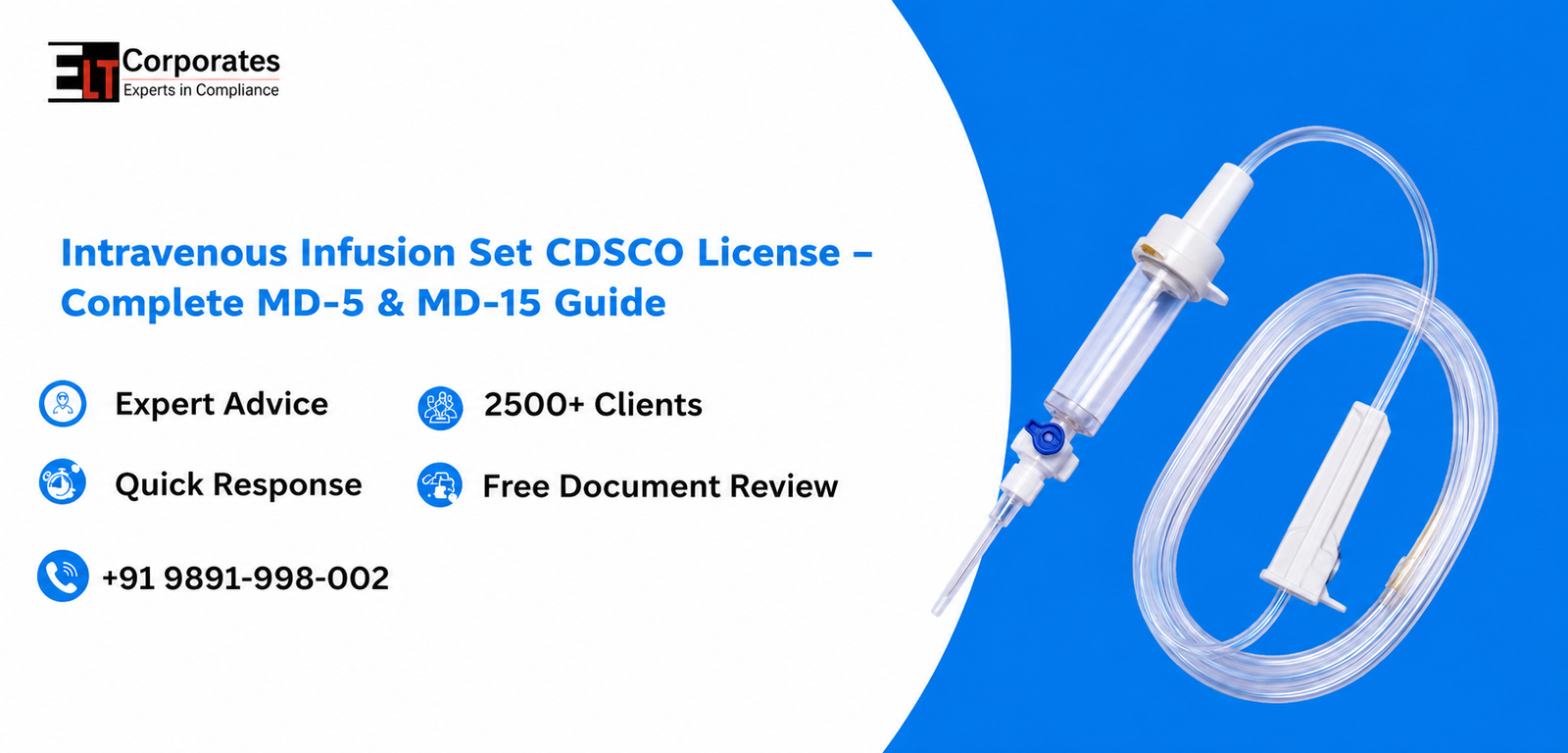
Intravenous (IV) infusion sets are among the highest-volume, most fundamental consumable medical devices used in healthcare delivery — administering fluids, medications, blood products, and nutritional solutions to patients across virtually every clinical setting in India, from rural primary health centres and ambulances to the most advanced tertiary care ICUs. As single-use, sterile, patient-contacting, blood-contacting devices used in extraordinarily high volumes, IV infusion sets are subject to particularly rigorous CDSCO scrutiny under the Medical Devices Rules, 2017 (MDR 2017).
Whether you are a foreign manufacturer seeking to export IV infusion sets to India, an Indian importer of international infusion set brands, or a domestic manufacturer of disposable medical devices, CDSCO registration is a mandatory legal requirement. Importing, manufacturing, distributing, or selling an IV infusion set without a valid CDSCO licence is a criminal offence under the Drugs and Cosmetics Act, 1940.
We provide complete CDSCO registration services for IV infusion sets — covering both the import licence pathway (Form MD-14 / MD-15) and the manufacturing licence pathway (Form MD-5 / MD-6) — with end-to-end expert support from device classification through licence issuance and ongoing post-market compliance.
What is CDSCO Registration for IV Infusion Sets?
CDSCO registration is the formal process through which the Central Drugs Standard Control Organisation (CDSCO), functioning under the Ministry of Health and Family Welfare, Government of India, evaluates an IV infusion set and grants a Market Authorisation (Medical Device Licence) permitting its commercial manufacture or import for sale in India.
All applications are filed through the CDSCO SUGAM online portal:
- Form MD-14 — Application for Import Licence (for IV infusion sets manufactured outside India)
- Form MD-5 — Application for Manufacturing Licence (for IV infusion sets manufactured in India)
Upon successful evaluation and approval:
- Form MD-15 — Import Licence is issued
- Form MD-6 — Manufacturing Licence is issued
Both licence types are device-specific, manufacturer-specific, and valid for 5 years from the date of issue.
What is an IV Infusion Set — Device Scope
An intravenous infusion set (also called an IV set, infusion administration set, or drip set) is a single-use, sterile medical device used to deliver fluids, medications, or blood products from a container (IV bag or bottle) into a patient’s vein via a venous access device (cannula or catheter). The set typically comprises tubing, a drip chamber, a flow regulator, injection ports, and a connector.
IV Infusion Set Types Covered Under CDSCO Registration
Gravity IV Administration Sets The standard, most widely used infusion set — relying on gravity to drive fluid flow, with a roller clamp or similar mechanical flow regulator for manual rate control. Used extensively across hospitals, clinics, and primary care settings for routine fluid and medication administration.
Burette / Paediatric Infusion Sets Infusion sets incorporating a graduated burette chamber for precise, small-volume fluid measurement and delivery — particularly important for paediatric and neonatal patients where precise fluid control is critical to avoid fluid overload.
Blood Transfusion Sets Specialised infusion sets with an integrated filter (typically 170–200 micron mesh) designed specifically for the safe administration of whole blood and blood components — a distinct device category from general IV fluid administration sets, with specific filtration and biocompatibility requirements given direct blood contact.
Infusion Pump-Compatible Administration Sets Sets specifically designed and validated for use with electronic infusion pumps and syringe pumps — engineered to precise tubing tolerances and flow characteristics compatible with pump mechanisms, often proprietary to specific pump manufacturers.
Burette Sets with Air-Vent / Air-Eliminating Filters Sets incorporating specialised filters to eliminate air bubbles from the fluid path — an important safety feature reducing air embolism risk.
Y-Type / Multi-Port Infusion Sets Sets with multiple injection ports or Y-connectors allowing simultaneous or sequential administration of multiple fluids/medications through a single venous access point.
Light-Resistant / Photosensitive Drug Administration Sets Specialised sets with amber or UV-protective tubing for administering light-sensitive medications that degrade upon light exposure.
Extension Sets and Add-On Devices Shorter tubing sets used to extend the length of a primary infusion line, often incorporating additional injection ports — typically used in conjunction with a primary administration set.
Pressure Infusion / Rapid Infusion Sets Sets designed for rapid, high-pressure fluid administration — used in trauma, emergency, and surgical settings requiring rapid volume resuscitation.
Regulatory Classification of IV Infusion Sets Under MDR 2017
| Device Type | Risk Class | Licensing Authority | TPA Required |
| Standard gravity IV administration set | Class B | CDSCO (Central) | Generally not required |
| Burette / paediatric infusion set | Class B | CDSCO (Central) | Generally not required |
| Blood transfusion set | Class B / C | CDSCO (Central) | Depends on specific design |
| Infusion pump-compatible administration set | Class B | CDSCO (Central) | Generally not required |
| Extension sets and add-on devices | Class B | CDSCO (Central) | Generally not required |
| Pressure / rapid infusion sets | Class B | CDSCO (Central) | Generally not required |
Classification note: Standard IV infusion sets are generally classified as Class B medical devices under MDR 2017 — reflecting the established, well-understood nature of this device category, despite its sterile, invasive, patient-contacting characteristics. However, classification must always be confirmed through formal analysis, as some specialised infusion set designs (particularly those incorporating advanced safety mechanisms, integrated electronics, or used in critical blood/blood product administration) may attract different consideration. Our regulatory team conducts a formal, device-specific classification analysis for every application.
Why IV Infusion Sets Receive Particularly Rigorous Scrutiny
Given the nature of this device category, CDSCO and international regulators apply particularly close attention to several dimensions that are less critical for non-invasive or non-patient-contacting devices:
Direct Blood/Bloodstream Contact IV infusion sets deliver fluids directly into the patient’s bloodstream — making biocompatibility, sterility assurance, and material safety paramount concerns, with zero tolerance for contamination or toxic leachables.
Sterility Assurance As sterile, single-use devices, the manufacturing process, sterilisation validation, and packaging integrity directly determine patient safety — any breach in sterility assurance creates immediate, serious infection risk.
High Volume, Low Unit Cost The combination of extremely high production/import volumes and low per-unit cost creates particular regulatory interest in ensuring consistent quality across mass production — a single batch quality failure can affect an enormous number of patients.
DEHP and Plasticiser Concerns Many IV infusion sets use PVC tubing, which may contain plasticisers such as DEHP (di-2-ethylhexyl phthalate) — a substance subject to specific safety scrutiny, particularly for use in neonatal, paediatric, and high-volume/long-duration infusion applications, given potential leaching into the administered fluid.
Who Needs CDSCO IV Infusion Set Registration?
- Foreign OEMs exporting IV infusion sets to India — international brands such as B. Braun, BD (Becton Dickinson), ICU Medical, Smiths Medical, Fresenius Kabi, Vygon, and others must appoint an Indian Authorised Agent (IAA) to file the import licence application
- Indian importers and distributors of international IV infusion set brands
- Domestic manufacturers of IV infusion sets — a significant and well-established segment given India’s large domestic disposables manufacturing base
- Hospital supply distributors supplying disposable medical consumables to hospitals, nursing homes, and primary health centres
- Blood bank equipment suppliers distributing blood transfusion sets
- Government procurement and tender suppliers — supplying IV infusion sets through GeM, state health department tenders, and institutional procurement
- Hospitals and healthcare facilities procuring IV sets directly in bulk — must purchase only CDSCO-registered devices
- Contract manufacturers and OEM suppliers producing infusion sets for private-label distribution
Complete Document Checklist for IV Infusion Set CDSCO Registration
SECTION A — Indian Applicant / IAA Documents
1. Application in Form MD-14 (Import) or Form MD-5 (Manufacturing) Accurately completed application filed through the CDSCO SUGAM portal with correct applicant, manufacturer, and device details.
2. Business Registration Certificate Certificate of Incorporation, Partnership Deed, LLP Agreement, or equivalent proof of the Indian entity’s legal existence.
3. Import Export Code (IEC) Valid IEC from DGFT — mandatory prerequisite for import licence applications.
4. GST Registration Certificate Valid GSTIN of the applicant entity.
5. Authorisation Letter from Foreign Manufacturer Formally notarised and apostilled letter from the overseas manufacturer appointing the Indian entity as Indian Authorised Agent (IAA), explicitly listing all IV infusion set model/catalogue numbers covered.
6. Indian Authorised Agent (IAA) Agreement Formal agreement defining the IAA’s regulatory responsibilities under MDR 2017 in India.
7. Affidavit / Undertaking by Indian Applicant Sworn affidavit by proprietor / directors declaring compliance with MDR 2017 and accuracy of all submitted information.
8. Power of Attorney (if filing through regulatory consultant) Duly executed POA authorising the consultant to file and manage the application.
SECTION B — Device Technical Documents
9. Device Description and Intended Use Comprehensive document covering:
- Full device name, catalogue/model number(s), and all configurations/variants in the application (with/without burette, with/without filter, drip rate variants — e.g., 15 drops/mL, 20 drops/mL, 60 drops/mL micro-drip)
- Intended use — administration of IV fluids, medications, blood/blood products, or specific application (general use, paediatric, blood transfusion, pump-compatible)
- Intended clinical environment — hospital ward, ICU, OT, emergency department, ambulance, home care
- Intended users — nurses, physicians, trained healthcare staff
- Intended patient population — adult, paediatric, neonatal
- Description of all components — spike/piercing pin, drip chamber, tubing, roller clamp/flow regulator, injection port(s), filter (where present), connector (Luer lock/slip), protective caps
- Materials of construction for each component (PVC, polyethylene, polypropylene, latex-free elastomer specifications)
- Sterilisation method (ethylene oxide, gamma irradiation, or other)
- Shelf life and expiry basis
10. Technical Specifications Detailed performance specifications including:
- Tubing internal and external diameter
- Tubing length
- Drip chamber drop factor (drops per mL — standard 15/20 drops/mL or micro-drip 60 drops/mL)
- Flow rate range achievable
- Filter specifications (pore size, material) for blood transfusion sets or air-eliminating filters
- Connector type (Luer lock, Luer slip) and compatibility specifications
- Injection port specifications (self-sealing, needle-free where applicable)
- Burette chamber capacity and graduation accuracy (for burette sets)
- Spike/piercing pin design and compatibility with standard IV container ports
- Compatibility with standard infusion pumps (where claimed as pump-compatible)
- DEHP/plasticiser content disclosure (particularly relevant for PVC-based tubing)
- Latex content disclosure (latex-free claims must be substantiated)
11. Essential Principles Checklist (Schedule III — MDR 2017) Demonstration of how the IV infusion set satisfies each applicable Essential Principle of Safety and Performance under Schedule III of MDR 2017 — with references to standards, test reports, and technical evidence for each principle.
12. Risk Management File (ISO 14971:2019) Complete risk management documentation covering:
- Risk management plan
- Hazard identification specific to IV infusion sets:
- Particulate contamination introduced into the bloodstream
- Microbial contamination / non-sterility
- Leachable/extractable chemical toxicity (e.g., DEHP leaching, particularly for lipid-containing fluids or prolonged infusion)
- Air embolism (inadequate air elimination)
- Flow rate inaccuracy leading to under/over-infusion
- Connector incompatibility / disconnection leading to fluid leakage or air entry
- Component fracture/breakage during use (spike breakage, connector failure)
- Incompatibility with specific drug formulations (chemical interaction with tubing material)
- Cross-contamination at injection ports
- Sharps injury risk (from spike or related components during setup/disposal)
- Risk estimation and evaluation for each hazard
- Risk control measures and verification of effectiveness
- Residual risk assessment
- Benefit-risk analysis
13. Biocompatibility Documentation (ISO 10993 Series) A critical and extensive document set for IV infusion sets, given their direct, often prolonged, blood-contacting and fluid-path nature. Required biocompatibility endpoints per ISO 10993-1, based on the device’s “externally communicating device — blood path, indirect” contact category and contact duration (limited, prolonged, or permanent depending on intended use duration):
- Cytotoxicity (ISO 10993-5)
- Sensitisation (ISO 10993-10 / ISO 10993-23)
- Irritation (ISO 10993-23)
- Acute systemic toxicity (ISO 10993-11)
- Material-mediated pyrogenicity (ISO 10993-11)
- Haemocompatibility (ISO 10993-4) — assessing thrombosis, coagulation, platelet, haematology, and complement activation effects, given direct blood contact
- Subacute/subchronic toxicity (ISO 10993-11) — for prolonged contact duration devices
- Genotoxicity (ISO 10993-3) — typically required for prolonged/permanent contact category devices
- Chemical characterisation and extractables/leachables analysis (ISO 10993-18) — including specific assessment of any plasticisers, residual sterilant (ETO residue), and other process chemicals
14. Sterilisation Validation Documentation Given that IV infusion sets are sterile devices, comprehensive sterilisation validation documentation is required:
- Sterilisation method description (ETO, gamma irradiation, e-beam)
- Validation per applicable standard — ISO 11135 (for ETO sterilisation) or ISO 11137 (for radiation sterilisation)
- Sterility Assurance Level (SAL) achievement data (typically 10⁻⁶)
- For ETO-sterilised devices — residual ETO and ethylene chlorohydrin (ECH) levels demonstrated to comply with ISO 10993-7 limits, given direct blood/fluid path contact
15. Packaging Validation Documentation demonstrating that the sterile barrier packaging maintains sterility under expected storage, handling, and transport conditions — per ISO 11607 (Packaging for terminally sterilised medical devices), including seal integrity testing and accelerated/real-time ageing studies supporting the claimed shelf life.
16. Usability Engineering File (IEC 62366-1) — where applicable For infusion sets with specific design features requiring usability consideration (complex multi-port configurations, specific connector mechanisms, burette setup procedures):
- Use-related hazard identification — incorrect setup, incorrect connector engagement, air elimination errors during priming
- Usability evaluation evidence
SECTION C — Test Reports and Standards Compliance
All test reports must be issued by NABL-accredited laboratories or internationally accredited laboratories (ILAC MRA members).
17. ISO 8536 Series — Infusion Equipment for Medical Use This is the primary product-specific standard family for IV infusion sets, comprising multiple parts addressing different aspects:
- ISO 8536-4 — Infusion sets for single use, gravity feed — covering dimensional requirements, mechanical performance, flow rate accuracy, and general construction requirements for standard gravity IV sets
- ISO 8536-8 — Infusion sets for single use, pressure infusion apparatus
- ISO 8536-9 — Fluid lines for use with pressure infusion apparatus
- ISO 8536-10 — Accessories for fluid lines for single use with pressure infusion apparatus
- ISO 8536-12 — Check valves for single use
Compliance with the applicable parts of ISO 8536 is essential and forms the core performance evidence for IV infusion set CDSCO registration.
18. ISO 1135 Series — Transfusion Equipment for Medical Use For blood transfusion sets specifically — ISO 1135-4 covers transfusion sets for single use, specifying particular requirements including filter mesh specifications, blood-contact material requirements, and performance testing specific to blood/blood component administration.
19. ISO 594-1 / ISO 594-2 — Conical Fittings (Luer Connectors) Specifies dimensional and performance requirements for Luer taper fittings used in connectors — ensuring secure, leak-free, and compatible connections between the infusion set and other medical devices (syringes, cannulas, other infusion lines). ISO 594-2 specifically covers lock fittings (Luer lock).
20. ISO 11135 — Sterilization of Health-Care Products — Ethylene Oxide (where ETO sterilised) Process validation requirements for ETO sterilisation, demonstrating achievement of the required SAL.
21. ISO 11137 Series — Sterilization of Health-Care Products — Radiation (where radiation sterilised) Process validation requirements for gamma or e-beam radiation sterilisation.
22. ISO 11607 Series — Packaging for Terminally Sterilized Medical Devices Packaging validation requirements, including seal strength, microbial barrier properties, and shelf-life support.
23. ISO 10993 Series — Biological Evaluation of Medical Devices The comprehensive biocompatibility test series detailed in Document 13 above — cytotoxicity, sensitisation, irritation, systemic toxicity, haemocompatibility, genotoxicity, and chemical characterisation.
24. ISO 10993-7 — Ethylene Oxide Sterilization Residuals Specific testing for ETO and ECH residual levels, applicable to ETO-sterilised infusion sets, given the direct fluid-path/blood-path contact.
25. EN ISO 80369 Series — Small-Bore Connectors for Liquids and Gases in Healthcare Applications (where applicable) Relevant for infusion sets incorporating non-Luer or specialised small-bore connectors designed to prevent misconnection between different delivery systems (e.g., enteral vs intravascular).
SECTION D — Quality Management System Documents
26. ISO 13485:2016 Certificate Valid ISO 13485 QMS certificate from an accredited certification body — scope must explicitly cover IV infusion sets, infusion/transfusion equipment, or sterile disposable medical devices.
27. QMS Overview Summary of the manufacturer’s quality management system, including specific reference to cleanroom/controlled environment manufacturing (commonly required for sterile disposable device production).
28. Post-Market Surveillance (PMS) Plan Documented plan for collecting and reviewing real-world performance and complaint data — particularly important given the high-volume nature of this device category, where even low-frequency defect rates can affect large absolute numbers of patients.
29. Vigilance Procedures Procedures for detecting and reporting serious incidents — including sterility breaches, particulate contamination findings, connector failures, or adverse reactions potentially linked to leachable chemicals.
30. Batch Release and Quality Control Testing Procedures Given the single-use, sterile nature of this device, documentation of batch-wise quality control testing (sterility testing, pyrogen/endotoxin testing, visual/dimensional inspection sampling, packaging integrity testing) prior to batch release.
SECTION E — Labelling and Instructions for Use
31. Device Label (Schedule V — MDR 2017) Compliant label for the device and packaging including:
- Device name and catalogue/model number
- Manufacturer’s name and address
- Country of manufacture
- IAA’s name and address
- UDI (GTIN, lot/batch number)
- Manufacturing date and expiry date
- “STERILE” designation and sterilisation method symbol
- “Single Use Only” / “Do Not Reuse” symbol — critical for this device category
- Drop factor (drops/mL) clearly indicated
- Latex content statement (latex-free or contains natural rubber latex, as applicable)
- DEHP content statement (where PVC-based)
- “Do not use if package is damaged” warning
- Applicable ISO 15223 symbols
32. Instructions for Use (IFU) Comprehensive documentation covering:
- Intended use
- Contraindications and precautions (e.g., specific warnings regarding DEHP exposure for neonates/pregnant patients where relevant, drug compatibility considerations)
- Aseptic setup and priming procedure (air elimination technique)
- Connection procedure to IV container and venous access device
- Flow rate adjustment and monitoring
- Injection port use procedure
- Burette filling and use procedure (for burette sets)
- Disposal instructions (sharps/biomedical waste handling per applicable regulations)
- Storage conditions
SECTION F — Documents from Foreign Manufacturer (Import Applications)
33. Free Sale Certificate (FSC) / Market Authorisation From the competent authority in the manufacturer’s home country:
- USA: FDA 510(k) clearance for infusion/administration sets
- European Union: CE Certificate under EU MDR 2017/745 from an EU Notified Body
- Australia: TGA ARTG registration
- Canada: Health Canada Medical Device Licence
Must be apostilled / legalised by the Indian Embassy.
34. Manufacturing Licence of Foreign Facility Proof of manufacturing site authorisation, including evidence of cleanroom/controlled manufacturing environment registration where applicable.
35. GMP Compliance Certificate ISO 13485 certificate or equivalent.
36. Site Master File (SMF) Comprehensive manufacturing facility description, including manufacturing environment classification (cleanroom class) and sterilisation facility details (in-house or contract sterilisation).
37. Declaration of Conformity Formal manufacturer declaration of MDR 2017 conformity and Essential Principles compliance.
Step-by-Step CDSCO Registration Process for IV Infusion Sets
Step 1 — Free Regulatory Assessment and Classification
Our team reviews your IV infusion set’s design, components, intended use, and sterilisation method to determine the correct MDR 2017 classification.
Step 2 — Documentation Gap Analysis
We systematically compare available documents against CDSCO requirements — identifying missing biocompatibility studies, sterilisation validation gaps, or labelling deficiencies.
Step 3 — Biocompatibility Data Review
Given the extensive biocompatibility requirements for this blood-contacting device category, we conduct a focused review confirming all required ISO 10993 endpoints are addressed with current, applicable test reports — including haemocompatibility and extractables/leachables data.
Step 4 — Sterilisation and Packaging Validation Review
We verify ISO 11135/11137 sterilisation validation documentation and ISO 11607 packaging validation data are complete and support the claimed shelf life.
Step 5 — Foreign Manufacturer Document Coordination
We coordinate with the overseas manufacturer to obtain FSC, SMF, ISO 13485 certificate, Declaration of Conformity, and apostille/legalisation of foreign documents.
Step 6 — Technical Dossier Preparation
We prepare or review the complete dossier — Essential Principles Checklist, Risk Management File, biocompatibility summary, and labelling review.
Step 7 — SUGAM Portal Application Filing
We manage the complete SUGAM portal submission — Form MD-14 / MD-5, document upload, and government fee payment.
Step 8 — CDSCO Query Response
Our regulatory experts prepare technically precise, well-documented written responses to all CDSCO queries.
Step 9 — Premises Inspection Support (Manufacturing Licence)
For domestic manufacturing licence applications, we prepare your facility — including cleanroom and sterile manufacturing area readiness — for CDSCO inspection.
Step 10 — Licence Issuance and Post-Licence Onboarding
Upon approval, we deliver the MD-15 or MD-6 licence with a complete post-licence compliance briefing.
Government Fee for IV Infusion Set CDSCO Registration
| Application Type | Government Fee |
| Import Licence — Class B IV infusion set (Form MD-14) | ₹5,000 per device |
| Import Licence — Class C (where applicable) | ₹50,000 per device |
| Manufacturing Licence — Class B (Form MD-5) | ₹5,000 |
| Renewal of Import / Manufacturing Licence | 50% of original fee |
| Amendment to existing licence | ₹2,500 – ₹10,000 |
Government fees are paid online through the SUGAM portal and are subject to revision by the Government of India.
Estimated Timeline for IV Infusion Set CDSCO Registration
| Device Type | Estimated Timeline |
| Standard gravity IV administration set | 3 – 6 months |
| Burette / paediatric infusion set | 3 – 6 months |
| Blood transfusion set | 4 – 8 months |
| Pump-compatible administration set | 3 – 6 months |
Timelines depend on documentation completeness — particularly the availability of complete ISO 10993 biocompatibility data and sterilisation validation documentation — CDSCO workload, and query resolution speed.
Post-Registration Compliance Obligations
Label Compliance Every IV infusion set unit sold in India must bear an MDR 2017 Schedule V compliant label with IAA details, UDI, sterility designation, single-use marking, and all mandatory elements.
Batch-Wise Quality Control Ongoing batch release testing (sterility, particulate matter, dimensional/functional testing) must be maintained and documented for every production/import batch.
Vigilance Reporting Serious incidents — sterility breaches, particulate contamination, connector failures causing fluid leakage or air embolism, adverse reactions linked to leachable chemicals — must be reported to CDSCO within prescribed timeframes.
Renewal MD-15 / MD-6 licences are valid for 5 years and must be renewed before expiry.
Change Notifications Significant changes — new component materials, sterilisation method changes, new connector designs — require formal amendment applications to CDSCO.
Common Reasons for Application Delay or Rejection
Incomplete haemocompatibility data Given the blood-contacting nature of IV infusion sets, missing or inadequate ISO 10993-4 haemocompatibility testing is a frequent and significant gap.
Missing extractables/leachables (ISO 10993-18) data Particularly relevant for PVC-based tubing with plasticisers — incomplete chemical characterisation data is a common deficiency.
Inadequate ETO residual testing For ETO-sterilised sets, missing or outdated ISO 10993-7 residual testing data.
Generic ISO 8536 compliance claims without component-specific test data Test reports that do not address all relevant dimensional, mechanical, and performance requirements specific to the exact set configuration (with/without burette, with/without filter) being registered.
Packaging validation gaps Missing or inadequate ISO 11607 packaging integrity and shelf-life support data.
Latex/DEHP labelling inconsistencies Label claims (latex-free, DEHP-free) not adequately substantiated by material composition documentation and test data.
Why Choose Our CDSCO Registration Services for IV Infusion Sets?
Sterile Disposable Device Specialisation We have specific experience registering IV infusion sets, transfusion sets, and related sterile disposable devices with CDSCO — understanding the extensive biocompatibility and sterilisation validation documentation this category demands.
ISO 8536 and ISO 10993 Series Expertise The primary standards for infusion equipment and biocompatibility require detailed technical knowledge — our team ensures comprehensive standards compliance across all applicable parts of these standard families.
Haemocompatibility and Extractables Expertise We provide specialised guidance on the haemocompatibility (ISO 10993-4) and extractables/leachables (ISO 10993-18) testing that is particularly critical — and frequently underestimated — for blood-contacting infusion devices.
High-Volume Manufacturer Experience Given India’s substantial domestic disposable medical device manufacturing base, we have specific experience supporting high-volume manufacturers through the MD-5/MD-6 pathway, including cleanroom and sterile manufacturing GMP compliance preparation.
End-to-End Accountability From free initial assessment through licence issuance and ongoing post-market compliance — we provide complete, accountable service throughout the registration lifecycle.
Frequently Asked Questions
Q1. Is CDSCO registration required for all IV infusion sets, including basic gravity-feed sets?
Yes. All IV infusion sets — regardless of design complexity — are notified medical devices under Schedule I of the Medical Devices Rules, 2017, and require CDSCO registration (import or manufacturing licence) before commercial sale, including the most basic standard gravity IV administration sets.
Q2. What is the most important standard for IV infusion set CDSCO registration?
The ISO 8536 series (particularly ISO 8536-4 for standard gravity infusion sets) is the primary product-specific performance standard, while the ISO 10993 series for biocompatibility — particularly haemocompatibility (ISO 10993-4) given direct blood contact — represents the most extensive and critical documentation requirement for this device category.
Q3. Why is biocompatibility testing so extensive for IV infusion sets compared to some other medical devices?
IV infusion sets are classified as blood-path-contacting devices under ISO 10993-1’s risk-based framework, which mandates the most comprehensive set of biocompatibility endpoints — including haemocompatibility, systemic toxicity, and genotoxicity — given the direct, often repeated or prolonged, exposure of blood and tissue to the device’s fluid path materials.
Q4. Is CE marking sufficient to sell IV infusion sets in India?
No. CE certification documents are submitted as the Free Sale Certificate (FSC) supporting the CDSCO import licence application but do not substitute for a separate Indian CDSCO registration.
Q5. Do blood transfusion sets require different documentation from standard IV infusion sets?
Yes. Blood transfusion sets are governed by the specific ISO 1135 series (rather than ISO 8536), incorporate specific blood filter requirements, and require biocompatibility data specifically validated for whole blood and blood component contact — representing additional, distinct documentation beyond standard IV set requirements.
Q6. What does “DEHP-free” labelling require in terms of supporting documentation?
A “DEHP-free” or equivalent claim requires material composition documentation confirming the absence of DEHP (or other specified phthalate plasticisers) in the device’s PVC or other polymer components, typically supported by material certificates from the resin/compound supplier and, where appropriate, chemical analysis confirming the absence of the substance in the finished device.
Q7. What happens if we sell an unregistered IV infusion set in India?
Importing, distributing, or selling an unregistered medical device is a criminal offence under the Drugs and Cosmetics Act, 1940. Given the high-volume nature of this device category and its direct patient safety implications, regulatory enforcement attention to unregistered infusion sets is particularly significant. Consequences include product seizure and destruction, cancellation of IEC and business licences, financial penalties, imprisonment of up to 3 years, and reputational damage.
Q8. Can a single CDSCO licence cover multiple IV infusion set configurations (with/without burette, different drop factors) from the same manufacturer?
Generally, multiple configurations and catalogue variants from the same manufacturer and manufacturing facility can be included in a single application, provided each variant’s specific design and any configuration-specific test data (e.g., burette accuracy testing for burette variants) are adequately documented. Our team advises on the optimal portfolio registration strategy for your specific product range.
Comments are closed