
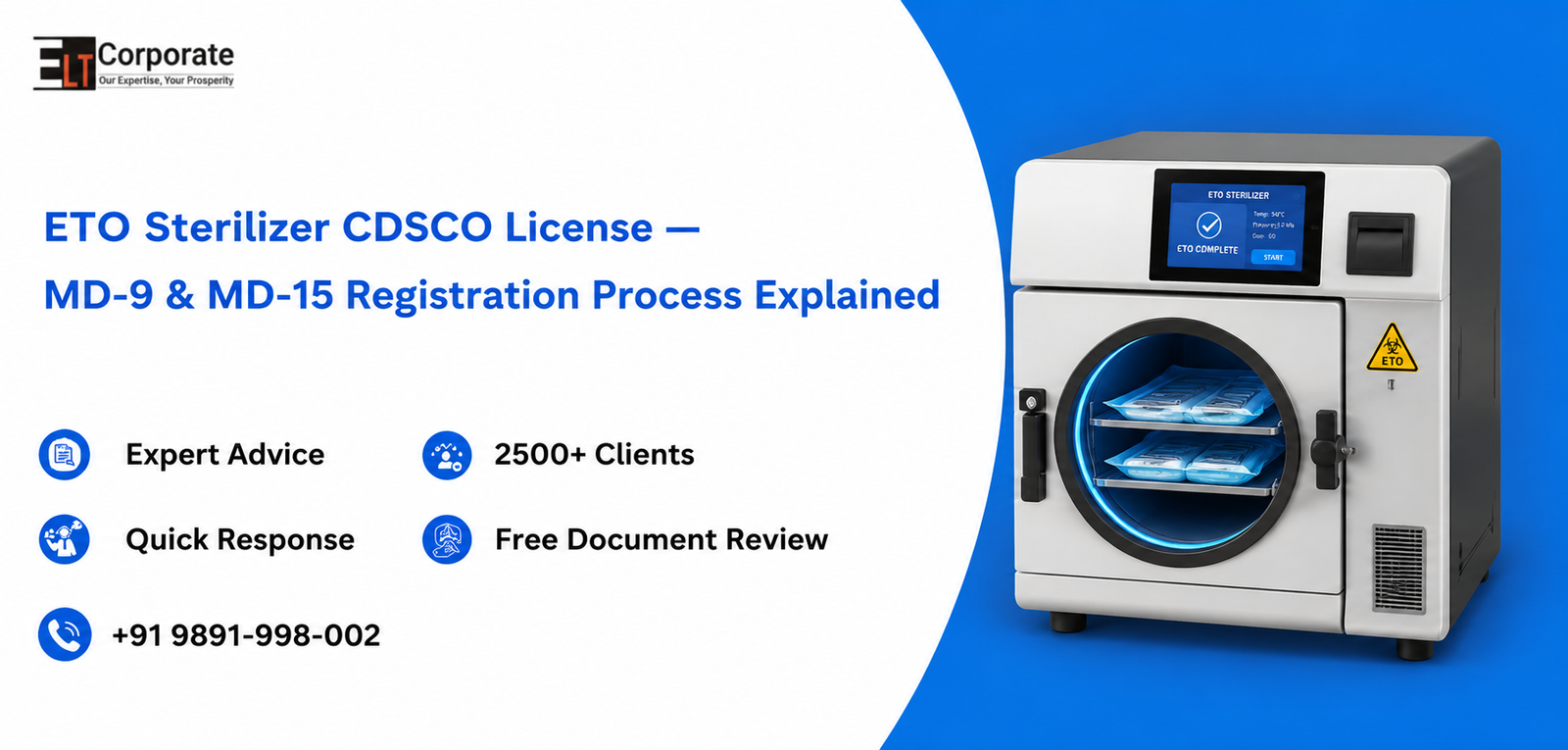
Ethylene Oxide (ETO) sterilizers are among the most critical pieces of equipment in the healthcare and medical device manufacturing ecosystem. Used to sterilize heat-sensitive medical devices, surgical instruments, single-use disposables, implantable devices, and pharmaceutical packaging — ETO sterilizers are indispensable in hospitals, central sterile supply departments (CSSDs), contract sterilization facilities, and medical device manufacturing plants across India.
As India’s healthcare infrastructure expands and the domestic medical device manufacturing sector grows, the demand for ETO sterilizers — both for hospital installation and for industrial sterilization service use — is rising steadily. Whether you are a foreign manufacturer seeking to export ETO sterilizers to India, an Indian importer of international ETO sterilization equipment, or a domestic manufacturer of sterilization systems, CDSCO registration is a mandatory legal requirement under the Medical Devices Rules, 2017 (MDR 2017).
We provide complete CDSCO registration services for ETO sterilizers — covering the import licence (Form MD-14 / MD-15) and manufacturing licence (Form MD-5 / MD-6) pathways, as well as the Sterilization Service Provider registration (Form MD-9 / MD-10) pathway — with end-to-end expert support from device classification through licence issuance and post-market compliance.
Understanding the Two Distinct Regulatory Pathways for ETO Sterilization in India
A critical distinction that many ETO sterilizer businesses overlook is that the Medical Devices Rules, 2017 create two separate regulatory pathways for ETO sterilization in India — and understanding which pathway (or both) applies to your business is the essential first step:
Pathway 1 — ETO Sterilizer as a Medical Device (MD-14 / MD-15 / MD-5 / MD-6)
This pathway applies to businesses that manufacture or import ETO sterilizer equipment — the physical sterilization machines themselves — for sale, supply, or installation in India. The ETO sterilizer is treated as a regulated medical device under Schedule I of MDR 2017, requiring an import licence (MD-15) or manufacturing licence (MD-6).
Pathway 2 — ETO Sterilization Service Registration (MD-9 / MD-10)
This pathway applies to businesses that provide sterilization services using ETO or other sterilization methods — contract sterilization facilities, hospital CSSDs using ETO, and sterilization service providers who sterilize medical devices on behalf of manufacturers or healthcare facilities. These entities must register as Sterilization Service Providers under the Medical Devices Rules, 2017, using Form MD-9 (application) and receiving Form MD-10 (registration certificate).
Many businesses in the ETO space need both pathways — for example, a company that imports ETO sterilizer equipment (MD-15 needed) and also operates a contract sterilization service facility (MD-9 / MD-10 needed).
This guide covers both pathways in detail.
What is an ETO Sterilizer — Device Overview
Ethylene Oxide (ETO) Sterilization — The Process
ETO sterilization is a low-temperature sterilization method that uses ethylene oxide gas — a highly effective broad-spectrum sterilant — to kill microorganisms (bacteria, fungi, viruses, and spores) on medical devices and instruments. It is the method of choice for:
- Heat-sensitive devices that cannot withstand steam (autoclave) sterilization
- Complex devices with long, narrow lumens (catheters, endoscopes, tubing)
- Electronic medical devices and devices with optical components
- Single-use medical device packaging
- Implantable devices requiring sterility assurance
ETO Sterilizer Equipment Types
ETO sterilizers vary significantly in size, design, and intended use — and this variation affects their regulatory classification and documentation requirements:
Small Hospital / CSSD ETO Sterilizers Compact units designed for installation in hospital central sterile supply departments. Typically 50 to 300 litre chamber volume. Used for sterilizing surgical instruments, flexible endoscopes, and other reusable or heat-sensitive hospital equipment.
Industrial / Manufacturing ETO Sterilizers Large-scale sterilization systems used in medical device manufacturing plants and contract sterilization facilities. Chamber volumes from 1,000 to 100,000 litres. Used for bulk sterilization of single-use medical devices, implants, and pharmaceutical packaging. Often part of a validated sterilization process under ISO 11135.
Micro ETO Sterilizers Very small capacity units (typically 1 to 20 litres) designed for dental clinics, veterinary practices, or small medical facilities requiring limited ETO sterilization capability.
Modular and Container ETO Sterilization Systems Prefabricated, skid-mounted ETO sterilization systems designed for installation in manufacturing facilities or for use as standalone contract sterilization units.
ETO Sterilizer System Components The complete ETO sterilization system typically includes:
- ETO sterilizer chamber / vessel
- Control system (PLC-based, touch screen interface)
- ETO gas supply system (cartridge or cylinder-based)
- Aeration / degassing system
- ETO abatement / scrubber system (to neutralize exhaust ETO)
- Monitoring and recording system (temperature, humidity, pressure, ETO concentration)
- Validation and qualification documentation package
Regulatory Classification of ETO Sterilizers Under MDR 2017
ETO Sterilizer as a Medical Device — Classification
| Equipment Type | Risk Class | Licensing Authority | TPA Required |
| Micro ETO sterilizer (dental / small clinic) | Class B | CDSCO (Central) | Generally not required |
| Hospital CSSD ETO sterilizer | Class C | CDSCO (Central) | Yes — TPA mandatory |
| Industrial / manufacturing ETO sterilizer | Class C | CDSCO (Central) | Yes — TPA mandatory |
| ETO sterilizer with integrated gas abatement system | Class C | CDSCO (Central) | Yes — TPA mandatory |
| ETO sterilizer accessories (gas cartridges, biological indicators, chemical indicators) | Class B / C | CDSCO (Central) | Depends on classification |
ETO Sterilization Service Provider — Registration
| Entity Type | Form | Registration Authority |
| Contract sterilization facility (standalone) | MD-9 / MD-10 | CDSCO (Central) |
| Hospital CSSD offering ETO sterilization services | MD-9 / MD-10 | CDSCO (Central) |
| Medical device manufacturer operating in-house ETO sterilization | MD-9 / MD-10 | CDSCO (Central) |
PATHWAY 1 — ETO Sterilizer Device Registration (MD-15 Import Licence / MD-6 Manufacturing Licence)
Who Needs This Registration?
- Foreign OEMs exporting ETO sterilizer equipment to India — must appoint an Indian Authorised Agent (IAA) to file the import licence (MD-14 application → MD-15 licence)
- Indian importers and distributors of international ETO sterilizer brands (STERI-VAC / 3M, Anderson, Andersen, Stryker, Matachana, Getinge, Belimed, Tuttnauer, and others)
- Domestic manufacturers of ETO sterilization equipment in India — must obtain manufacturing licence (MD-5 application → MD-6 licence)
Complete Document Checklist — ETO Sterilizer Device Registration
SECTION A — Indian Applicant / IAA Documents
1. Application in Form MD-14 (Import) or Form MD-5 (Manufacturing) Accurately completed application filed through the CDSCO SUGAM portal.
2. Business Registration Certificate Certificate of Incorporation, Partnership Deed, LLP Agreement, or equivalent.
3. Import Export Code (IEC) Valid IEC from DGFT — mandatory for import applications.
4. GST Registration Certificate Valid GSTIN of the applicant.
5. Authorisation Letter from Foreign Manufacturer Notarised and apostilled letter appointing the Indian entity as IAA, explicitly listing ETO sterilizer models covered.
6. IAA Agreement Formal agreement defining the IAA’s regulatory responsibilities under MDR 2017 in India.
7. Affidavit / Undertaking Sworn affidavit by proprietor / directors declaring MDR 2017 compliance.
8. Power of Attorney (if filing through consultant) Duly executed POA.
SECTION B — Device Technical Documents
9. Device Description and Intended Use Comprehensive description covering:
- Full device name, model number(s), and all variants
- Operating principle — ETO sterilization cycle process (pre-conditioning, gas exposure, aeration/degassing)
- ETO concentration range used in the sterilization cycle
- Chamber volume and load capacity specifications
- Intended use — hospital CSSD, industrial manufacturing, dental clinic, contract sterilization
- Intended users — trained biomedical engineers, sterilization technicians, CSSD staff
- Types of medical devices / loads for which the sterilizer is intended
- Description of all system components — chamber, control system, ETO supply, abatement system, monitoring system
- Description of safety features — pressure relief, gas leak detection, interlock systems, emergency stop
- Compatibility with applicable ETO sterilization process standards (ISO 11135)
10. Technical Specifications Detailed performance specifications including:
- Chamber volume (litres)
- Chamber material and construction
- Maximum operating pressure and temperature
- ETO gas supply method (cartridge, cylinder, piped)
- ETO concentration range (mg/L)
- Sterilization cycle parameters — pre-conditioning humidity and temperature, gas exposure time, aeration time
- Control system specifications — PLC type, HMI interface, data recording capability
- Alarm specifications — gas leak alarm, pressure alarm, temperature alarm, cycle failure alarm
- Abatement / scrubber system specifications — ETO destruction efficiency, discharge limits
- Electrical specifications — voltage, frequency, power consumption
- Physical dimensions and weight
- Environmental operating conditions — installation requirements, room ventilation requirements
- Compliance with ETO exposure limits (OSHA, EN 1422, or applicable standards)
11. Essential Principles Checklist (Schedule III — MDR 2017) Demonstration of how the ETO sterilizer meets each applicable Essential Principle of Safety and Performance — with references to standards, test reports, and technical evidence.
12. Risk Management File (ISO 14971:2019) Complete risk management documentation covering:
- Risk management plan
- Hazard identification — specific to ETO sterilizers:
- ETO gas leak (occupational exposure risk)
- Incomplete sterilization cycle (sterilization failure — patient safety risk)
- ETO residue on sterilized devices exceeding limits (patient contact risk)
- Explosion and fire risk (ETO is flammable and explosive)
- Abatement system failure (environmental and occupational ETO release)
- Control system failure (incorrect cycle parameters)
- Electrical hazards
- Pressure vessel failure
- Risk estimation and evaluation for each hazard
- Risk control measures and verification of effectiveness
- Residual risk assessment
- Benefit-risk analysis
13. Software Documentation (IEC 62304) For ETO sterilizers with PLC-based control systems and embedded software:
- Software description and architecture (cycle control algorithms, alarm management, data logging)
- Software safety classification per IEC 62304
- Software verification and validation records
- Cybersecurity assessment (for networked/remote monitoring systems)
14. Sterilization Process Validation Documentation A critical and unique requirement for ETO sterilizers — documentation demonstrating that the sterilizer is capable of delivering a validated sterilization process achieving the required Sterility Assurance Level (SAL):
- Installation Qualification (IQ) documentation
- Operational Qualification (OQ) documentation — demonstrating repeatable cycle performance
- Performance Qualification (PQ) documentation — demonstrating effective sterilization of the intended load
- Biological indicator data — demonstrating 10⁶ SAL achievement
- References to ISO 11135:2014 (Sterilization of health-care products — Ethylene oxide)
15. Usability Engineering File (IEC 62366-1) Usability documentation covering:
- Intended user analysis — biomedical engineers, CSSD technicians
- Use-related hazard identification — incorrect cycle parameter setting, improper load preparation, failure to complete aeration
- Formative and summative usability evaluations
- Residual use-related risk assessment
SECTION C — Test Reports and Standards Compliance
16. IEC 61010-1 — Safety Requirements for Electrical Equipment for Measurement, Control, and Laboratory Use Safety standard applicable to ETO sterilizer control systems and electrical components.
17. IEC 61010-2-040 — Safety Requirements for Sterilizers and Washer-Disinfectors Specific safety requirements for sterilizers used in healthcare and laboratory settings — covering electrical safety, pressure safety, and thermal safety of sterilization equipment.
18. EN 1422 — Sterilizers for Medical Purposes — Ethylene Oxide Sterilizers The primary product-specific standard for ETO sterilizers — specifying requirements for ETO sterilizer performance, safety, control systems, cycle documentation, and validation. Compliance with EN 1422 (or equivalent national standard) is the most important single performance standard for ETO sterilizer CDSCO registration.
Key requirements under EN 1422:
- ETO sterilizer chamber design and construction requirements
- Minimum and maximum cycle parameter ranges
- Control system requirements — automatic cycle control, parameter monitoring, alarm functions
- Documentation and record-keeping requirements
- Safety interlock requirements
- Gas leak detection requirements
- Aeration requirements
19. ISO 11135:2014 — Sterilization of Health-Care Products — Ethylene Oxide Requirements for development, validation, and routine control of ETO sterilization processes for medical devices. This standard is critical for demonstrating that the sterilizer is designed and validated to achieve the required sterilization efficacy. While primarily a process validation standard, it is directly referenced in ETO sterilizer technical documentation.
20. ISO 11607 — Packaging for Terminally Sterilized Medical Devices (if applicable) For ETO sterilizers used to sterilize packaged medical devices — reference to ISO 11607 packaging validation may be relevant.
21. IEC 60601-1 — General Safety and Essential Performance (if applicable) For ETO sterilizers that interface directly with patient care environments or that incorporate patient monitoring functions, general medical electrical equipment safety requirements may apply.
22. IEC 60601-1-2 — Electromagnetic Compatibility (if applicable) For ETO sterilizers with digital control systems operated in healthcare facility environments.
23. IEC 62304 — Medical Device Software For ETO sterilizers with embedded PLC control software and data logging systems.
24. IEC 62366-1 — Usability Engineering Evidence of usability validation.
25. Pressure Vessel / Boiler Certification (if applicable) For ETO sterilizer chambers classified as pressure vessels under Indian pressure vessel regulations (Indian Boiler Regulations, IBR) — applicable certification from the relevant state boiler inspection authority.
SECTION D — Quality Management System Documents
26. ISO 13485:2016 Certificate Valid ISO 13485 QMS certificate from an accredited certification body — scope must cover sterilization equipment or medical device manufacturing equipment.
27. QMS Overview Summary of the manufacturer’s quality management system.
28. Post-Market Surveillance (PMS) Plan Documented plan for real-world performance data collection — particularly important for ETO sterilizers given the serious patient safety consequences of sterilization failure.
29. Vigilance Procedures Procedures for detecting and reporting serious incidents — including sterilization cycle failures, ETO gas leaks, and device recalls related to sterilization failures.
30. Periodic Safety Update Report (PSUR) — if available For devices already marketed internationally.
SECTION E — Clinical / Performance Evaluation Documents
31. Performance Evaluation Report For ETO sterilizers, a traditional Clinical Evaluation Report (CER) is replaced by a comprehensive Performance Evaluation Report demonstrating:
- Sterilization efficacy — achievement of required SAL (10⁻⁶) for the intended load types
- Cycle repeatability and consistency across multiple validation runs
- ETO residue levels on sterilized devices — compliance with ISO 10993-7 limits for ETO and ETO reaction products (ethylene chlorohydrin, ethylene glycol) on patient-contacting devices
- Comparison with established ETO sterilization standards and published performance data
32. ISO 10993-7 Compliance Data Documentation demonstrating that devices sterilized by the ETO sterilizer can meet the ETO residue limits specified in ISO 10993-7 — relevant for devices that will be in contact with patients after sterilization.
SECTION F — Labelling and Instructions for Use
33. Device Label (Schedule V — MDR 2017) Compliant label for the ETO sterilizer and packaging including:
- Device name and model
- Manufacturer’s name and address
- Country of manufacture
- IAA’s name and address
- UDI
- Manufacturing date
- Serial number
- Applicable symbols
- Electrical specifications
- Pressure vessel ratings
- Safety warnings (ETO is toxic and flammable)
34. Instructions for Use (IFU) / Technical Manual Comprehensive documentation covering:
- Safety warnings and precautions (ETO toxicity, flammability, explosion risk, exposure limits)
- Installation requirements — room dimensions, ventilation requirements, electrical supply, ETO gas supply connection
- Commissioning and qualification procedures (IQ/OQ/PQ guidance)
- Cycle operation guide — cycle selection, load preparation, parameter setting, cycle monitoring, cycle completion
- Alarm management — alarm descriptions, causes, and corrective actions
- Routine maintenance procedures and schedule
- Annual service and calibration requirements
- Abatement system operation and maintenance
- ETO gas cartridge / cylinder management
- Emergency procedures — gas leak response, evacuation procedures
- Regulatory compliance information — ETO exposure limits (OSHA PEL, ACGIH TLV), applicable environmental discharge regulations
- Troubleshooting guide
- Spare parts list
SECTION G — Documents from Foreign Manufacturer (Import Applications)
35. Free Sale Certificate (FSC) / Market Authorisation From the competent authority in the manufacturer’s home country:
- USA: FDA 510(k) clearance for ETO sterilizers (many hospital ETO sterilizers are 510(k) cleared)
- European Union: CE Certificate under EU MDR 2017/745 from an EU Notified Body
- Australia: TGA ARTG registration
- Canada: Health Canada Medical Device Licence Must be apostilled / legalised by the Indian Embassy.
36. Manufacturing Licence of Foreign Facility Proof of manufacturing site authorisation.
37. GMP Compliance Certificate ISO 13485 certificate or equivalent.
38. Site Master File (SMF) Comprehensive manufacturing facility description.
39. Declaration of Conformity Formal manufacturer declaration of MDR 2017 conformity and Essential Principles compliance.
PATHWAY 2 — ETO Sterilization Service Provider Registration (MD-9 / MD-10)
What is Sterilization Service Provider Registration?
The Medical Devices Rules, 2017 require that businesses providing sterilization services — whether as contract sterilization facilities, hospital CSSDs using ETO, or medical device manufacturers operating their own ETO sterilization systems to sterilize products for third parties or for their own commercial products — register as Sterilization Service Providers with CDSCO.
The registration is obtained through:
- Form MD-9 — Application for registration as a Sterilization Service Provider
- Form MD-10 — Registration Certificate issued by CDSCO upon approval
Who Needs MD-9 / MD-10 Registration?
- Contract sterilization facilities — standalone businesses that provide ETO (or other modality) sterilization services to medical device manufacturers, hospitals, and healthcare facilities
- Medical device manufacturers — companies that operate their own ETO sterilization systems and sterilize their products as part of the manufacturing process (for commercial sale)
- Hospital CSSDs providing ETO sterilization — where ETO sterilization is offered as a service to hospital departments or to external facilities
- Pharmaceutical companies using ETO sterilization for pharmaceutical device-drug combination products
Documents Required for MD-9 / MD-10 Registration
1. Application in Form MD-9 Completed application filed through the CDSCO SUGAM portal specifying the sterilization modalities offered (ETO, radiation, steam, dry heat, etc.).
2. Business Registration Certificate Proof of legal existence of the entity operating the sterilization facility.
3. GST Registration Certificate
4. Proof of Premises / Facility Lease or ownership documents for the sterilization facility premises.
5. Facility Layout Plan Detailed floor plan of the sterilization facility showing:
- ETO sterilizer installation area
- Load preparation / staging area
- Aeration / degassing area
- Quarantine area (pre-sterilization)
- Release area (post-sterilization)
- ETO gas storage area
- Abatement system location
- Monitoring and control room
6. List of Sterilization Equipment Details of all sterilization equipment installed — make, model, chamber volume, CDSCO registration number (MD-15 or equivalent), and year of installation.
7. ISO 11135 Validation Documentation Evidence that the ETO sterilization process has been fully validated in accordance with ISO 11135:2014 — including IQ, OQ, and PQ records demonstrating consistent sterilization efficacy.
8. Sterilization Process Master Documents
- Validated sterilization cycle parameters for each product / load type sterilized
- Standard Operating Procedures (SOPs) for all sterilization activities
- Batch record templates
- Biological indicator use and interpretation procedures
- Chemical indicator use procedures
9. Quality Management System Documentation Evidence of a documented QMS governing the sterilization service operations — preferably ISO 13485 or ISO 9001 certified.
10. ISO 13485 Certificate (if available) Strong indicator of QMS compliance — strongly recommended for contract sterilization facilities.
11. Personnel Qualifications and Training Records Qualifications and training records of key personnel — particularly the qualified sterilization technicians and the person responsible for sterilization process validation and release.
12. ETO Safety Management Documentation
- ETO exposure monitoring programme (personal and area monitoring)
- Compliance with occupational ETO exposure limits (OSHA PEL 1 ppm 8-hour TWA; STEL 5 ppm 15-minute)
- ETO gas leak detection system description
- Emergency response procedures for ETO release
- Worker health surveillance programme (ETO is a known carcinogen — regulatory compliance with occupational health monitoring is critical)
13. Environmental Compliance Documentation
- ETO abatement system validation — demonstrating ETO destruction efficiency meeting applicable environmental discharge limits
- Compliance with applicable State Pollution Control Board (SPCB) / Central Pollution Control Board (CPCB) requirements for ETO emissions
- Consent to Operate from SPCB (where applicable)
14. Sterilized Product Release Procedures Documented procedures for:
- Parametric release of sterilized products (cycle parameter review)
- Biological indicator result interpretation
- Quarantine and hold procedures for failed or suspect batches
- Sterility assurance documentation for each sterilization batch
15. Traceability and Record-Keeping System Demonstration of a complete traceability system linking each sterilized batch to:
- The specific sterilization cycle run
- Cycle parameter records
- Biological indicator results
- Customer / product identification
- Release decision and authorisation
16. Affidavit / Undertaking Sworn declaration of compliance with MDR 2017 sterilization service provider requirements.
Step-by-Step MD-9 / MD-10 Registration Process
Step 1 — Sterilization Facility Assessment We assess your ETO sterilization facility against MDR 2017 Sterilization Service Provider requirements — evaluating equipment registration status, ISO 11135 validation status, QMS documentation, and safety compliance.
Step 2 — Documentation Gap Analysis We identify gaps in sterilization validation documentation, SOPs, personnel training records, and environmental compliance documentation.
Step 3 — ISO 11135 Validation Support If your ETO sterilization process has not been formally validated per ISO 11135, we coordinate with validation specialists to support the IQ/OQ/PQ validation process.
Step 4 — Form MD-9 Preparation and Filing We prepare the complete MD-9 application and supporting document package — and file it through the CDSCO SUGAM portal.
Step 5 — CDSCO Inspection Coordination CDSCO may conduct a physical inspection of the sterilization facility as part of the MD-9 review. We prepare your facility and team for the inspection.
Step 6 — Query Response We manage all CDSCO queries with technically precise, well-documented responses.
Step 7 — MD-10 Registration Certificate Issuance Upon approval, CDSCO issues the MD-10 Sterilization Service Provider Registration Certificate.
Government Fee Structure
For ETO Sterilizer Device Registration:
| Application Type | Government Fee |
| Import Licence — Class B ETO sterilizer (MD-14) | ₹5,000 per device |
| Import Licence — Class C ETO sterilizer (MD-14) | ₹50,000 per device |
| Manufacturing Licence — Class C ETO sterilizer (MD-5) | ₹50,000 |
| Renewal of Import / Manufacturing Licence | 50% of original fee |
| Amendment to existing licence | ₹2,500 – ₹10,000 |
For Sterilization Service Provider Registration:
| Application Type | Government Fee |
| Sterilization Service Provider Registration (Form MD-9) | As prescribed under MDR 2017 Schedule I fee structure |
| Renewal of Registration (Form MD-9) | As prescribed |
All government fees are paid online through the CDSCO SUGAM portal and are subject to revision by the Government of India.
Estimated Timeline
| Registration Type | Estimated Timeline |
| Import Licence — Class B ETO sterilizer | 3 – 6 months |
| Import Licence — Class C ETO sterilizer | 6 – 12 months |
| Manufacturing Licence — Class C ETO sterilizer | 8 – 14 months |
| Sterilization Service Provider — MD-9 / MD-10 | 3 – 9 months |
Post-Registration Compliance Obligations
For ETO Sterilizer Device Licence Holders (MD-15 / MD-6):
Label Compliance Every ETO sterilizer unit sold in India must bear an MDR 2017 Schedule V compliant label with IAA details, UDI, safety warnings, and all mandatory elements.
Vigilance Reporting Serious incidents — sterilization cycle failures traced to equipment malfunction, ETO gas leaks causing occupational harm, or device recalls traced to sterilization equipment failure — must be reported to CDSCO within prescribed timeframes.
Software Update Notifications Control system software updates affecting cycle parameters or safety interlocks must be notified to CDSCO before deployment.
PSURs Class C ETO sterilizers require periodic Periodic Safety Update Reports.
Renewal MD-15 / MD-6 licences are valid for 5 years and must be renewed before expiry.
For Sterilization Service Providers (MD-10):
Continuous ISO 11135 Compliance Maintaining validated sterilization processes — including annual requalification, biological indicator monitoring, and cycle parameter records — is a continuous obligation.
ETO Exposure Monitoring Ongoing occupational ETO exposure monitoring for all facility workers — personal dosimetry and area monitoring — with records maintained and available for CDSCO inspection.
Batch Records Complete, traceable sterilization batch records must be maintained for each load processed — minimum 5 years retention.
Environmental Compliance Continuous compliance with SPCB / CPCB ETO emission limits and abatement system performance monitoring.
Incident Reporting ETO gas leaks, sterilization failures, and any product recalls related to sterilization must be reported to CDSCO.
Registration Renewal MD-10 registration must be renewed as prescribed — typically every 5 years.
Why ETO Sterilizer Businesses in India Need Specialist Regulatory Support
The ETO sterilizer regulatory pathway in India involves an unusual combination of technical disciplines:
Medical Device Regulatory Expertise Understanding MDR 2017 classification rules, Essential Principles, SUGAM portal processes, and TPA requirements for ETO sterilizers specifically.
Sterilization Science and ISO 11135 Knowledge The process validation documentation requirements — IQ/OQ/PQ, biological indicator data, SAL achievement — require sterilization science expertise that is distinct from general medical device regulatory knowledge.
Chemical Safety and Environmental Compliance ETO is a toxic, flammable, and carcinogenic gas. Managing the occupational safety, environmental compliance, and regulatory documentation associated with ETO sterilization requires chemical safety expertise beyond typical medical device regulatory scope.
Pressure Vessel Regulations ETO sterilizer chambers are pressure vessels — subject to Indian Boiler Regulations (IBR) in addition to MDR 2017 requirements. Ensuring compliance with both regulatory frameworks is essential.
Our team brings all of these competencies together — providing truly integrated ETO sterilizer registration and compliance support.
Why Choose Our CDSCO Registration Services for ETO Sterilizers?
Dual-Pathway Expertise We are one of the few regulatory consultancies with deep expertise in both the ETO sterilizer device registration pathway (MD-14/MD-15/MD-5/MD-6) and the Sterilization Service Provider registration pathway (MD-9/MD-10) — providing truly integrated support for businesses operating across both pathways.
EN 1422 and ISO 11135 Technical Depth The primary standards for ETO sterilizers — EN 1422 (device standard) and ISO 11135 (process validation) — require specialised technical knowledge. Our team understands both standards and their documentation requirements in the CDSCO context.
ISO 10993-7 Residue Compliance ETO residue limits on sterilized devices (per ISO 10993-7) are an important consideration in ETO sterilizer performance documentation. We specifically address residue compliance in the technical dossier.
ETO Safety and Environmental Documentation We support clients in preparing occupational safety, environmental compliance, and emergency response documentation required for MD-9 registration — areas that are frequently under-documented in first-time applicants.
TPA Process Management Class C ETO sterilizers require Third Party Audit — we prepare technically robust dossiers that withstand TPA scrutiny and manage the audit process efficiently.
End-to-End Accountability From free initial assessment through licence / registration issuance and ongoing post-market compliance — we provide complete, accountable service throughout the registration lifecycle.
Frequently Asked Questions
Q1. Is CDSCO registration required for all ETO sterilizers sold in India?
Yes. ETO sterilizers are notified medical devices under Schedule I of the Medical Devices Rules, 2017. All ETO sterilizers — imported or domestically manufactured — require a valid CDSCO import licence (MD-15) or manufacturing licence (MD-6) before they can be legally sold, imported, or distributed in India.
Q2. We operate a contract ETO sterilization facility in India. Do we need a CDSCO registration beyond just owning a registered ETO sterilizer?
Yes. Operating a sterilization service — providing ETO sterilization to medical device manufacturers or healthcare facilities — requires separate Sterilization Service Provider registration (Form MD-9 / MD-10) from CDSCO, in addition to ensuring that the ETO sterilizer equipment itself is registered (MD-15 or MD-6).
Q3. What is the most important standard for ETO sterilizer CDSCO registration? The two most important standards are EN 1422 (for the sterilizer equipment’s design and performance requirements) and ISO 11135 (for the sterilization process validation requirements). Test reports demonstrating EN 1422 compliance are required for the device registration dossier, while ISO 11135 validation documentation is required for both the device dossier and the MD-9 service provider registration.
Q4. Are ETO sterilizer gas cartridges and biological indicators separately regulated?
Yes. ETO gas supply systems, biological indicators, and chemical indicators used with ETO sterilizers may independently qualify as regulated medical devices under MDR 2017, requiring their own separate CDSCO registrations. Our team can assess the regulatory status of each accessory and develop a portfolio registration strategy.
Q5. Our ETO sterilizer is CE-marked under EU MDR. Do we still need CDSCO registration in India?
Yes. The CE certificate is submitted as the Free Sale Certificate (FSC) supporting your CDSCO MD-14 import licence application — but it does not substitute for a separate Indian CDSCO registration. All medical devices, including ETO sterilizers, require their own CDSCO import licence for the Indian market.
Q6. Is Indian Boiler Registration required for ETO sterilizer chambers in addition to CDSCO registration?
ETO sterilizer pressure vessels may be subject to the Indian Boilers Act / Indian Boiler Regulations (IBR) depending on their design pressure and volume. Compliance with IBR — including registration with the state boiler inspection authority — may be required in addition to CDSCO registration. Our team advises on applicable requirements for your specific equipment.
Q7. What ETO occupational exposure limits apply to sterilization facilities in India?
India’s occupational safety regulations reference international limits including the OSHA Permissible Exposure Limit (PEL) of 1 ppm 8-hour TWA and 5 ppm 15-minute STEL. The International Agency for Research on Cancer (IARC) classifies ETO as a Group 1 carcinogen. Compliance with applicable exposure limits, personal monitoring programmes, and worker health surveillance is mandatory for all ETO sterilization facility operators.
Q8. How frequently must ETO sterilization processes be revalidated under ISO 11135?
ISO 11135 requires ongoing process monitoring (routine biological indicator testing with every cycle or per defined frequency), periodic requalification when significant changes occur (equipment modification, facility changes, product changes), and comprehensive annual review of the sterilization process. Specific revalidation triggers and frequencies are defined in the manufacturer’s sterilization validation plan.
Comments are closed