
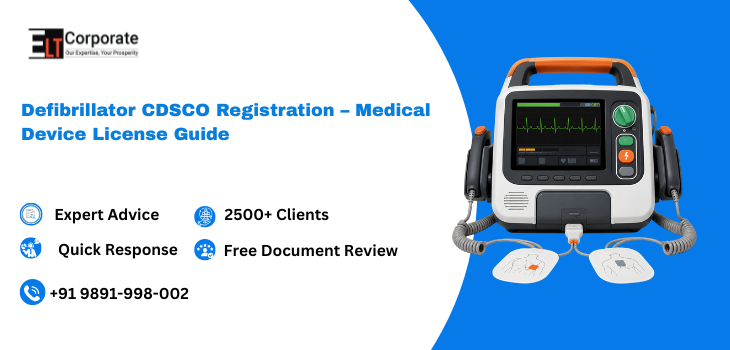
Defibrillators are among the most critical life-saving medical devices in modern healthcare. From Automated External Defibrillators (AEDs) installed in airports, shopping malls, and offices to advanced ICU-grade biphasic defibrillators and implantable cardioverter-defibrillators (ICDs) used in cardiac care units, these devices deliver the electrical therapy that can restore normal heart rhythm in life-threatening emergencies. In India, every defibrillator — whether imported or domestically manufactured — must be registered with the Central Drugs Standard Control Organisation (CDSCO) before it can be legally placed on the market.
Under the Medical Devices Rules, 2017 (MDR 2017), defibrillators are listed as notified, regulated medical devices under Schedule I. Importing, manufacturing, distributing, or selling a defibrillator in India without a valid CDSCO licence is a criminal offence under the Drugs and Cosmetics Act, 1940 — attracting product seizure, financial penalties, and imprisonment.
We provide complete CDSCO registration services for all types of defibrillators — from AEDs and manual external defibrillators to wearable cardioverter-defibrillators and implantable devices — covering both import licence (Form MD-14 / MD-15) and manufacturing licence (Form MD-5 / MD-6) pathways.
What is CDSCO Registration for Defibrillators?
CDSCO registration is the formal process through which a defibrillator manufacturer, importer, or their authorised agent obtains a Market Authorisation (Medical Device Licence) from the Central Drugs Standard Control Organisation, permitting the device to be commercially placed on the Indian market.
The application is filed through the CDSCO SUGAM online portal (sugam.gov.in) in:
- Form MD-14 — Application for Import Licence (for defibrillators manufactured outside India)
- Form MD-5 — Application for Manufacturing Licence (for defibrillators manufactured in India)
Upon approval:
- Form MD-15 — Import Licence is issued (for imported defibrillators)
- Form MD-6 — Manufacturing Licence is issued (for domestically manufactured defibrillators)
Both licence types are product-specific, manufacturer-specific, and valid for 5 years from the date of issue.
Defibrillator Types Covered Under CDSCO Registration
The CDSCO registration requirement applies across the full spectrum of defibrillator technology:
Automated External Defibrillators (AEDs)
Portable, user-friendly devices designed for use by laypersons and first responders in public access settings. AEDs automatically analyse cardiac rhythm and deliver a shock if ventricular fibrillation (VF) or pulseless ventricular tachycardia (pVT) is detected. Widely deployed in airports, railway stations, shopping malls, sports arenas, corporate offices, and schools.
Manual External Defibrillators (MEDs)
Advanced defibrillators used by trained medical professionals in hospitals, emergency departments, ICUs, and ambulances. Manual defibrillators require the operator to interpret the ECG and manually select energy levels and deliver the shock. Most hospital-grade defibrillators combine defibrillation with multi-parameter patient monitoring (ECG, SpO₂, NIBP, EtCO₂) and pacing functions.
Biphasic Defibrillators
The current standard for both AEDs and manual defibrillators — delivering a bidirectional electrical current waveform that is more effective at lower energy levels than older monophasic technology. Most modern defibrillators use biphasic waveforms (biphasic truncated exponential or rectilinear biphasic).
Semi-Automated External Defibrillators
Devices that analyse rhythm automatically but require the operator to press a button to deliver the shock — used in clinical and first-responder settings where some operator oversight is preferred.
Defibrillator / Monitor Combinations
Multifunction devices combining defibrillation with comprehensive patient monitoring — including ECG, SpO₂, NIBP, invasive blood pressure, capnography, and temperature monitoring. Standard in ICUs, operation theatres, cardiac catheterisation labs, and emergency departments.
Wearable Cardioverter-Defibrillators (WCDs)
Non-implantable, externally worn defibrillation systems prescribed for patients at temporary elevated risk of sudden cardiac death — typically following myocardial infarction or during evaluation for ICD implantation. The device continuously monitors cardiac rhythm and delivers therapy if a lethal arrhythmia is detected.
Implantable Cardioverter-Defibrillators (ICDs)
Surgically implanted devices that continuously monitor cardiac rhythm and deliver pacing therapy or high-voltage defibrillation shocks as needed. ICDs are the most regulated category of defibrillator — Class D devices requiring the most stringent conformity assessment.
Cardiac Resynchronisation Therapy Defibrillators (CRT-Ds)
A combined ICD and cardiac resynchronisation therapy (CRT) device, implanted in patients with heart failure and electrical dyssynchrony. Among the most complex cardiac implantable electronic devices regulated by CDSCO.
Defibrillator Accessories
Defibrillation electrodes (pads / paddles), lead systems, patient connectors, and AED cabinets that independently meet the definition of a medical device also require CDSCO registration or are covered under the primary device registration.
Regulatory Classification of Defibrillators Under MDR 2017
Correct classification under the Medical Devices Rules, 2017 is the essential first step — it determines the conformity assessment route, documentation requirements, and whether a Third Party Audit (TPA) is mandatory.
| Device Type | Risk Class | Licensing Authority | TPA Required |
| AED — Public Access / Layperson use | Class C | CDSCO (Central) | Yes |
| Semi-automated external defibrillator | Class C | CDSCO (Central) | Yes |
| Manual external defibrillator (professional use) | Class C | CDSCO (Central) | Yes |
| Defibrillator / Monitor combination | Class C | CDSCO (Central) | Yes |
| Wearable Cardioverter-Defibrillator (WCD) | Class C | CDSCO (Central) | Yes |
| Implantable Cardioverter-Defibrillator (ICD) | Class D | CDSCO (Central) | Yes — enhanced |
| CRT-D (Resynchronisation + Defibrillation) | Class D | CDSCO (Central) | Yes — enhanced |
| Defibrillation pads / electrodes (standalone) | Class C | CDSCO (Central) | Yes |
Note: Almost all defibrillators are classified as Class C or Class D under MDR 2017 due to their life-sustaining, life-supporting function and the life-threatening nature of the conditions they treat. A Third Party Audit (TPA) is mandatory for all Class C and Class D devices. ICDs and CRT-Ds as Class D devices face the most stringent evaluation — analogous to the highest level of scrutiny applied to any medical device in India.
Who Needs CDSCO Defibrillator Registration?
- Foreign OEMs — Zoll, Philips, Stryker, Cardiac Science, Defibtech, Mindray, Schiller, Nihon Kohden, Medtronic, Abbott, Boston Scientific, Biotronik and others exporting to India — must appoint an Indian Authorised Agent (IAA)
- Indian importers and distributors of international defibrillator brands
- Domestic manufacturers of AEDs or defibrillator components made in India
- Hospitals and cardiac care centres procuring defibrillators for institutional use — must purchase only CDSCO-registered devices
- Emergency medical services (EMS) and ambulance operators equipping vehicles with defibrillators
- Corporate offices, airports, and public venues installing AEDs for public access defibrillation programmes — must use registered devices
- MedTech startups developing new AED or defibrillator technologies for the Indian market
- Defence and government organisations procuring defibrillators through GeM or tender processes
Complete Document Checklist for Defibrillator CDSCO Registration
SECTION A — Indian Applicant / IAA Documents
1. Application in Form MD-14 (Import) or Form MD-5 (Manufacturing) Accurately completed application filed through the CDSCO SUGAM portal with correct applicant, manufacturer, and device details.
2. Business Registration Certificate Certificate of Incorporation, Partnership Deed, LLP Agreement, or equivalent proof of the Indian entity’s legal existence.
3. Import Export Code (IEC) Valid IEC from DGFT — mandatory prerequisite for import licence applications.
4. GST Registration Certificate Valid GSTIN of the Indian applicant.
5. Authorisation Letter from Foreign Manufacturer Formally notarised and apostilled letter from the overseas manufacturer appointing the Indian entity as authorised agent for India, explicitly listing all defibrillator models covered.
6. Indian Authorised Agent (IAA) Agreement Formal agreement defining regulatory roles and responsibilities of the IAA in India — including vigilance reporting, label compliance, and post-market obligations.
7. Affidavit / Undertaking by Indian Applicant Sworn affidavit by directors / proprietor declaring compliance with MDR 2017 and accuracy of all submitted information.
8. Power of Attorney (if filing through regulatory consultant) Duly executed POA authorising the consultant to file and manage the application.
SECTION B — Device Technical Documents
9. Device Description and Intended Use A comprehensive document covering:
- Full device name, model number(s), and all variants in the application
- Operating principle — how the device analyses cardiac rhythm and delivers defibrillation therapy
- Energy delivery specifications — waveform type (biphasic truncated exponential, rectilinear biphasic, monophasic), energy range, and delivered energy accuracy
- Intended clinical use and clinical setting (public access, emergency department, ICU, OT, cardiac lab, home / wearable, implantable)
- Intended users — laypersons (for AEDs), trained first responders, clinical professionals (for manual defibrillators), or cardiac electrophysiologists / surgeons (for ICDs/CRT-Ds)
- Patient population — adult, paediatric, neonatal (where applicable)
- Contraindications and limitations of use
- Description of all device components and accessories
- Description of all monitoring functions (for defibrillator/monitor combinations)
- Description of software features — rhythm analysis algorithm, advisory system, data logging, connectivity
10. Technical Specifications Detailed performance specifications including:
- Energy delivery: Maximum delivered energy (e.g., 200J, 360J), energy accuracy (±% of selected energy)
- Waveform: Waveform type, waveform parameters (pulse width, peak current, impedance compensation range)
- Rhythm analysis algorithm: Sensitivity and specificity for VF detection, shock advisory performance (as per IEC 60601-2-4 or AHA performance standards)
- Charge time: Time to charge to maximum energy from power-on
- ECG display and recording: Lead configurations, display resolution, paper speed (for print-capable models)
- Monitoring parameters (for combination devices): SpO₂, NIBP, IBP, EtCO₂, temperature
- Pacing specifications (for devices with pacing function): Pacing rate range, output range, pacing modes
- Battery: Battery type, charge capacity, expected shock deliveries per full charge, shelf life, charging time
- Alarm specifications: Alarm categories, alarm performance
- Connectivity: Data export formats, software interface, wireless connectivity
- AED-specific: Voice prompts, CPR guidance, pad placement guidance
- Dimensions, weight, and portability
- Environmental operating conditions: Temperature, humidity, altitude, IP rating
- ICD/CRT-D specific: Sensing specifications, detection algorithms, therapy programming range, MRI compatibility (if applicable)
11. Essential Principles Checklist (Schedule III — MDR 2017) Comprehensive demonstration of conformity with each applicable Essential Principle of Safety and Performance under Schedule III of MDR 2017 — with specific references to applicable standards, test reports, and clinical data for each principle.
12. Risk Management File (ISO 14971:2019) Complete risk management documentation covering:
- Risk management plan
- Hazard identification — electrical hazards, energy delivery errors, rhythm misclassification, battery failure, electromagnetic interference, software errors, use errors
- Risk estimation and evaluation
- Risk control measures and verification of effectiveness
- Residual risk assessment and acceptability
- Benefit-risk analysis — particularly critical for ICDs/CRT-Ds where the risks of therapy (inappropriate shocks) must be weighed against the benefit of protection from sudden cardiac death
- Post-production information input
For Class D ICDs and CRT-Ds, the risk management file receives the highest level of CDSCO scrutiny. Inappropriate shock delivery is a known serious adverse event with significant clinical consequences — the risk management file must demonstrate that the detection algorithms and safety interlocks address this risk with objective evidence.
13. Defibrillator Rhythm Analysis Algorithm Documentation (AEDs) For AEDs, the rhythm analysis algorithm is the core safety-critical software component. Documentation must include:
- Algorithm description and operating principle
- Clinical validation data demonstrating the algorithm’s sensitivity (ability to correctly identify shockable rhythms) and specificity (ability to correctly identify non-shockable rhythms)
- Performance against AHA / ERC / ILCOR recommended performance standards
- Algorithm update / version control history
14. Software Documentation (IEC 62304) Defibrillators — particularly AEDs, manual defibrillators with digital rhythm analysis, WCDs, and ICDs — contain complex, safety-critical embedded software. Documentation must include:
- Software description and architecture overview
- Software safety classification per IEC 62304 (all defibrillator control software is Class C — highest safety classification)
- Software development lifecycle documentation
- Software verification and validation records
- Cybersecurity risk assessment per IEC 81001-5-1
- Software version history and change control
- Description of any remote monitoring software, patient management apps, or cloud platforms
15. Usability Engineering File (IEC 62366-1) Documentation of the usability engineering process — particularly critical for AEDs, where the entire premise of the device is that untrained laypersons can successfully use it in a high-stress emergency:
- Intended use environment analysis (public locations, emergency scenes, hospitals)
- User population analysis (untrained laypersons for AEDs; trained clinicians for manual defibrillators)
- Identification of use-related hazards — failure to deliver shock, inappropriate shock, CPR interruption errors, pad misplacement
- Formative usability evaluations during development
- Summative usability evaluation (human factors validation study with representative users)
- Residual use-related risk assessment
SECTION C — Test Reports and Standards Compliance
All test reports must be issued by NABL-accredited or internationally accredited laboratories (ILAC MRA members).
16. IEC 60601-1 — General Safety and Essential Performance Foundational electrical, mechanical, and thermal safety standard for all electrically powered medical devices. Mandatory for all defibrillators.
17. IEC 60601-1-2 — Electromagnetic Compatibility (EMC) Critical for defibrillators — which must both resist electromagnetic interference from the hospital environment (other medical equipment, MRI rooms, RF sources) and not emit interference that disrupts other equipment. Defibrillators have particularly stringent EMC requirements due to the pulsed high-voltage energy they deliver.
18. IEC 60601-1-6 — Usability General usability requirements — complementing the IEC 62366-1 usability engineering file.
19. IEC 60601-1-8 — Alarm Systems Alarm system requirements — critical for manual defibrillators and defibrillator/monitor combinations where alarm failure in an emergency can have fatal consequences.
20. IEC 60601-1-11 — Home Healthcare Environment (if applicable) For WCDs and any defibrillator intended for home use — additional requirements for the home electromagnetic environment.
21. IEC 60601-2-4 — Cardiac Defibrillators This is the primary, most critical product-specific standard for defibrillators. IEC 60601-2-4 specifies particular requirements for basic safety and essential performance of cardiac defibrillators — covering:
- Delivered energy accuracy
- Charge time requirements
- Waveform specifications
- Rhythm analysis algorithm performance (for AEDs and semi-automated devices)
- Patient protection requirements
- Operator protection requirements
- Synchronisation (for cardioversion)
- Pacing function requirements (for devices with pacing)
Full compliance with IEC 60601-2-4 is the most important single test requirement for defibrillator CDSCO registration.
22. IEC 60601-2-27 — ECG Monitoring (if applicable) For defibrillators with integrated ECG monitoring capability — particular requirements for ECG monitoring equipment.
23. IEC 60601-2-30 — NIBP Monitoring (if applicable) For defibrillator/monitor combinations with non-invasive blood pressure monitoring.
24. IEC 60601-2-49 — Multi-Parameter Patient Monitoring (if applicable) For combination defibrillator/monitor devices — covering the multi-parameter monitoring system as a whole.
25. ISO 80601-2-61 — Pulse Oximetry / SpO₂ (if applicable) For combination devices with integrated SpO₂ monitoring.
26. ISO 11135 / ISO 11137 / ISO 17665 — Sterility (for ICDs and ICD leads) For implantable cardioverter-defibrillators and their lead systems — sterility validation of the device and packaging.
27. ISO 10993 Series — Biocompatibility
- For defibrillation pads and electrodes — biocompatibility of skin-contacting adhesive and conductive gel materials
- For ICDs and ICD leads — comprehensive biocompatibility assessment per ISO 10993-1 covering cytotoxicity, sensitisation, implantation, genotoxicity, carcinogenicity, and reproductive/developmental toxicity as applicable
28. IEC 62304 — Medical Device Software Mandatory for all defibrillators with embedded control and rhythm analysis software — all defibrillator software is effectively Class C under IEC 62304 given its safety-critical function.
29. IEC 62366-1 — Usability Engineering Test report or evaluation evidence demonstrating usability validation — particularly critical for AEDs.
30. ISO 13485 Annex / Quality Management Evidence Quality management system evidence from the manufacturer.
SECTION D — Quality Management System Documents
31. ISO 13485:2016 Certificate Valid ISO 13485 certificate from an accredited certification body with a product scope that explicitly includes defibrillators or cardiac rhythm management devices. Certificate must be current at the time of application.
32. QMS Overview / Quality Manual Summary Summary of the manufacturer’s QMS structure, quality policy, and how the system ensures continued compliance of defibrillators placed on the market.
33. Post-Market Surveillance (PMS) Plan Documented plan for systematic collection, analysis, and action on post-market data — covering data sources, review frequency, and thresholds for corrective action. For ICDs and CRT-Ds, PMS data is particularly critical given the serious consequences of device failure in implanted patients.
34. Vigilance Procedures Documented procedures for detecting, evaluating, and reporting serious incidents to CDSCO within prescribed timeframes. Field Safety Corrective Actions (recalls, software updates with safety implications, advisory notices) must be managed per CDSCO requirements.
35. Periodic Safety Update Report (PSUR) For devices already marketed internationally — a PSUR summarising post-market safety and performance data, benefit-risk conclusions, and corrective actions. Particularly important for ICDs where global post-market registries (e.g., from major international cardiac societies) provide extensive real-world safety data.
SECTION E — Clinical Evaluation Documents
36. Clinical Evaluation Report (CER) A systematic, documented evaluation of clinical data demonstrating that the defibrillator achieves its intended clinical performance and is safe for the intended use. For defibrillators, the CER must address:
- For AEDs: Rhythm analysis algorithm performance data (sensitivity and specificity), survival outcomes in out-of-hospital cardiac arrest (OHCA) scenarios, real-world registry data
- For manual defibrillators: Clinical performance data on defibrillation efficacy, appropriate use in cardiac arrest protocols, comparison with predicate devices
- For ICDs / CRT-Ds: Extensive clinical trial data (ICDs have been evaluated in landmark trials — MADIT, SCD-HeFT, AVID, etc.) — the CER must reference and summarise the key evidence base, device-specific clinical performance data, and real-world registry outcomes
37. Clinical Investigation Data (if applicable) For novel defibrillation waveforms, new rhythm detection algorithms, or new ICD/CRT-D design features not supported by equivalent device data — clinical investigation results may be required.
38. Post-Market Clinical Follow-Up (PMCF) Plan Particularly critical for ICDs and CRT-Ds — plan for continued collection of clinical data from implanted patients in India, including device performance data and complication rates.
SECTION F — Labelling and Instructions for Use
39. Device Label (Schedule V — MDR 2017) Compliant label for the device and packaging including:
- Device name and model number
- Manufacturer’s name and address
- Country of manufacture
- Indian Authorised Agent’s name and address
- UDI (GTIN + serial/lot number)
- Manufacturing date
- Single-use designation (for defibrillation pads / electrodes)
- Sterility indicator (for ICDs and leads)
- Power requirements
- Applicable ISO 15223 symbols
- MR conditional / MR unsafe designation (for ICDs)
- Energy range
40. Instructions for Use (IFU) / User Manual For AEDs:
- Step-by-step operation guide designed for untrained laypersons
- Pad placement diagrams (adult and paediatric)
- CPR guidance integration
- Voice prompt descriptions
- Battery maintenance
- Maintenance schedule and self-test information
- AED cabinet and deployment guidance
For Manual Defibrillators:
- Professional operation guide
- ECG interpretation guidance
- Energy selection and delivery procedure
- Synchronised cardioversion procedure
- Defibrillation pad and paddle use
- Pacing procedure (for devices with pacing)
- Cleaning and disinfection
- Technical specifications and service intervals
For ICDs / CRT-Ds:
- Patient implant card information
- Programmer interface and device interrogation guide
- Programming specifications
- Follow-up requirements
- Patient lifestyle guidance (driving, electromagnetic interference sources, MRI conditions)
- Lead implantation technical guide
SECTION G — Documents from Foreign Manufacturer
41. Free Sale Certificate (FSC) / Market Authorisation From the competent authority in the manufacturer’s home country:
- USA: FDA 510(k) clearance (AEDs, manual defibrillators, WCDs) or PMA approval (ICDs, CRT-Ds)
- European Union: CE Certificate under EU MDR 2017/745 from an EU Notified Body
- Australia: TGA ARTG registration
- Canada: Health Canada Medical Device Licence
- Japan: PMDA approval
Must be apostilled or legalised by the Indian Embassy / Consulate.
42. Manufacturing Licence of Foreign Facility Proof of manufacturing site authorisation in the country of manufacture — FDA Establishment Registration for US sites, or equivalent.
43. GMP Compliance Certificate ISO 13485 certificate or equivalent GMP compliance evidence for the manufacturing facility.
44. Site Master File (SMF) Comprehensive description of the manufacturing facility, quality systems, manufacturing processes, and regulatory history.
45. Declaration of Conformity Formal manufacturer declaration that the defibrillator conforms to all applicable requirements of MDR 2017 and Essential Principles of Safety and Performance.
Step-by-Step CDSCO Registration Process for Defibrillators
Step 1 — Free Regulatory Assessment and Classification
Our team reviews your defibrillator specifications, intended use, and existing certifications to determine the correct MDR 2017 classification and identify the complete documentation requirements.
Step 2 — Documentation Gap Analysis
We systematically compare available documents against CDSCO requirements — identifying missing test reports, incomplete clinical evidence, outdated certificates, or IFU gaps that must be addressed before filing.
Step 3 — Algorithm and Software Documentation Review
For AEDs — we specifically review the rhythm analysis algorithm documentation and validate that clinical performance data meets applicable standards. For all devices — we review IEC 62304 software documentation and cybersecurity assessment completeness.
Step 4 — Foreign Manufacturer Document Coordination
We work with you and the overseas manufacturer to obtain all required documents and coordinate apostille / legalisation of FSC and other foreign documents.
Step 5 — Technical Dossier Preparation and Review
We prepare or review the complete dossier — Essential Principles Checklist, Risk Management File, CER, usability file, software documentation, and labelling — to CDSCO submission standard.
Step 6 — SUGAM Portal Application Filing
We manage the complete SUGAM portal submission — Form MD-14/MD-5 completion, document upload, and government fee payment.
Step 7 — Third Party Audit (TPA) Management
For all defibrillators (Class C) and ICDs/CRT-Ds (Class D), TPA is mandatory. We prepare the dossier for TPA review, manage TPA communication, and respond to audit findings promptly and effectively.
Step 8 — CDSCO Query Response
Our team prepares technically precise, well-documented responses to all CDSCO queries — covering device performance, clinical evidence, algorithm validation, and regulatory compliance.
Step 9 — Premises Inspection Support (Manufacturing Licence)
For domestic manufacturing licence applications, we prepare your facility and team for CDSCO inspection.
Step 10 — Licence Issuance and Post-Licence Onboarding
Upon approval, we deliver your MD-15 or MD-6 licence with a complete explanation of post-licence obligations — including vigilance reporting timelines, PSUR schedule, and change notification requirements.
Government Fee for Defibrillator CDSCO Registration
| Application Type | Government Fee |
| Import Licence — Class C Defibrillator (AED, Manual, WCD) | ₹50,000 per device |
| Import Licence — Class D Device (ICD, CRT-D) | ₹50,000 per device |
| Manufacturing Licence — Class C / D Defibrillator | ₹50,000 |
| Renewal of Import / Manufacturing Licence | 50% of original licence fee |
| Amendment to existing licence | ₹2,500 – ₹10,000 |
Fees are paid online through the SUGAM portal and are subject to revision by the Government of India.
Estimated Timeline for Defibrillator CDSCO Registration
| Device Type | Estimated Timeline |
| AED — Automated External Defibrillator (Class C) | 6 – 12 months |
| Manual External Defibrillator / Combination (Class C) | 6 – 12 months |
| Wearable Cardioverter-Defibrillator (Class C) | 8 – 14 months |
| ICD — Implantable Cardioverter-Defibrillator (Class D) | 12 – 18 months |
| CRT-D — Cardiac Resynchronisation Therapy Defibrillator (Class D) | 12 – 24 months |
Timelines depend on documentation completeness, TPA scheduling, CDSCO workload, and query resolution speed. Class D devices (ICDs, CRT-Ds) undergo the most stringent evaluation and typically require the longest timelines.
Post-Registration Compliance Obligations
Label Compliance Every defibrillator unit placed on the Indian market must bear an MDR 2017 Schedule V compliant label. For ICDs and CRT-Ds — sterile packaging and implant card requirements must also be met.
Vigilance Reporting Serious incidents — including unexpected shocks, failure to deliver therapy when needed, electromagnetic interference incidents, or device malfunctions with patient harm — must be reported to CDSCO within prescribed timeframes. Given the life-critical nature of defibrillators, CDSCO treats vigilance reporting with particular seriousness.
Field Safety Corrective Actions (FSCAs) Product recalls, safety alerts, software updates with safety implications, and any other FSCAs involving defibrillators in India must be managed per CDSCO requirements and communicated to all affected customers (hospitals, clinics, individual AED owners).
PSURs Class C and Class D defibrillators require periodic Periodic Safety Update Reports summarising post-market safety and performance data.
ICD Patient Registry Compliance For ICDs and CRT-Ds — maintaining patient implant records and cooperating with CDSCO’s evolving requirements for device traceability is increasingly important.
Change Notifications Software updates (especially those affecting rhythm detection algorithms), waveform parameter changes, new electrode pad designs, and intended use expansions require change notifications to CDSCO before implementation.
Why Choose Our CDSCO Registration Services for Defibrillators?
Deep Cardiac Device Regulatory Expertise Defibrillators — particularly ICDs and CRT-Ds — are among the most complex medical devices regulated by CDSCO. Our team has specific experience with cardiac rhythm management device registration, including the unique clinical evidence requirements, algorithm documentation expectations, and Class D evaluation process.
IEC 60601-2-4 Mastery We have detailed knowledge of the primary defibrillator standard — IEC 60601-2-4 — and ensure that test reports, technical specifications, and algorithm documentation are fully aligned with this standard’s requirements before submission.
Algorithm Validation Expertise (AEDs) AED rhythm analysis algorithm validation is a specialised area where documentation gaps frequently arise. Our team specifically reviews algorithm clinical performance data against AHA/ERC standards and CDSCO expectations.
Class D Device TPA Experience ICD and CRT-D applications undergo the most intensive TPA review of any medical device category. We have experience preparing Class D dossiers that withstand rigorous TPA scrutiny and managing the audit process efficiently.
Clinical Evidence Depth The clinical evidence base for defibrillators — from AED population studies to landmark ICD trials — is extensive. Our clinical evaluation specialists know how to navigate this literature and build CERs that are credible, comprehensive, and CDSCO-compliant.
End-to-End Service with Full Accountability From free initial assessment through MD-15 issuance and ongoing post-market compliance support — we provide complete, accountable regulatory partnership, not a transactional document service.
Frequently Asked Questions
Q1. Are all types of defibrillators regulated under MDR 2017 in India?
Yes. All defibrillator types — AEDs, manual external defibrillators, wearable cardioverter-defibrillators, and implantable cardioverter-defibrillators (ICDs/CRT-Ds) — are listed as notified medical devices under Schedule I of the Medical Devices Rules, 2017, and require CDSCO registration before commercial placement in India.
Q2. Can a corporate office or public venue install an AED without CDSCO registration of the device?
No. AEDs installed in public venues, corporate offices, airports, or any other non-clinical settings must be CDSCO-registered devices, sourced from a licensed importer or distributor. Procurement and installation of unregistered AEDs exposes the purchaser and installer to regulatory risk.
Q3. Is CE marking (EU MDR) or FDA approval sufficient to sell defibrillators in India?
No. CE marking and FDA approval are accepted as supporting evidence in the CDSCO application (as the Free Sale Certificate from the country of origin) but do not substitute for a separate Indian CDSCO registration. All defibrillators require their own Form MD-15 import licence from CDSCO.
Q4. Are ICD and CRT-D registration timelines longer than external defibrillators?
Yes significantly. ICDs and CRT-Ds are Class D devices — the highest risk classification under MDR 2017 — and undergo the most intensive evaluation, including enhanced TPA review. Timelines of 12 to 24 months are typical. Starting the registration process early is critical for companies planning ICD/CRT-D launches in India.
Q5. If a defibrillator’s rhythm analysis software is updated, does CDSCO need to be notified?
Yes. Software updates that affect the safety, performance, or intended use of the device — including updates to rhythm detection algorithms — must be notified to CDSCO before deployment. Software change notifications are a key post-market compliance obligation for all defibrillator manufacturers.
Q6. Can defibrillation pads and electrodes be registered as accessories under the main defibrillator registration?
Defibrillation pads and electrodes that independently function as medical devices require their own separate CDSCO registration. They cannot be covered under the main defibrillator’s licence. Our team provides accessory registration strategy as part of the overall portfolio registration planning.
Q7. What post-market obligations apply specifically to ICD patients in India?
ICD and CRT-D manufacturers are expected to maintain patient implant records, manage device advisories and recalls that affect implanted patients, ensure follow-up device programmers are available to Indian cardiac electrophysiologists, and — increasingly — participate in CDSCO’s evolving device traceability requirements. Our post-registration support covers all of these obligations.
Q8. We are an Indian MedTech startup developing a new AED. What is our registration pathway?
As a domestic manufacturer, you would apply for a manufacturing licence in Form MD-5. For a Class C AED, CDSCO (not the State Licensing Authority) would be the issuing authority, and TPA would be required. The documentation requirements — including IEC 60601-2-4 test reports, algorithm validation data, ISO 13485 certification, and clinical evaluation — are the same as for imported AEDs. Our team provides startup-specific regulatory strategy and documentation support for Indian medical device developers.
Get Started with Defibrillator CDSCO Registration
The Indian cardiac care market is at an inflection point — with growing adoption of AEDs in public access programmes, increasing ICD implantation rates, and rapidly expanding hospital infrastructure creating sustained demand for all categories of defibrillation technology.
Whether you are a global defibrillator manufacturer entering India, an Indian distributor expanding your cardiac device portfolio, or a MedTech startup developing the next generation of AED technology for the Indian market — CDSCO registration is your essential first step.
Contact our regulatory team today for a free assessment of your defibrillator — device classification, documentation gap analysis, and a clear timeline to CDSCO licence issuance, at no cost.
Comments are closed