India’s medical device industry is continually changing, and so manufacturers need to comply with relevant current regulations in order to maintain the safety and quality of their medical devices. Sterilisation is a key area of medical device production as it enables medical devices to be made safe by eliminating potentially harmful microbes.
In 2026, the Central Government introduced amendments to the Medical Devices (Second Amendment) Rules, 2026. These amendments include guidance on managing outsourced sterilisation and identifying which sterilisation facility has been used.
A new rule introduced by the CDSCO Outsourced Sterilisation Rules 2026 is that where a manufacturer has outsourced the sterilisation of medical devices to a licensed facility, the licence number of that facility must appear on the medical device label.
This new rule is of particular relevance to manufacturers who themselves do not possess a sterilisation facility and so outsource this function.
Within this blog, we provide an explanation of the new rules and changes and also highlight labelling, compliance and preparation considerations for manufacturers.
What Are CDSCO Outsourced Sterilisation Rules 2026?
The CDSCO Outsourced Sterilisation Rules 2026 relate to the Medical Devices (Second Amendment) Rules, 2026 amendments which were notified in G.S.R. 743(E) on 14 August 2026.
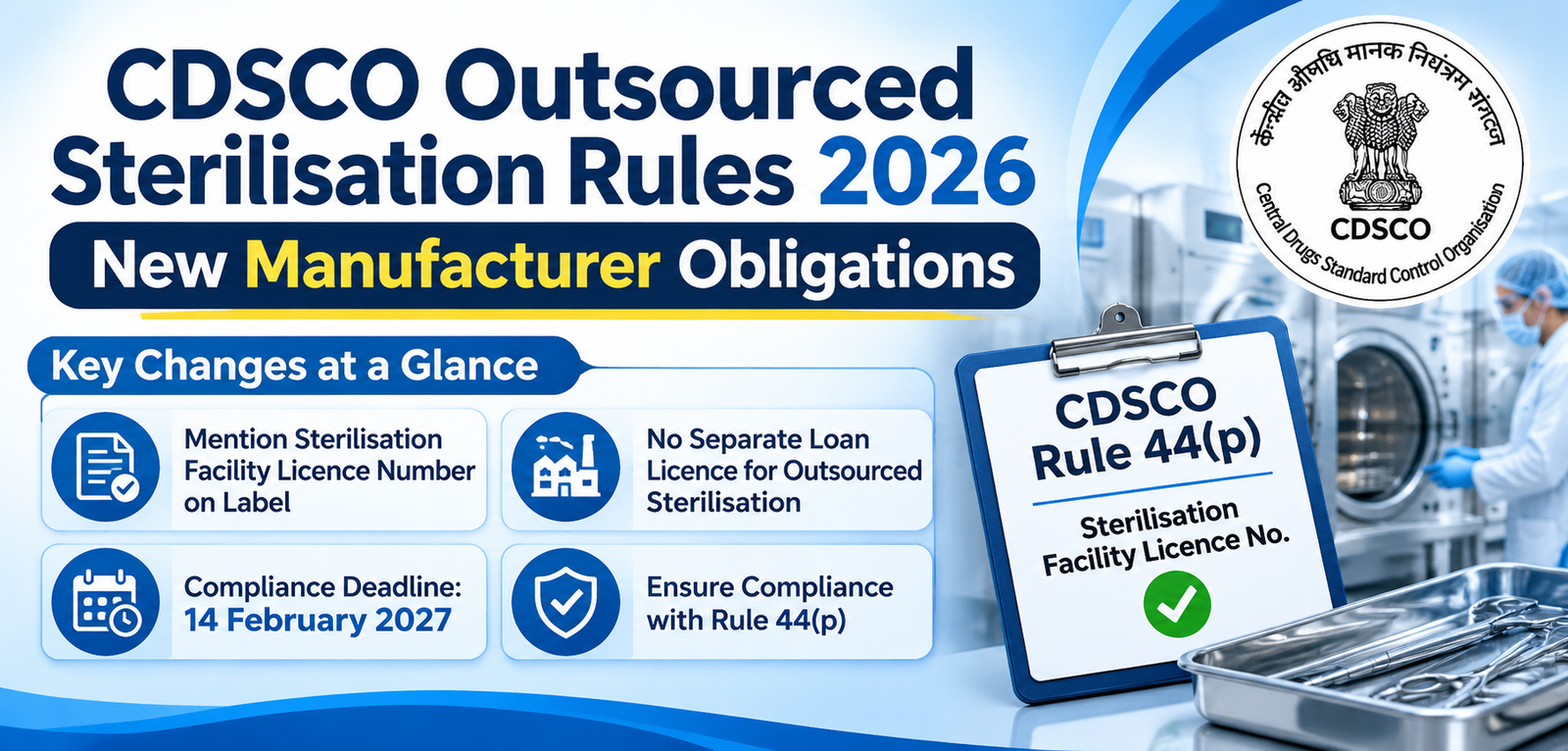
A new sub-rule (p) has been added to Rule 44 of the Medical Devices Rules, 2017. If a medical device manufacturer outsources the sterilisation of their medical devices to a facility which has a valid licence to perform this function, then the licence number of that sterilisation facility must be shown on the medical device label.
The government has implemented this change in order to further enhance transparency around and traceability of the medical device production process.
Further more, the amendment streamlines the licensing procedure. According to the Ministry of Health and Family Welfare, where a manufacturer utilises a sterilisation facility which is itself already licensed then the manufacturer will not now need to apply for a loan licence for the outsourced sterilisation function.
Objectives Of The Amendment
Enhance transparency around manufacturers’ outsourced sterilisation functions;
Facilitate identification of a sterilisation facility;
Further traceability of medical devices;
Minimise unnecessary licensing;
Enhance manufacturer compliance;
Enable effective regulatory oversight of sterilisation.
Why Did CDSCO Introduce New Outsourced Sterilisation Regulation?
Many medical devices, e.g. surgical tools, implants, syringes and needles, are manufactured and/or supplied in a sterile condition. Sterilisation is therefore an essential element of medical device production.
Whilst some manufacturers lack the infrastructure, machinery and skills to sterilise medical devices in-house, other manufacturers will outsource this function to dedicated sterilisation facilities.
It is important that the relevant sterilisation facility can be easily identified, as this is relevant for regulatory inspection, traceability and quality control.
The CDSCO Outsourced Sterilisation Rules 2026 achieve this by requiring the licence number of a medical device’s sterilisation facility to be shown on the medical device label.
Furthermore, this amendment reduces the extra licensing that may be needed by manufacturers who utilise suitably licensed external sterilisation facilities.
Importance Of The Amendment
To increase traceability – the relevant sterilisation facility can be identified using its licence number.
Streamline licensing – where a manufacturer uses a third-party sterilisation facility which is already licensed there is no longer a need for that manufacturer to apply for a loan licence for the outsourced sterilisation function.
To enhance transparency – extra information can be seen on medical device labels regarding which facility has been used for sterilisation.
To provide regulatory clarity – manufacturers are given clear guidance regarding both outsourced sterilisation functions and labelling.
What Does New Rule 44(p) Of The Medical Devices Rules, 2017 Contain?
One of the key aspects of the CDSCO Outsourced Sterilisation Rules 2026 is the inclusion of Rule 44(p).
This is specific to manufacturers who outsource sterilisation.
Where a medical device manufacturer employs a facility with a valid licence in order to sterilise medical devices then the licence number of that facility must be shown on the medical device label.
The amendment also highlights the various formats in which the licence number can be shown, always preceding it with one of the following:
Sterilization Sites Manufacturing License Number
Ster. Mfg. Lic. No.
S.M. L.
Manufacturers should ensure that the licence number which appears on medical device labels relates to the correct sterilisation facility.
Example: Imagine that a manufacturer makes sterile surgical instruments and does not have its own sterilisation function.
The manufacturer will outsource its sterilisation function to a third party which is itself licensed to undertake this work in accordance with the Medical Devices Rules, 2017.
The manufacturer should then show on its medical device labels the licence number of the third-party sterilisation facility. One of the above expressions should be shown first.
This assists in the identification of the facility which has been used for sterilisation.
What Are The New Labelling Requirements For Medical Device Manufacturers?
New Labelling Requirements are a key component of the CDSCO Outsourced Sterilisation Rules 2026. Manufacturers should assess their current medical device labelling and packaging so that the relevant information about the sterilisation facility can be incorporated.
Consideration should be given to:
- Display the licence number of the sterilisation facility
Manufacturers should show the licence number of a third-party facility which has been used for sterilisation.
- Precede the licence number with one of the permitted phrases
The licence number should always follow one of the above expressions as detailed in Rule 44(p).
An example would be:
Ster. Mfg. Lic. No
Please note that manufacturers should insert their own Sterilisation Facility Licence Number into the above example.
- Assess current packaging
Manufacturers should evaluate current printing, labelling and information on packaging in order to determine how best to insert the additional information.
- Ensure information is accurate
The licence details of the sterilisation facility should be both correct and in line with that entity’s valid documentation.
- Amend labelling procedures
Manufacturers should alter their labelling procedures and quality documentation so that they are in line with the new regulation.
When Will The New Sterilisation Labelling Regulation Come Into Effect?
The government has granted a six-month period in which to implement the new labelling regulation.
The Medical Devices (Second Amendment) Rules, 2026 were notified on 14 August 2026.
Consequently, the new labelling regulation contained within Rule 44(p) comes into effect on 14 February 2027.
Important dates
Notification date 14 August 2026
Period for implementation 6 months
Compliance due 14 February 2027
Whilst there are many factors to consider when altering labelling, establishing the correct licence for a sterilisation facility and amending packaging, manufacturers should not leave these tasks until the final days prior to the compliance deadline.
By adhering to the CDSCO Outsourced Sterilisation Rules 2026 within the implementation stage, manufacturers can help to avoid last-minute issues concerning compliance.
Is An Additional Loan Licence Still Required For Outsourced Sterilisation?
This is frequently asked by medical device manufacturers.
Until recently, in addition to the sterilisation facility’s licence, manufacturers often had to also obtain a loan licence for their outsourced sterilisation function. Even if the third-party facility was itself already licensed.
However, the 2026 amendment has simplified this process.
According to the Ministry of Health and Family Welfare, manufacturers no longer need to apply for an extra loan licence for their outsourced sterilisation function where they are utilising a third-party facility which is already licensed to carry out sterilisation in accordance with the Medical Devices Rules, 2017.
Nevertheless, it is vital that manufacturers only utilise third-party facilities which are licensed.
As well as ensuring that the correct facility is used, manufacturers must also comply with relevant quality and safety regulations.
What Types Of Documentation Should Manufacturers Prepare For Outsourced Sterilisation?
Although the new Rule 44(p) provides information relating specifically to labelling, manufacturers should also establish suitable documentation for their outsourced sterilisation function.
Such documentation can be used to demonstrate that a licensed facility has been utilised for sterilisation and that this has been effectively managed.
Previously, the CDSCO had issued guidance on documentation relating to outsourced sterilisation (see communication dated 24 June 2025).
Manufacturers should consider preparing the following types of documentation:
Document Purpose Sterilisation facility licence To confirm that a facility is licensed Outsourcing agreement To detail the outsourcing relationship
Quality Management System documentation To show how outsourced functions are managed Sterilisation documentation To provide evidence of sterilisation Batch documentation To assist with product and batch traceability Validation documentation To confirm that the sterilisation function has been validated Product labelling To demonstrate compliance with the new labelling regulation Depending on the relevant licensing conditions and regulatory expectations, specific documentation may be required. Manufacturers should ensure that their Quality Management System documentation reflects their outsourcing function.
How Will The CDSCO Outsourced Sterilisation Rules 2026 Impact Medical Device Manufacturers?
Overall, the CDSCO Outsourced Sterilisation Rules 2026 are likely to make it easier for manufacturers to manage their outsourced sterilisation functions and will further regulate this process.
Such regulation is of particular relevance to smaller and medium-sized medical device manufacturers who outsource their sterilisation function.
Below are some of the impacts of the amendment.
- Streamlined Licensing
Manufacturers who utilise a facility which is licensed for sterilisation will benefit from no longer needing to apply for an extra loan licence for their outsourced sterilisation function.
- Enhanced Regulatory Traceability
Medical device labels will contain the licence number of a sterilisation facility. This facilitates the identification of which facility has been used for this purpose.
- Altered Labelling And Packaging
Manufacturers must examine existing medical device labelling and incorporate the necessary information regarding the sterilisation facility within the appropriate timescale.
- Improved Documentation
Manufacturers should review their outsourcing agreement, quality and sterilisation documentation.
- Increased Operational Flexibility
Manufacturers who do not have in-house sterilisation functions can continue to utilise suitable third-party facilities without needing to additionally apply for a loan licence for their outsourced sterilisation function.
CDSCO Outsourced Sterilisation Rules 2026 – Manufacturer Compliance Checklist
Manufacturers can utilise a range of steps to prepare for the new regulation.
Consider the following:
Determine whether your medical device sterilisation function is in-house or outsourced.
Confirm that the third-party sterilisation facility is licensed.
Obtain and check the licence number of a medical device’s sterilisation facility.
Evaluate current medical device labelling and packaging.
Include information regarding the licence of the sterilisation facility.
Amend labelling and quality procedures.
Prepare and maintain outsourcing, quality and sterilisation documentation.
Establish and preserve validation and batch documentation.
Conduct a compliance review prior to 14 February 2027.
By following this checklist, manufacturers can effectively prepare for the CDSCO Outsourced Sterilisation Rules 2026 and further strengthen their compliance.
Common Compliance Issues Which Manufacturers Should Avoid
Despite the relative simplicity of the new regulation, manufacturers can sometimes encounter issues when implementing it.
Some of the most frequent compliance issues are:
- Utilising an unlicensed sterilisation facility
Not all third-party sterilisation facilities will necessarily be authorised to sterilise medical devices. Manufacturers should not assume that a particular third party is licensed.
- Continuing to use outdated labelling
Using pre-dated packaging after the compliance deadline can give rise to compliance issues.
- Including inaccurate licence information
The licence number which is shown on medical device labels should match that of the relevant sterilisation facility.
- Failing to establish appropriate documentation
Manufacturers should compile suitable documentation concerning outsourcing, quality and sterilisation.
- Confusing manufacturing and sterilisation licensing
A manufacturer’s manufacturing licence and a third-party sterilisation facility’s licence serve different regulatory purposes. It is important for manufacturers to recognise the distinction between these two types of licensing in order to effectively comply with the CDSCO Outsourced Sterilisation Rules 2026.
How ELT Corporate Can Help Medical Device Manufacturers
Often alongside dealing with various CDSCO regulations, manufacturers also need to both understand and correctly implement new regulatory requirements.
ELT Corporate supports medical device manufacturers, importers and others within the sector to both understand regulatory expectations and to prepare suitable documentation.
We can provide advice on medical device CDSCO registration
Offer guidance for manufacturers on obtaining a Medical Device Manufacturing Licence;
We provide
CDSCO Registration – Advice regarding medical device registration;
Medical Device Manufacturer’s Licence – Advice relating to manufacturer’s licence;
CDSCO Medical Device Import Licence – Advice on medical device import licences;
Regulatory – Advice in relation to the creation and review of regulatory material;
Medical Device Labelling– Advice on medical device labelling and awareness of regulatory developments;
Compliance – Advice on the Medical Devices Rules, 2017 and associated amendments;
Outsourced Sterilisation – Advice on the interpretation of the new Rule 44(p) together with information regarding facility licences and labelling modifications.
At ELT Corporate, we advise manufacturers on regulatory matters and support them in creating suitable regulatory material and strengthening their compliance procedures.
FAQs
Q1 What does Rule 44(p) of the Medical Devices Rules, 2017 state?
It states that manufacturers must add the licence number of an external service provider who has a current licence onto medical device labelling if they are having their medical devices sterilised by that service.
Q2 From when is the new outsourced sterilisation labelling obligation in force?
It will be in force from 14 February 2027. This follows a six-month period of transition which is included within the amendment.
Q3 Is a loan licence still needed for outsourced sterilisation in 2026?
No. The Ministry of Health and Family Welfare have stated that no loan licence is now needed for medical device sterilisation which is outsourced to an external service provider who has a current licence, in accordance with the Medical Devices Rules, 2017.
Q4 What details should be included on medical device labelling?
Medical device manufacturers must include the licence number of an external medical device sterilisation service provider on medical device labelling. This is usually denoted by one of a number of different designations, including ‘Ster. Mfg. Lic. No.’ or ‘S.M. L.’.
Q5 Are manufacturers free to select any external medical device sterilisation service provider?
No. Manufacturers must utilise an external medical device sterilisation service provider who has a current licence operating within the relevant regulatory environment.
Q6 Should manufacturers amend their medical device labelling?
Yes. Manufacturers should examine and amend their medical device labelling so that it meets the new labelling criteria for outsourced sterilisation prior to the enforcement date.
Q7 Which manufacturers are influenced by the new sterilisation rules?
Primarily, these rules will impact upon medical device manufacturers that outsource medical device sterilisation to another medical device sterilisation service provider who has a current licence.
Comments are closed