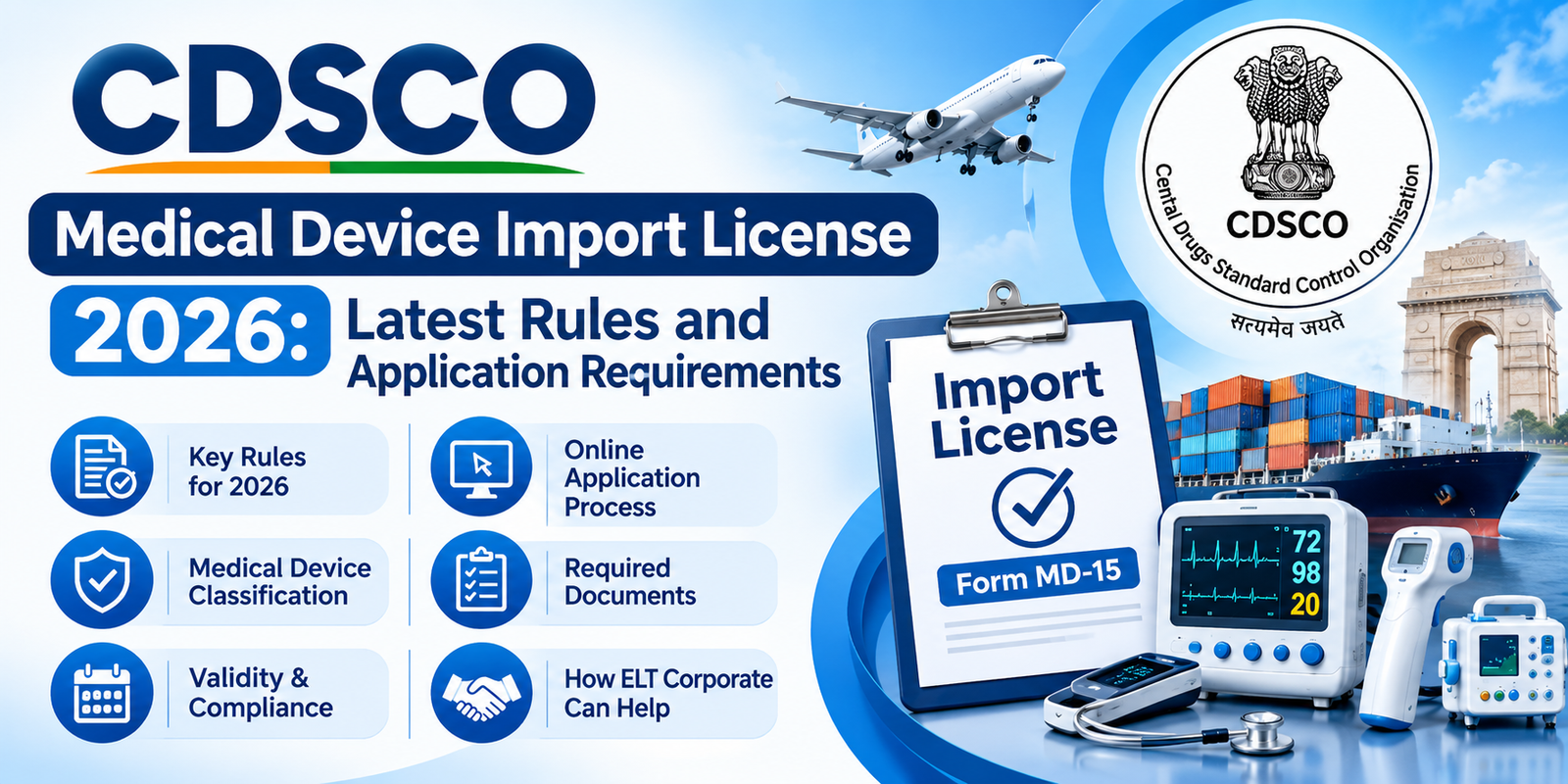
Importing medical devices into India requires businesses to follow the applicable regulatory requirements before placing their products in the Indian market. The Central Drugs Standard Control Organisation regulates medical devices in India under the Medical Devices Rules, 2017. Foreign manufacturers and Indian importers must understand the relevant licensing procedures, product classification, documentation and approval requirements.
The CDSCO Medical Device Import License is an important requirement for businesses planning to import regulated medical devices into India. The application process generally involves submitting the required information through the CDSCO online portal, providing supporting documents and obtaining the applicable import license from the regulatory authority.
In 2026, medical device importers should pay particular attention to regulatory updates, documentation accuracy, product classification and post-approval responsibilities. This guide explains the import licensing process in simple language, including eligibility, required documents, application steps, common mistakes and regulatory compliance.
What Is a CDSCO Medical Device Import License?
A CDSCO Medical Device Import License is regulatory permission required for importing medical devices into India for sale or distribution. It is granted by the Central Licensing Authority after reviewing the application and supporting documents.
Under the Medical Devices Rules, 2017, an eligible Indian authorised agent applies in Form MD-14 to obtain the import license in Form MD-15.
This process helps the regulatory authority verify important information about the imported product, such as:
- Medical device name and description.
- Intended use of the device.
- Manufacturing site details.
- Product safety and performance information.
- Quality management system documentation.
- Regulatory approval in the country of origin, where applicable.
The purpose is to ensure that imported medical devices meet the relevant Indian regulatory requirements before they are marketed or distributed.
Latest CDSCO Medical Device Import License Rules in 2026
Businesses planning to import medical devices should understand the current provisions under the Medical Devices Rules, 2017, including applicable amendments.
Here are seven important regulatory points:
1. Follow the Medical Devices Rules, 2017
Medical devices imported into India must comply with the applicable provisions of the Medical Devices Rules, 2017. These rules explain licensing, classification, documentation and other regulatory responsibilities.
2. Apply through Form MD-14
The authorised agent must submit the prescribed application in Form MD-14 through the CDSCO online system. The application should contain the required product and manufacturer information.
3. Obtain the Import License in Form MD-15
After reviewing the application and relevant documents, the Central Licensing Authority may grant the import license in Form MD-15 if the applicable requirements are satisfied.
4. Understand Medical Device Risk Classification
Medical devices are classified into four categories according to their risk level:
| Device class | Risk category |
| Class A | Low risk |
| Class B | Low-moderate risk |
| Class C | Moderate-high risk |
| Class D | High risk |
The applicable requirements depend on the device category and its intended purpose.
5. Provide Manufacturer and Product Documents
Importers must submit the relevant technical, manufacturing, quality and regulatory documents. The documentation requirements may differ depending on the classification of the device.
6. Check the 2026 Regulatory Amendments
The Medical Devices (Second Amendment) Rules, 2026 were notified on 14 August 2026. The amendment introduced requirements for labelling devices whose sterilisation is outsourced, including identification of the sterilisation site’s manufacturing license number.
Another important 2026 amendment added the European Union to the recognised jurisdictions under Rule 63 for eligible devices without predicate devices, subject to applicable conditions. These changes are particularly relevant when evaluating overseas approvals and supply arrangements.
7. Maintain License Validity and Compliance
An import license remains valid unless cancelled or surrendered, provided the required retention fee is deposited after every five years for each overseas manufacturing site and licensed medical device. Importers should also maintain accurate records and comply with applicable post-approval conditions.
Who Needs a CDSCO Medical Device Import License?
Businesses involved in importing medical devices into India for commercial purposes should determine the applicable licensing requirements before starting import operations.
The following businesses may need to consider this licensing process:
- Medical Device Importers: Companies importing medical devices from foreign manufacturers.
- Indian Authorised Agents: Representatives appointed by overseas manufacturers to handle regulatory responsibilities in India.
- Foreign Medical Device Manufacturers: Companies planning to introduce their products into the Indian market through an authorised agent.
- Healthcare Product Distributors: Businesses involved in supplying imported medical devices to hospitals, clinics and other eligible buyers.
- Medical Technology Companies: Organisations introducing diagnostic equipment, surgical instruments, implants and other regulated devices into India.
An overseas manufacturer generally needs an eligible Indian authorised agent to submit the application and manage the regulatory requirements.
Documents Required for CDSCO Medical Device Import License
Preparing accurate documents is one of the most important parts of the import licensing process. Missing, incomplete or inconsistent information may lead to regulatory queries and delays.
The following documents are commonly required, depending on the product category and applicable regulatory requirements.
| Document | Purpose |
| Form MD-14 application | Official import license application |
| Power of Attorney | Authorises the Indian agent to represent the foreign manufacturer |
| Wholesale or manufacturing license / MD-42 registration | Establishes the eligibility of the authorised agent |
| Free Sale Certificate | Supports the product’s regulatory status in the country of origin, where applicable |
| Manufacturing site registration | Provides details of the overseas manufacturing facility |
| Quality Management System certificate | Demonstrates applicable quality system compliance |
| Plant Master File | Describes the manufacturing facility and its operations |
| Device Master File | Provides technical and product-related information |
| Declaration of Conformity | States conformity with applicable requirements |
| Product specifications | Explains device design, characteristics and intended use |
| Clinical and performance information | Supports product safety and performance, where required |
| Fee payment proof | Confirms payment of the applicable application fee |
Additional documents may be requested depending on the medical device classification, regulatory pathway and manufacturing arrangements.
How to Apply for a CDSCO Medical Device Import License in India?
The application process involves several steps. Businesses should complete each stage carefully to avoid unnecessary application queries.
Step 1: Identify the Medical Device Classification
First, identify the correct risk class of the medical device. Check its intended use, design, working principle and applicable classification rules.
Step 2: Appoint an Indian Authorised Agent
An overseas manufacturer should appoint an eligible Indian authorised agent who can represent the manufacturer before the Indian regulatory authorities. The agent must fulfil the applicable licensing or registration requirements.
Step 3: Prepare the Required Documents
Collect the manufacturer’s regulatory certificates, technical documents, quality management information, product details and other supporting records. Check that the information is consistent across all documents.
Step 4: Submit the Application in Form MD-14
The authorised agent must complete Form MD-14 and submit the application through the CDSCO online system with the applicable documents and fee.
The official portal also requires applicants to add their Importer Exporter Code (IEC) details before applying for import licenses.
Medical Devices
Step 5: Respond to Regulatory Queries
The regulatory authority may examine the application and request additional information or clarification. Applicants should provide accurate responses and supporting documents within the applicable timeframe.
Step 6: Regulatory Review and Inspection, If Required
The Central Licensing Authority may review the documents and arrange an inspection of the overseas manufacturing site where considered necessary under the rules.
Step 7: Grant of Import License
After satisfactory evaluation, the authority may grant the import license in Form MD-15.
The applicant should check the license details and ensure that the approved product and manufacturing site information are correct.
Important: Rule 36 provides for a decision within nine months from the application date, subject to the applicable regulatory process. This is the prescribed period, not a guarantee that every application will be completed within that time.
How Does Medical Device Risk Classification Affect Import Licensing?
Risk classification is an important part of the import licensing process because the regulatory requirements vary according to the risk associated with a device.
| Classification | Examples |
| Class A | Non-sterile, non-measuring basic medical devices |
| Class B | Certain diagnostic and monitoring devices |
| Class C | Certain implants and higher-risk diagnostic devices |
| Class D | Certain life-supporting and high-risk devices |
The exact classification must be checked against the intended use and applicable CDSCO classification rules. A product should not be classified based only on its commercial name.
For businesses applying for a CDSCO Medical Device Import License, correct classification helps determine the appropriate regulatory pathway and documentation requirements.
Common Reasons for CDSCO Import License Application Queries
Importers sometimes face regulatory questions because their applications contain incomplete information or documents that do not match the manufacturer’s details.
Common reasons include:
- Incorrect medical device risk classification.
- Missing or improperly authenticated Power of Attorney.
- Incomplete Free Sale Certificate or regulatory approval documents.
- Differences in manufacturer and manufacturing site details.
- Missing technical information in the Device Master File.
- Incomplete quality management documentation.
- Incorrect product specifications or intended use.
- Missing information about the authorised agent.
To reduce these issues, applicants should review their documentation carefully before submitting the application.
What Is the Validity of a CDSCO Medical Device Import License?
An import license issued in Form MD-15 generally remains valid perpetually unless it is cancelled or surrendered.
However, the license holder must deposit the prescribed retention fee after every five years for each licensed medical device and overseas manufacturing site.
Failure to deposit the retention fee within the permitted period can result in deemed cancellation of the license.
Businesses should therefore maintain a compliance calendar and regularly check their license information and regulatory responsibilities.
How ELT Corporate Helps with CDSCO Import License Registration
Obtaining an import license requires proper documentation, an understanding of regulatory requirements and careful application preparation. ELT Corporate provides professional regulatory consultancy to businesses planning to import medical devices into India.
Our team assists clients throughout the CDSCO Medical Device Import License process, helping them understand the applicable requirements and manage the necessary documentation.
Our services include:
- Regulatory Consultation: Guidance on applicable CDSCO rules and import licensing requirements.
- Device Classification: Assistance in identifying the appropriate medical device risk category.
- Documentation Support: Assistance with preparing and reviewing technical and regulatory documents.
- Authorised Agent Support: Guidance on the requirements for appointing an Indian authorised agent.
- Application Filing: Assistance with preparing and submitting Form MD-14.
- Query Management: Support in preparing responses to regulatory questions.
- Post-Approval Compliance: Guidance on license retention and applicable regulatory responsibilities.
Whether you are a foreign manufacturer or an Indian medical device importer, ELT Corporate aims to make the CDSCO Medical Device Import License process easier to understand and manage.
Contact ELT Corporate for professional guidance on your medical device import licensing requirements.
Conclusion
The CDSCO Medical Device Import License is an important regulatory requirement for businesses planning to introduce medical devices into the Indian market. Understanding the Medical Devices Rules, 2017, identifying the correct product classification, preparing the necessary documents and following the appropriate application procedure can help businesses manage the licensing process more effectively.
In 2026, importers should also stay informed about applicable regulatory amendments, online portal requirements and post-approval responsibilities. Working with an experienced regulatory consultant can make the process easier and help businesses avoid common documentation mistakes.
ELT Corporate supports medical device manufacturers and importers with regulatory consultation, documentation and application-related assistance to help them navigate the Indian medical device regulatory framework.
Frequently Asked Questions
Q1. What is a CDSCO Medical Device Import License?
A CDSCO Medical Device Import License is regulatory permission issued by the Central Licensing Authority to eligible applicants for importing medical devices into India for sale or distribution. It is granted in Form MD-15.
Q2. Which form is required to apply for a medical device import license?
Applicants must submit their application in Form MD-14 through the CDSCO online portal. Once approved, the import license is issued in Form MD-15.
Q3. Who can apply for a CDSCO import license in India?
An eligible Indian authorised agent holding the required manufacturing, wholesale or applicable registration credentials can apply on behalf of an overseas medical device manufacturer.
Q4. Is a Free Sale Certificate required for medical device imports?
A Free Sale Certificate or relevant regulatory approval documentation may be required, depending on the applicable regulatory pathway and device category. Applicants should check the current Fourth Schedule requirements.
Q5. How many medical device risk classes are recognised by CDSCO?
CDSCO recognises four medical device risk classes: Class A, Class B, Class C, and Class D, ranging from low-risk to high-risk devices.
Q6. How long does it take to obtain an import license?
Under Rule 36, the prescribed decision period is within nine months from the application date. Actual processing depends on document completeness, regulatory review, inspections where required and responses to queries.
Q7. Is the CDSCO Medical Device Import License valid permanently?
Generally, the license remains valid perpetually unless cancelled or surrendered. However, the license holder must pay the applicable retention fee every five years to maintain its validity.
Q8. Can ELT Corporate help with the CDSCO import license application?
Yes. ELT Corporate provides consultancy support for the CDSCO Medical Device Import License process, including product classification, documentation, Form MD-14 application preparation, regulatory queries and post-approval compliance guidance.
Comments are closed