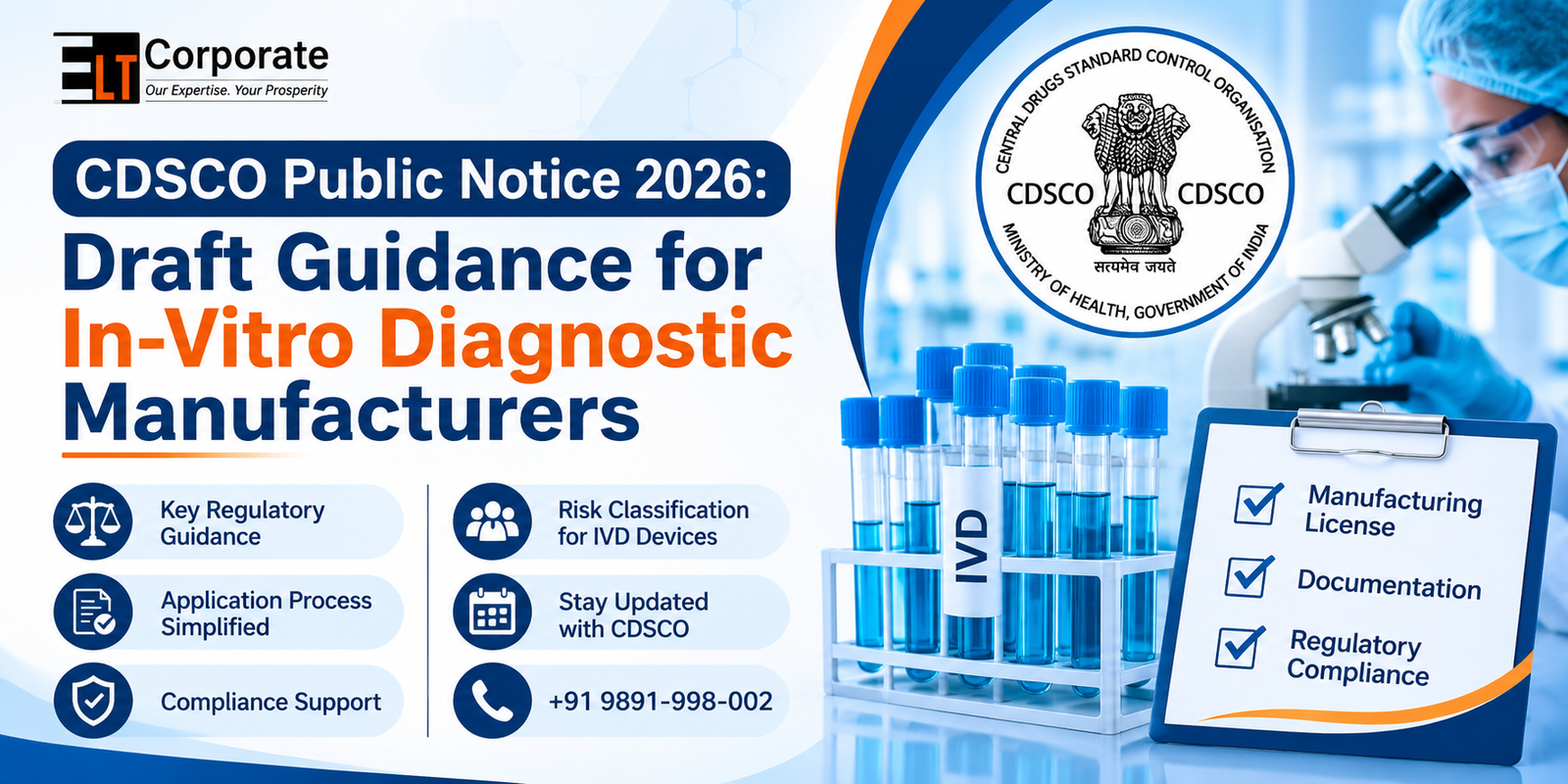
The Indian medical device regulatory framework continues to develop, with greater attention being given to the manufacturing and quality requirements of medical devices. In October 2026, the Central Drugs Standard Control Organization published a draft guidance document for manufacturers of In-Vitro Diagnostic Medical Devices.
The CDSCO Draft Guidance for IVD Medical Devices was published on 9 October 2026 under document number CDSCO/IVD/GD/DRAFT/MFG/01/2026. The main purpose of this document is to help manufacturers understand how to prepare and submit product license applications through the CDSCO Online System for Medical Devices and the National Single Window System.
This draft provides information about application requirements, the details to be submitted in different sections, and the supporting documents needed for regulatory review. It is particularly relevant to manufacturers planning to apply for a new IVD manufacturing license or seeking clarity about the application procedure.
In this article, we explain the important points of the draft guidance, its relevance for manufacturers, and the regulatory considerations businesses should understand in 2026.
What Is the CDSCO Draft Guidance for IVD Medical Devices 2026?
The CDSCO Draft Guidance for IVD Medical Devices is a regulatory guidance document prepared to assist manufacturers while submitting applications for IVD medical device manufacturing licenses in India.
IVD medical devices are products used to examine samples obtained from the human body, such as blood, urine, tissue, and other biological materials. These products help healthcare professionals identify diseases, monitor medical conditions, and support clinical decisions.
Examples include:
- Blood glucose monitoring test kits.
- Pregnancy test kits.
- HIV diagnostic test kits.
- Blood grouping reagents.
- Clinical chemistry analysers.
- Molecular diagnostic test kits.
- Rapid diagnostic test kits.
The draft guidance explains the information that applicants should provide in different sections of their online applications. It also aims to improve the completeness and accuracy of applications submitted to the regulatory authorities.
The CDSCO Draft Guidance for IVD Medical Devices is a draft document and should be understood separately from the binding requirements of the Medical Devices Rules, 2017.
Why Has CDSCO Published This Draft Guidance?
Preparing a manufacturing license application requires manufacturers to submit technical, regulatory, and quality-related information. Missing or unclear information can lead to regulatory queries and delays.
The purpose of the CDSCO Draft Guidance for IVD Medical Devices is to provide manufacturers with a clearer understanding of the application submission process.
Its main objectives include:
- Explaining the application submission procedure.
- Providing guidance on information required in application sections.
- Improving the accuracy of submitted documents.
- Supporting manufacturers in preparing complete applications.
- Helping applicants understand the relevant regulatory checklist.
- Making the online application process easier to understand.
This guidance is also useful for businesses planning to establish new IVD manufacturing facilities in India.
Who Should Follow the New CDSCO Draft Guidance?
The draft guidance is particularly relevant to businesses involved in the manufacturing of in-vitro diagnostic medical devices.
The following stakeholders should review the document:
IVD Medical Device Manufacturers: Companies manufacturing diagnostic kits, reagents, analysers, and other IVD products should understand the application requirements.
New Manufacturing Businesses: Businesses planning to enter the IVD manufacturing sector should understand the licensing process before starting their applications.
Loan License Applicants: Businesses applying for permission to manufacture IVD products through another licensed manufacturing facility should understand the applicable requirements.
Regulatory Affairs Professionals: Professionals responsible for preparing and submitting applications should review the guidance to understand the information expected by the authorities.
Quality Assurance Teams: QA professionals should understand the quality management and supporting documentation requirements associated with manufacturing license applications.
IVD Medical Device Risk Classification Under CDSCO
Risk classification is one of the most important steps before applying for an IVD manufacturing license. Under the Medical Devices Rules, 2017, IVD medical devices are divided into four classes according to their potential risk to individual health and public health.
The CDSCO Draft Guidance for IVD Medical Devices explains the following classification system:
| Device class | Risk category | Examples |
| Class A | Low Risk | Specimen containers, general laboratory reagents |
| Class B | Low-Moderate Risk | Pregnancy test kits, glucose strips |
| Class C | Moderate-High Risk | TB detection kits, congenital disorder screening kits |
| Class D | High Risk | HIV, HCV, HBV screening kits and blood grouping reagents |
Manufacturers should identify the correct classification based on the intended use and applicable classification parameters.
The classification list may be updated from time to time. Therefore, manufacturers should check the latest classification information before submitting an application.
Which Licensing Authority Is Responsible for IVD Manufacturing?
The applicable licensing authority depends on the risk class of the IVD medical device.
Under the CDSCO Draft Guidance for IVD Medical Devices, the responsibilities are divided between the Central Licensing Authority (CLA) and State Licensing Authority (SLA).
- Class A and Class B: Manufacturing licenses are issued by the State Licensing Authority.
- Class C and Class D: Manufacturing licenses are issued by the Central Licensing Authority through CDSCO.
This distinction is important because manufacturers must submit their applications to the appropriate authority.
Applying through the correct regulatory route helps avoid confusion during the licensing process.
Types of IVD Manufacturing Licenses and Application Forms
The draft guidance explains different application categories depending on the manufacturing purpose and product risk class.
The following table summarises the application forms and corresponding license forms:
| Purpose | IVD class | Application form | License form | Authority |
| Manufacturing license | A and B | MD-3 | MD-5 | SLA |
| Loan license | A and B | MD-4 | MD-6 | SLA |
| Manufacturing license | C and D | MD-7 | MD-9 | CLA |
| Loan license | C and D | MD-8 | MD-10 | CLA |
| Test manufacturing license | All classes | MD-12 | MD-13 | CLA |
Important application categories:
Fresh Manufacturing License: Required when a company establishes a new manufacturing facility or starts manufacturing IVD medical devices for the first time.
Loan License: Applicable when an applicant intends to manufacture IVD products using another licensee’s existing manufacturing facility, subject to the applicable regulatory conditions.
Test License: Required when manufacturing a limited quantity of IVD products for testing, evaluation, clinical investigations, demonstration, examination, or training.
Product Endorsement: Used when a manufacturer wants to add another IVD product to an existing manufacturing license, subject to the applicable requirements.
The CDSCO Draft Guidance for IVD Medical Devices provides information about these application pathways to help manufacturers understand which form applies to their activities.
Online Application Process for IVD Manufacturing License
CDSCO has identified the online application systems that manufacturers should use for different IVD manufacturing applications.
The draft guidance refers to two application platforms:
- CDSCO Online System for Medical Devices.
- National Single Window System.
The application platform depends on the type of license being requested.
General application process:
- Identify the IVD product and its applicable risk classification.
- Determine whether a fresh manufacturing license, loan license, test license, or product endorsement is required.
- Identify the appropriate licensing authority.
- Prepare the required company, manufacturing facility, and product-related documents.
- Complete the applicable online application form.
- Upload supporting technical and quality documents.
- Submit the application through the relevant online system.
- Respond to regulatory queries, if raised.
- Complete the applicable inspection and compliance requirements.
- Obtain the license after the application satisfies the applicable regulatory requirements.
For Forms MD-3, MD-4, MD-7, and MD-8, the draft identifies the CDSCO Online System for Medical Devices. Form MD-12 is submitted through NSWS.
Documents Required for IVD Manufacturing License Applications
Documentation is an important part of the licensing process. Manufacturers must prepare information about their company, manufacturing site, product design, quality systems, and device performance.
The draft guidance discusses documentation requirements for different application forms.
Some important documents and information include:
- Covering letter signed by the authorised signatory.
- Company constitution and registration details.
- Manufacturing site information.
- Plant Master File .
- Device Master File .
- Quality Management System documentation.
- Essential Principles Checklist.
- Risk management documentation.
- Product specifications and intended use.
- Device verification and validation information.
- Analytical performance evaluation.
- Clinical performance evidence, wherever applicable.
- Stability study information.
- Product labels and Instructions for Use .
- Details of qualified technical personnel.
- Manufacturing and testing facility details.
- Applicable undertakings and declarations.
The exact documents depend on the application category and the product involved.
Manufacturers should also ensure that the product information submitted in the application is consistent with the product label, IFU, technical file, and supporting evidence.
Quality Management System Requirements for IVD Manufacturers
A Quality Management System is essential for maintaining the consistency, safety, and performance of IVD medical devices.
Manufacturers should establish appropriate procedures and controls for their manufacturing activities.
Important QMS areas include:
Document Control: Maintain updated procedures, records, specifications, and manufacturing documents.
Quality Control: Establish suitable testing and inspection procedures for raw materials, intermediate products, and finished IVD devices.
Personnel Management: Ensure that manufacturing and testing activities are performed by suitably qualified and experienced personnel.
Equipment Management: Maintain equipment records, calibration information, maintenance schedules, and validation documents, as applicable.
Risk Management: Identify possible product and manufacturing risks and establish appropriate control measures.
Corrective and Preventive Actions: Investigate quality problems, identify their causes, and implement corrective actions.
The CDSCO Draft Guidance for IVD Medical Devices also highlights the importance of quality management, device verification, validation, and performance-related evidence.
Performance Evaluation and Technical Documentation
An IVD medical device must demonstrate that it performs according to its intended purpose.
Performance-related documentation helps establish whether a diagnostic product can provide reliable and appropriate results.
Manufacturers should consider the following areas:
- Analytical sensitivity and specificity.
- Accuracy and precision.
- Reproducibility.
- Interference and cross-reactivity.
- Limit of Detection (LoD), where applicable.
- Limit of Quantitation (LoQ), where applicable.
- Stability and shelf-life information.
- Verification and validation reports.
- Clinical performance evidence, where applicable.
The level of supporting evidence should be appropriate to the product’s intended use, technology, and risk classification.
The draft guidance also discusses the role of Device Master Files and supporting technical information in manufacturing applications.
Inspection Requirements for IVD Manufacturing Facilities
Manufacturing facility inspections are an important part of regulatory compliance.
The draft guidance explains inspection requirements for different IVD risk classes.
Manufacturers should ensure that their facilities are prepared for the applicable regulatory assessment.
Important areas that may require attention include:
- Manufacturing premises and facility layout.
- Equipment and instruments.
- Quality management procedures.
- Manufacturing and testing records.
- Personnel qualifications.
- Storage and environmental controls.
- Product testing arrangements.
- Documentation and traceability.
The draft guidance distinguishes between the inspection arrangements for Class A and B devices and those for Class C and D devices.
For Class C and D applications, the guidance describes inspection by the regulatory authority before grant of the applicable manufacturing license.
What Should Manufacturers Do After the CDSCO Public Notice?
The CDSCO Draft Guidance for IVD Medical Devices was published for stakeholder comments and suggestions on 9 October 2026.
The notice requested stakeholders to submit their comments within 15 days of publication. Therefore, the original comment period has passed as of November 2026.
However, manufacturers can still review the published draft and use it to understand the proposed application guidance.
Businesses should consider the following actions:
- Review the draft document carefully.
- Identify the regulatory requirements applicable to their IVD products.
- Check the latest product risk classification.
- Review existing manufacturing and quality documentation.
- Identify missing technical information.
- Check whether the correct application form has been selected.
- Monitor further CDSCO notifications and clarifications.
- Prepare applications in accordance with the applicable Medical Devices Rules, 2017.
Manufacturers should remember that the draft guidance does not replace the statutory provisions of the Medical Devices Rules, 2017. The final applicable requirements should always be checked against the current regulatory framework.
Important Takeaways from the CDSCO Draft Guidance 2026
The public notice and its accompanying draft document provide useful information for IVD manufacturers planning to apply for manufacturing licenses in India.
The main takeaways are:
- CDSCO published the draft guidance on 9 October 2026.
- The document focuses on manufacturing license applications.
- It explains the use of CDSCO Online System for Medical Devices and NSWS.
- IVD products are divided into four risk classes.
- Different licensing authorities handle different risk classes.
- Separate application forms apply to manufacturing, loan licensing, and test manufacturing.
- Technical documentation and quality systems are important parts of the application.
- Inspection requirements depend on the device class and applicable regulatory provisions.
The CDSCO Draft Guidance for IVD Medical Devices is particularly useful for manufacturers who want to understand the regulatory documentation and application process before submitting their applications.
How ELT Corporate Helps with CDSCO IVD Medical Device Registration
Understanding medical device regulations and preparing a complete manufacturing license application can be challenging, particularly for businesses entering the IVD sector for the first time.
ELT Corporate provides regulatory consulting support to businesses seeking assistance with medical device registration and licensing in India.
Our support can include:
- Guidance on IVD medical device risk classification.
- Assistance in identifying the applicable manufacturing license form.
- Preparation and review of regulatory documentation.
- Support with Device Master File and Plant Master File documentation.
- Guidance on Quality Management System requirements.
- Assistance with application preparation and submission.
- Support in responding to regulatory queries.
- Guidance on applicable CDSCO compliance requirements.
ELT Corporate aims to help manufacturers understand the regulatory process and prepare their applications with appropriate documentation.
If you are planning to manufacture IVD medical devices in India, professional regulatory guidance can help you understand the applicable requirements and organise your licensing documentation.
Conclusion
The publication of the CDSCO draft guidance in October 2026 is an important regulatory development for manufacturers of In-Vitro Diagnostic Medical Devices in India.
The document provides a structured explanation of manufacturing license applications, risk classification, documentation, online submission procedures, and inspection requirements.
Manufacturers should carefully review the CDSCO Draft Guidance for IVD Medical Devices and understand how the guidance relates to their products and manufacturing activities.
Businesses should also keep track of further CDSCO notifications, amendments, and clarifications to ensure that their manufacturing activities remain aligned with the applicable regulatory framework.
For manufacturers planning to enter the Indian IVD market, understanding the licensing requirements and preparing appropriate documentation are important steps towards regulatory compliance.
Frequently Asked Questions
Q1. What is the CDSCO Draft Guidance for IVD Medical Devices 2026?
It is a draft guidance document published by CDSCO on 9 October 2026 to help manufacturers understand the application process, documentation, and regulatory requirements for IVD medical device manufacturing licenses in India.
Q2. When did CDSCO publish the draft guidance for IVD manufacturers?
CDSCO published the draft guidance on 9 October 2026 under document number CDSCO/IVD/GD/DRAFT/MFG/01/2026.
Q3. What is the main purpose of the new CDSCO IVD manufacturing guidance?
Its main purpose is to explain the information and supporting documents required in different sections of manufacturing license applications submitted through the relevant online portals.
Q4. Which IVD medical devices are covered under the guidance?
The guidance covers in-vitro diagnostic medical devices, including diagnostic reagents, test kits, calibrators, control materials, instruments, analysers, and related products.
Q5. What are the four risk classes of IVD medical devices in India?
IVD medical devices are classified into four categories:
- Class A – Low Risk
- Class B – Low-Moderate Risk
- Class C – Moderate-High Risk
- Class D – High Risk
Q6. Which forms are required for IVD manufacturing licenses?
The applicable forms include MD-3 and MD-4 for Class A and B manufacturing and loan license applications, and MD-7 and MD-8 for Class C and D applications. Form MD-12 is used for a test manufacturing license.
Q7. Which authority grants IVD manufacturing licenses in India?
The State Licensing Authority grants manufacturing licenses for Class A and B IVD medical devices, while the Central Licensing Authority grants licenses for Class C and D devices.
Q8. Is the CDSCO Draft Guidance for IVD Medical Devices mandatory?
The document was published as a draft guidance for stakeholder comments. It is intended to explain regulatory application requirements and does not replace the binding provisions of the Medical Devices Rules, 2017.
Comments are closed