
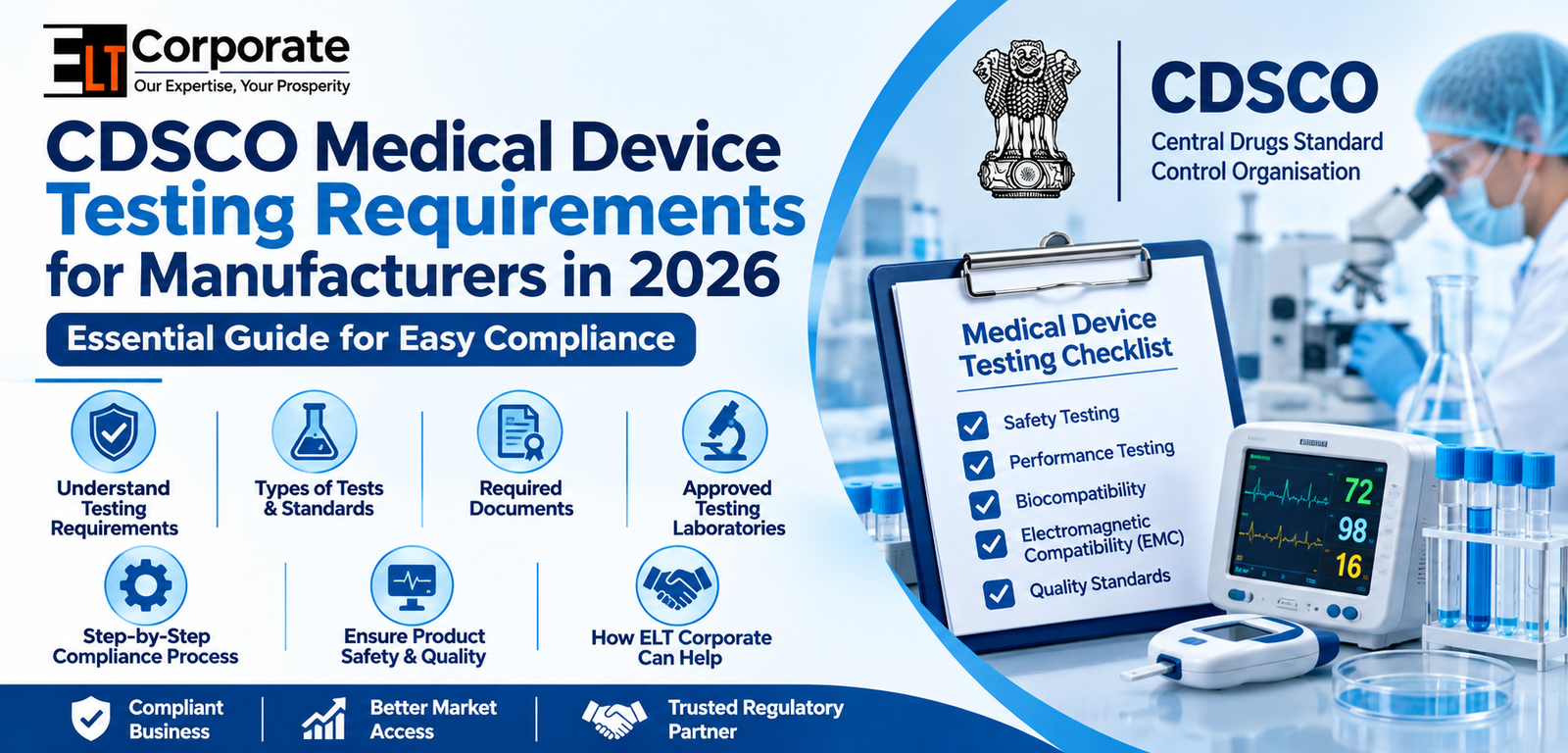
Manufacturing a medical device requires more than designing a product and preparing it for sale. Manufacturers must ensure that their medical devices are safe, effective for their intended purpose, and meet the applicable quality and performance requirements.
In India, the Central Drugs Standard Control Organization regulates medical devices under the Medical Devices Rules, 2017. Depending on the type, risk classification, and intended use of a device, manufacturers may need to conduct specific tests before applying for a manufacturing license or introducing their product into the market.
Understanding CDSCO Medical Device Testing Requirements helps manufacturers prepare the correct documents, select suitable testing laboratories, and avoid unnecessary delays during the approval process.
This guide explains the testing requirements, applicable standards, documents, laboratory requirements, and compliance process in simple English for medical device manufacturers in 2026.
What Are CDSCO Medical Device Testing Requirements?
CDSCO Medical Device Testing Requirements refer to the testing, evaluation, and documentation needed to demonstrate that a medical device meets applicable safety, quality, and performance requirements.
These requirements help manufacturers verify that their products:
- Are safe for patients and users.
- Perform according to their intended purpose.
- Meet applicable technical and quality standards.
- Are manufactured under a suitable quality management system.
- Have supporting test reports and technical documentation.
The testing requirements depend on the device’s classification, design, materials, intended use, and applicable regulatory pathway.
According to CDSCO, medical devices in India are regulated under the Drugs and Cosmetics Act, 1940, and the Medical Devices Rules, 2017.
Why Is Medical Device Testing Important for Manufacturers in 2026?
Medical device testing is an important part of regulatory compliance because it helps manufacturers identify product defects and demonstrate that their devices meet the required specifications.
Following CDSCO Medical Device Testing Requirements can help manufacturers:
1. Ensure Patient Safety
Testing helps identify risks such as electrical hazards, material-related problems, contamination, and device malfunction.
2. Demonstrate Product Performance
Manufacturers must provide evidence that their devices perform as claimed. Testing helps verify whether a product meets its intended purpose.
3. Support CDSCO Manufacturing License Applications
Test reports and technical documents may be required as part of the regulatory application, depending on the device and applicable requirements.
4. Improve Product Quality
Testing helps manufacturers identify design or production problems before commercial distribution.
5. Reduce Regulatory Delays
Preparing suitable testing documents in advance can help reduce incomplete submissions and requests for additional information.
CDSCO Medical Device Risk Classification and Testing Requirements
Medical devices are classified into four categories according to their risk level.
The testing requirements depend on the device’s risk classification and the nature of the product.
| Device Class | Risk Level | Examples |
| Class A | Low risk | Simple non-invasive devices |
| Class B | Low to moderate risk | Certain examination and monitoring devices |
| Class C | Moderate to high risk | Certain implantable and therapeutic devices |
| Class D | High risk | Certain life-supporting and high-risk implantable devices |
Important: These examples are indicative only. The actual classification depends on the intended use and applicable CDSCO classification rules.
Class A and Class B Medical Device Testing
Class A and Class B devices generally require testing based on their intended use, design, materials, and applicable standards.
Examples of testing may include:
- Physical and mechanical testing.
- Material safety evaluation.
- Biocompatibility testing, where applicable.
- Performance testing.
- Sterility testing, where applicable.
- Packaging and shelf-life evaluation, where applicable.
Class C and Class D Medical Device Testing
Class C and Class D devices may require more extensive testing and technical evidence because of their higher risk.
Depending on the product, testing may include:
- Detailed performance evaluation.
- Electrical safety and electromagnetic compatibility testing.
- Biocompatibility assessment.
- Sterility and microbiological testing.
- Software verification and validation.
- Clinical or performance evaluation evidence, where required.
Manufacturers should identify applicable requirements before finalising their testing plan.
Types of Medical Device Testing Required for CDSCO Compliance
Not every medical device requires the same tests. The following testing categories may apply depending on the product.
1. Physical and Mechanical Testing
Physical and mechanical testing checks whether a medical device can withstand normal use without breaking, deforming, or creating unacceptable risks.
Examples include:
- Tensile strength testing.
- Compression testing.
- Durability testing.
- Pressure resistance testing.
- Dimensional accuracy testing.
- Functional movement testing.
For example, an orthopaedic implant may require mechanical strength and durability testing to demonstrate that it can withstand the expected conditions of use.
2. Biocompatibility Testing
Biocompatibility testing evaluates whether the materials used in a medical device may cause harmful reactions when they come into contact with the human body.
Depending on the nature and duration of contact, the assessment may include:
- Cytotoxicity testing.
- Sensitisation testing.
- Irritation testing.
- Other biological safety evaluations, where applicable.
Manufacturers should consider the material composition, body-contact type, and duration of contact when determining the appropriate biological evaluation.
3. Electrical Safety Testing
Electrical safety testing may apply to medical devices that use electrical power.
These tests help evaluate risks associated with electrical shock, leakage current, insulation failure, and other electrical hazards.
Examples include:
- Electrical safety testing.
- Leakage current testing.
- Insulation resistance testing.
- Protective earth testing, where applicable.
- Temperature-related safety testing.
The applicable requirements may depend on standards such as IEC 60601-1.
4. Electromagnetic Compatibility Testing
Electromagnetic compatibility testing evaluates whether an electrical medical device can operate properly in its intended electromagnetic environment.
It also checks whether the device produces electromagnetic disturbances that could affect other equipment.
EMC testing may be relevant for:
- Patient monitoring systems.
- Medical imaging equipment.
- Electronic diagnostic devices.
- Therapeutic electrical equipment.
5. Sterility and Microbiological Testing
Sterility-related testing may be required for medical devices supplied as sterile or intended for use in sterile conditions.
Depending on the device, testing and validation may include:
- Sterility testing.
- Bioburden testing.
- Endotoxin testing, where applicable.
- Sterilisation process validation.
- Microbiological evaluation.
Manufacturers should also establish suitable controls for maintaining sterility during storage and distribution.
6. Packaging and Shelf-Life Testing
Packaging testing helps verify that the packaging protects the device during storage, transportation, and handling.
It may include:
- Packaging integrity testing.
- Seal strength testing.
- Transportation or distribution simulation.
- Accelerated ageing studies.
- Real-time stability studies.
- Shelf-life validation.
These studies help support the manufacturer’s claimed shelf life and packaging performance.
7. Software and Performance Testing
Medical devices that include software may require software verification, validation, and risk-related testing.
Examples include:
- Software functionality testing.
- Software verification and validation.
- Cybersecurity-related evaluation, where applicable.
- Performance testing.
- Risk management documentation.
For software-based medical devices, manufacturers should also review the relevant CDSCO guidance and applicable standards.
Which Standards Apply to Medical Device Testing in India?
The applicable standards depend on the type of medical device and its intended use.
Manufacturers should identify the relevant standards before preparing their testing protocols.
| Standard | General Application |
| ISO 13485 | Medical device quality management systems |
| ISO 14971 | Medical device risk management |
| ISO 10993 series | Biological evaluation of medical devices |
| IEC 60601 series | Medical electrical equipment safety and performance |
| IEC 62304 | Medical device software lifecycle processes |
| ISO 11607 series | Packaging for terminally sterilised medical devices |
| ISO 11135 | Ethylene oxide sterilisation |
| ISO 11137 | Radiation sterilisation |
CDSCO Medical Device Testing Laboratory Requirements
Manufacturers may conduct testing in their own facilities or use an eligible external laboratory, depending on the applicable regulatory requirements.
Under the Medical Devices Rules, 2017, Rule 83 provides for the registration of medical device testing laboratories that conduct testing or evaluation on behalf of manufacturers.
What Is MD-40 Medical Device Testing Laboratory Registration?
Form MD-40 is the registration certificate issued to an eligible medical device testing laboratory under the relevant provisions of the Medical Devices Rules, 2017.
The application for laboratory registration is made in Form MD-39.
A manufacturer selecting an external laboratory should verify that the laboratory is appropriately registered and has the required testing scope and facilities for the particular device.
CDSCO provides information on registered medical device testing laboratories and relevant regulatory requirements.
Important Requirements for Medical Device Testing Laboratories
A testing laboratory may need to demonstrate:
- Suitable premises and testing facilities.
- Qualified and experienced technical personnel.
- Appropriate testing equipment.
- Adequate space for the proposed testing activities.
- Proper environmental conditions for testing.
- A suitable laboratory quality management system.
- Valid accreditation, where required under the applicable rules.
The laboratory must have the facilities and technical capability to conduct the tests relevant to the medical device.
Documents Required for CDSCO Medical Device Testing
Manufacturers should prepare the necessary technical and regulatory documents before starting the testing process.
The exact documents depend on the device and the applicable regulatory pathway.
| Document | Purpose |
| Device description | Explains the product and its intended use |
| Device specifications | Defines technical and performance requirements |
| Device classification | Identifies the applicable risk class |
| Product drawings | Shows device design and dimensions |
| Bill of Materials | Identifies materials and components |
| Risk management file | Identifies and evaluates device-related risks |
| Test protocols | Defines testing methods and acceptance criteria |
| Test reports | Provides evidence of testing results |
| Quality management documents | Demonstrates manufacturing quality controls |
| Labelling and IFU | Explains intended use, warnings, and instructions |
| Stability and shelf-life data | Supports the claimed shelf life, where applicable |
| Sterilisation documents | Supports sterilisation claims, where applicable |
For certain applications, additional clinical, performance, or evaluation evidence may also be required.
Step-by-Step Process for Medical Device Testing in India
Manufacturers can follow the steps below to prepare for testing and regulatory compliance.
- Step 1: Identify the Medical Device Classification
Determine whether the device falls under Class A, B, C, or D based on its intended use and applicable classification rules. - Step 2: Review Applicable Standards
Identify relevant Indian or internationally recognised standards for the device. - Step 3: Prepare a Testing Plan
Define the required tests, methods, acceptance criteria, and sample quantities. - Step 4: Select a Suitable Testing Laboratory
Confirm the laboratory’s registration, testing scope, equipment, and technical capability. - Step 5: Submit Samples for Testing
Provide the required samples and technical information to the selected laboratory. - Step 6: Review the Test Reports
Evaluate the results against the applicable specifications and acceptance criteria. - Step 7: Prepare the Regulatory Application
Compile the test reports and other supporting documents required for the applicable manufacturing license or regulatory submission.
What Happens If a Medical Device Fails Testing?
If a medical device does not meet the applicable testing requirements, the manufacturer should investigate the reason for failure before proceeding.
The manufacturer may need to:
- Identify the cause of the failure.
- Review the device design and manufacturing process.
- Implement corrective and preventive actions.
- Update the risk management documentation.
- Repeat the relevant testing after making necessary corrections.
- Maintain records of the investigation and test results.
A failed test should not be ignored or removed from the technical documentation without a proper investigation.
Medical Device Testing Requirements for IVD Manufacturers
In-vitro diagnostic medical devices have specific testing and performance evaluation requirements.
These products are used to examine samples such as blood, urine, or other biological materials to provide diagnostic information.
Depending on the product, CDSCO Medical Device Testing Requirements for IVDs may include:
- Analytical performance evaluation.
- Sensitivity and specificity assessment.
- Accuracy and precision studies.
- Repeatability and reproducibility evaluation.
- Stability and shelf-life studies.
- Specimen and batch testing.
- Performance evaluation reports.
Manufacturers should review the applicable CDSCO IVD guidance before preparing their testing plan.
IVD Performance Evaluation and Documentation
IVD manufacturers should maintain suitable evidence demonstrating that their products perform according to their intended purpose.
The evidence may include analytical performance data, stability studies, and other product-specific evaluation reports.
The exact requirements depend on the IVD category, intended use, and applicable regulatory submission.
Common Mistakes Manufacturers Should Avoid
Manufacturers can reduce avoidable compliance problems by addressing the following issues before submitting their applications.
| Common Mistake | How to Avoid It |
| Selecting the wrong device classification | Verify classification before testing |
| Using an unsuitable testing laboratory | Check registration and testing scope |
| Following outdated standards | Verify the applicable standard edition |
| Submitting incomplete test reports | Review reports against regulatory requirements |
| Ignoring risk management | Maintain an updated risk management file |
| Making unsupported performance claims | Ensure claims are supported by evidence |
| Ignoring packaging and shelf life | Prepare applicable stability and packaging data |
| Delaying testing until the license application | Plan testing early in product development |
Conclusion
Understanding CDSCO Medical Device Testing Requirements is essential for manufacturers who want to develop and market safe, reliable, and compliant medical devices in India.
Medical device testing helps manufacturers demonstrate product safety, performance, quality, and compliance with applicable regulatory standards. From identifying the correct risk classification to selecting a suitable testing laboratory and preparing technical documentation, every step plays an important role in the regulatory process.
In 2026, manufacturers should carefully review the Medical Devices Rules, 2017, applicable CDSCO guidance, and relevant testing standards before beginning their regulatory applications.
Proper testing and documentation can help manufacturers reduce compliance issues, improve product quality, and prepare for a smoother medical device registration and licensing process.
How ELT Corporate Helps with CDSCO Medical Device Testing Requirements
ELT Corporate provides regulatory consultancy services to medical device manufacturers, importers, and healthcare businesses seeking regulatory compliance in India.
Our team can assist businesses with:
- Medical Device Registration: Guidance on applicable CDSCO registration and licensing requirements.
- Testing Requirements: Assistance in identifying relevant testing and technical documentation requirements.
- Testing Laboratory Guidance: Support in identifying suitable laboratories for applicable testing activities.
- Technical Documentation: Assistance with preparing and organising product-related regulatory documents.
- Manufacturing License Assistance: Support with applicable CDSCO manufacturing license applications.
- Regulatory Compliance: Guidance on applicable medical device regulatory requirements and documentation.
Whether you are a startup, an established manufacturer, or a medical device importer, ELT Corporate can help you understand the regulatory process and prepare your compliance documentation.
Visit ELT Corporate to learn more about our medical device regulatory services.
Frequently Asked Questions
Q1. What are CDSCO Medical Device Testing Requirements in 2026?
CDSCO Medical Device Testing Requirements include the applicable safety, performance, quality, and technical testing needed to demonstrate that a medical device meets regulatory requirements in India.
Q2. Is medical device testing mandatory for all manufacturers in India?
Testing or evaluation may be required depending on the device, its risk classification, intended use, and applicable regulatory pathway. Manufacturers should verify the specific requirements for their product.
Q3. Which medical device testing standards apply in India?
Applicable standards may include ISO 13485, ISO 14971, ISO 10993, IEC 60601, IEC 62304, and other product-specific standards. The applicable standards depend on the medical device.
Q4. What is Form MD-40 in medical device testing?
Form MD-40 is the registration certificate for a medical device testing laboratory under the Medical Devices Rules, 2017. The application for registration is made in Form MD-39.
Q5. Can manufacturers use an external medical device testing laboratory?
Yes. Manufacturers may use an eligible external laboratory for testing or evaluation, subject to applicable regulatory requirements and the laboratory’s registration and testing scope.
Q6. What documents are required for medical device testing?
Documents may include device specifications, product drawings, risk management documentation, testing protocols, test reports, quality management documents, labelling, and other product-specific technical information.
Q7. What happens if a medical device fails a CDSCO testing requirement?
The manufacturer should investigate the failure, identify the cause, implement corrective actions, and conduct the relevant testing again where necessary. Supporting records should be maintained.
Q8. How can ELT Corporate help with medical device testing compliance?
ELT Corporate can assist manufacturers with understanding applicable testing requirements, identifying suitable testing laboratories, preparing technical documentation, and navigating the relevant CDSCO registration and licensing process.
Comments are closed