
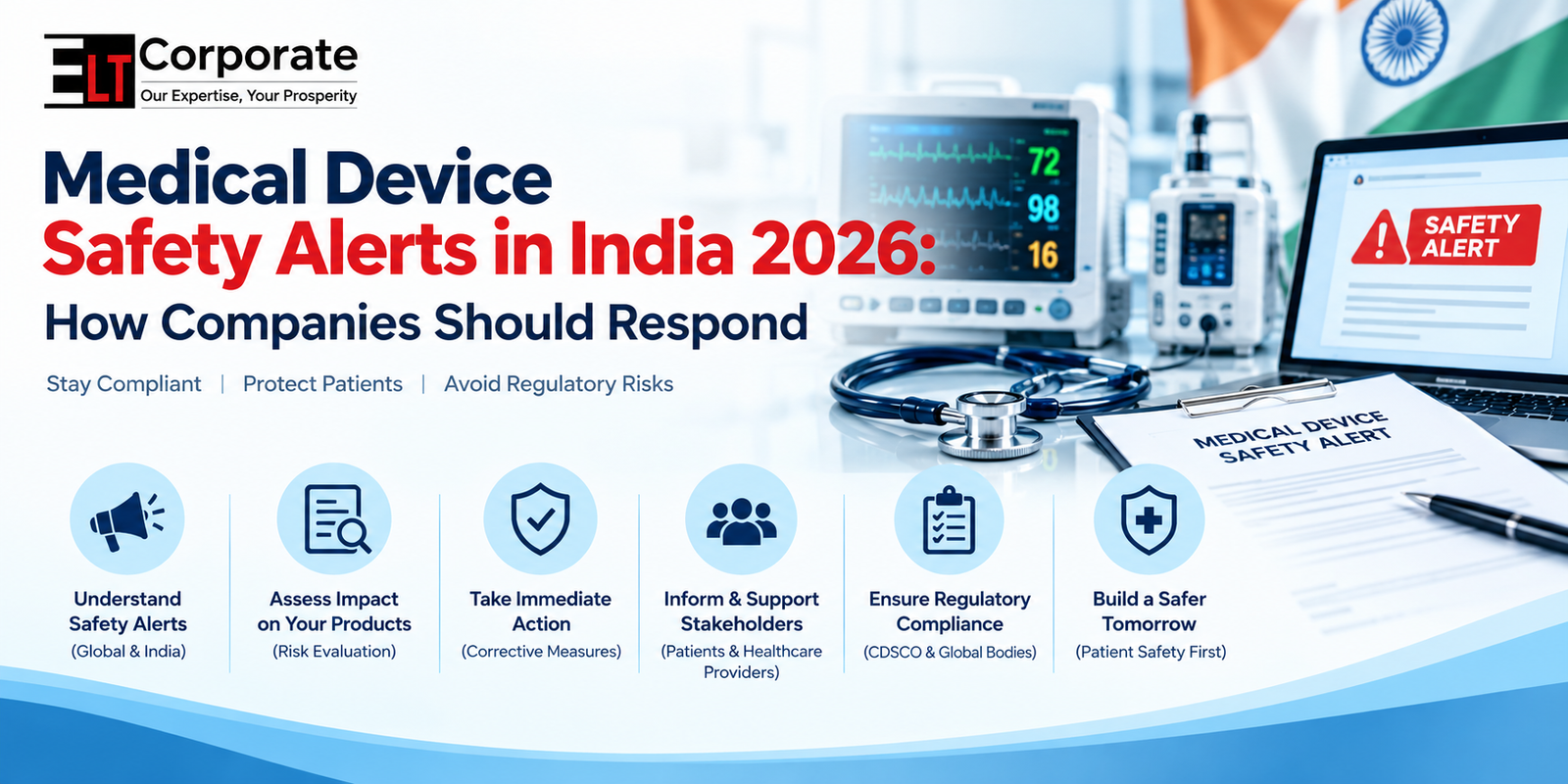
Medical devices play an important role in hospitals, diagnostic laboratories, clinics, and home healthcare. However, problems such as product defects, unexpected malfunctions, incorrect labelling, or safety-related incidents can affect patients and healthcare professionals.
Medical Device Safety Alerts in India 2026 matter to manufacturers, importers, authorised agents, distributors, and healthcare providers because businesses need a clear process to identify safety concerns and take appropriate action.
In India, the Central Drugs Standard Control Organisation oversees medical device regulation within the applicable legal framework. The Materiovigilance Programme of India, coordinated nationally by the Indian Pharmacopoeia Commission, supports the monitoring and reporting of medical device-related adverse events.
This guide explains what safety alerts mean, how companies should respond, what records they should maintain, and how ELT Corporate can assist with regulatory compliance.
What Are Medical Device Safety Alerts in India 2026?
Medical device safety alerts are communications that identify a potential or confirmed safety issue involving a medical device and explain what action may be needed to reduce risk. A safety alert may relate to a product defect, an unexpected malfunction, incorrect instructions, contamination, or another issue that could affect safe use.
For example, if a medical device repeatedly fails during its intended use, the manufacturer or relevant authority may need to investigate the problem and communicate appropriate precautions to users.
Why Are Medical Device Safety Alerts Important?
Safety alerts help companies and healthcare providers recognise possible risks before further harm occurs. Depending on the issue, the appropriate response may include:
- Investigating the reported problem.
- Informing affected customers or healthcare facilities.
- Issuing safety instructions.
- Correcting or replacing affected products.
- Initiating a field safety corrective action or recall, where necessary.
- Reporting relevant adverse events to the appropriate authority.
Not every safety alert automatically requires a product recall. The response should be based on the nature of the problem, the risk to patients, and the applicable regulatory requirements.
Who Should Monitor Medical Device Safety Alerts in India?
Everyone involved in the supply and use of medical devices should have an appropriate process for receiving and assessing safety information. Their responsibilities differ according to their role.
Medical Device Manufacturers
Manufacturers should monitor product performance, investigate complaints, evaluate potential risks, and take appropriate corrective action when they identify a safety issue. They should also maintain relevant technical records and meet applicable adverse-event reporting and post-market surveillance requirements.
Medical Device Importers
Importers should remain in contact with overseas manufacturers and monitor safety information affecting the products they supply in India. If an overseas manufacturer issues a warning or initiates a corrective action, the importer should assess whether Indian customers or regulatory authorities need to be informed.
Distributors and Dealers
Distributors should maintain traceable sales and delivery records so that affected products can be identified quickly. They should also communicate relevant safety information to customers and cooperate with the manufacturer or importer when corrective action is required.
Hospitals and Healthcare Providers
Healthcare facilities should have procedures for reporting suspected device-related incidents, preserving relevant information, and following safety instructions. Healthcare professionals should not ignore a suspected malfunction simply because the cause has not yet been confirmed.
What Are the Latest Safety Reporting Developments Companies Should Know in 2026?
Companies should monitor official CDSCO and IPC publications rather than rely only on news reports or information circulated by suppliers.
In 2026, the IPC published updated resources supporting medical device adverse-event reporting, including reporting tools updated on 2 September 2026 and hospital guidance for safety monitoring and reporting, Version 1.3, updated on 1 October 2026. These resources help stakeholders understand how to document and report suspected incidents.
The following areas deserve particular attention:
- Adverse-event reporting: Ensure staff know how to record and escalate suspected device-related incidents.
- Post-market surveillance: Review complaints, malfunction reports, and emerging safety trends.
- Field safety corrective actions: Prepare a process for communicating with customers and addressing identified risks.
- Regulatory updates: Check official notices and guidance for changes that affect your device or business.
For the latest notices, review the official CDSCO medical device section and the IPC Materiovigilance Programme of India resources.
What Should Companies Do After Receiving a Medical Device Safety Alert?
Companies should assess the alert promptly, identify affected products, evaluate the risk, and take appropriate action. They should not ignore an alert simply because no complaint has yet been received from their own customers.
Step 1: Verify the Safety Alert
Check the alert’s source, issue date, device name, model number, manufacturer, batch or lot number, and any serial numbers listed.
Confirm whether the alert applies to the products your business manufactures, imports, stores, or distributes.
Step 2: Identify Affected Products
Review inventory, import records, invoices, and distribution records to identify affected products and their locations.
If products have already been supplied, determine which distributors, hospitals, clinics, or other customers may need to be contacted.
Step 3: Assess the Potential Risk
Work with the relevant technical and quality teams to understand the reported problem and its potential impact on patients or users.
Consider whether the issue could cause injury, delay treatment, produce incorrect test results, or prevent the device from performing its intended function.
Step 4: Take Appropriate Corrective Action
Depending on the assessment, actions may include issuing customer instructions, inspecting products, repairing or replacing affected units, stopping distribution, or initiating a recall where necessary.
The response should be proportionate to the risk and consistent with applicable regulatory requirements.
Step 5: Notify Relevant Stakeholders
Inform affected customers, healthcare facilities, suppliers, and regulatory authorities as required. Provide clear instructions on what they should do with the affected devices.
Step 6: Maintain Records
Document the alert, investigation, risk assessment, decisions, communications, corrective actions, and follow-up activities.
Step 7: Review Whether the Problem Has Been Resolved
Verify that affected products have been identified and the required actions have been completed. Review whether additional preventive measures are needed.
A documented response process helps companies manage Medical Device Safety Alerts in India 2026 more consistently and demonstrate how they addressed the issue.
What Is the Difference Between a Safety Alert, an Adverse Event, and a Product Recall?
These terms are related, but they do not mean the same thing.
| Term | Meaning |
| Safety alert | A communication about a potential or confirmed safety concern and the actions that may be needed. |
| Adverse event | An incident associated with the use of a medical device that may have caused or contributed to harm or another unwanted outcome. |
| Field safety corrective action | An action taken by a manufacturer or responsible company to reduce a risk associated with a device already placed on the market. |
| Product recall | An action to retrieve, correct, replace, or otherwise address affected products, depending on the circumstances and applicable requirements. |
A safety alert does not automatically mean every unit must be recalled. However, a serious risk may require urgent corrective action.
Companies should evaluate the available evidence, follow applicable reporting requirements, and avoid delaying necessary patient-safety measures while waiting for complete certainty about the cause.
How Should Companies Report Medical Device Adverse Events in India?
Companies should establish a process to record suspected adverse events and report them through the applicable regulatory channels.
The Materiovigilance Programme of India supports the collection and evaluation of medical device-related adverse-event information. IPC provides reporting tools for licence holders, healthcare professionals, consumers, and other relevant stakeholders.
What Information Should Be Collected?
Depending on the reporting form and the incident, useful information may include:
- Device name, model, manufacturer, and identification details.
- Batch, lot, or serial number, where available.
- Date and description of the incident.
- Details of the malfunction or suspected defect.
- Patient impact or potential risk, where relevant and appropriately documented.
- Actions already taken to reduce the risk.
- Contact details for follow-up and investigation.
- Relevant photographs, test results, or supporting documents, where appropriate.
Companies should preserve accurate records and protect personal and confidential information.
Where Can a Company Find the Reporting Forms?
The IPC publishes medical device adverse-event reporting tools and a Field Safety Corrective Action form through its MvPI resources. Companies should select the form appropriate to their role and incident.
Visit the official medical device adverse-event reporting resources to review the available forms.
Important: Reporting through MvPI does not necessarily replace a separate notification to the relevant licensing authority when that notification is required. Companies should follow the requirements applicable to their licence and incident.
What Documents Should Companies Maintain During a Safety Investigation?
Answer: Companies should maintain a complete record of the incident, the investigation, and any corrective action taken. These records help demonstrate that the company assessed the risk and responded appropriately.
Important records may include:
- Customer complaints and adverse-event reports.
- Product batch, lot, and serial-number records.
- Manufacturing and quality-control records, where applicable.
- Supplier and distributor communication.
- Risk assessments and investigation findings.
- Corrective and preventive action records.
- Copies of safety notices and customer notifications.
- Recall or field safety corrective action records, where applicable.
- Evidence of follow-up and action completion.
For businesses responding to Medical Device Safety Alerts in India 2026, accurate documentation can also help identify recurring problems and prevent similar incidents.
Companies should retain records in accordance with applicable regulatory requirements and their documented quality management procedures.
What Happens If a Company Ignores a Medical Device Safety Alert?
Answer: Ignoring a relevant safety alert can increase risks to patients and create regulatory and commercial problems for a business.
Potential consequences may include:
- Continued use of a device that presents a safety risk.
- Delayed identification of affected products.
- Inadequate communication with healthcare providers.
- Failure to complete necessary corrective actions.
- Regulatory scrutiny or enforcement action where legal obligations have been breached.
- Damage to customer confidence and business reputation.
The actual consequences depend on the facts, the seriousness of the issue, and the applicable legal requirements. Not every missed alert results in the same legal outcome.
Businesses should therefore have a clear internal procedure for escalating safety concerns, assigning responsibility, and tracking corrective actions until completion.
How Can Companies Prepare for Medical Device Safety Alerts in India 2026?
Companies should prepare before an incident occurs rather than develop their response process during an emergency.
A practical preparation checklist includes:
- Assign responsibility for monitoring official safety notices.
- Maintain an up-to-date list of products and their identification details.
- Keep reliable supplier, importer, and customer records.
- Establish a complaint-handling and adverse-event reporting procedure.
- Define how safety risks will be assessed and escalated.
- Prepare a process for customer notifications and recalls, where required.
- Train relevant staff on incident reporting and documentation.
- Review corrective actions and update procedures when necessary.
Manufacturers and importers should also monitor the regulatory requirements relevant to their specific products. Businesses dealing with medical device software should review the guidance applicable to that category, including relevant vigilance and post-market surveillance expectations.
A well-prepared business can respond more effectively when Medical Device Safety Alerts in India 2026 identify a possible problem with a product it supplies.
How Can ELT Corporate Help With Medical Device Safety and Regulatory Compliance?
ELT Corporate helps businesses understand medical device regulatory requirements and prepare for compliance-related activities in India.
When a manufacturer, importer, or distributor identifies a potential safety issue, understanding the applicable regulatory responsibilities is an important first step.
Our support may include:
- Regulatory compliance guidance: Understanding relevant medical device rules and licensing conditions.
- Documentation review: Organising and reviewing regulatory documents and supporting records.
- Adverse-event reporting guidance: Helping businesses understand applicable reporting procedures and documentation requirements.
- Safety action documentation: Assisting with organising records relating to investigations and corrective actions.
- Import and manufacturing compliance: Guidance on applicable licensing and regulatory requirements.
- Regulatory query assistance: Helping businesses understand and prepare responses to relevant regulatory queries.
ELT Corporate can help businesses understand their regulatory obligations and plan appropriate next steps. The specific support required depends on the device, the nature of the incident, and the applicable legal requirements.
For more information, visit our medical device registration website or explore our medical device services.
Conclusion
Medical device safety is an ongoing responsibility that continues after a product reaches the market. Manufacturers, importers, distributors, and healthcare providers should know how to identify safety concerns, document incidents, communicate with affected stakeholders, and take appropriate corrective action.
Medical Device Safety Alerts in India 2026 highlight the importance of timely reporting, effective post-market surveillance, accurate records, and cooperation with the relevant regulatory authorities.
Companies should monitor official CDSCO and IPC updates, maintain a reliable complaint-handling process, and ensure that staff understand their responsibilities. If a safety
concern arises, they should assess the risk promptly and follow the applicable reporting and corrective-action requirements.
ELT Corporate can assist businesses in understanding medical device regulatory compliance and preparing the documentation needed to support their regulatory processes.
Frequently Asked Questions
Q1. What are medical device safety alerts in India?
Medical device safety alerts communicate potential or confirmed safety concerns involving medical devices and explain what precautions or corrective actions may be necessary.
Q2. Which authority regulates medical device safety in India?
CDSCO is India’s central medical device regulator. The Indian Pharmacopoeia Commission coordinates the Materiovigilance Programme of India, which supports the monitoring and reporting of medical device-related adverse events.
Q3. What should a company do after receiving a medical device safety alert?
The company should verify the alert, identify affected products, assess the potential risk, take appropriate corrective action, notify relevant stakeholders as required, and maintain complete records.
Q4. What is the Materiovigilance Programme of India?
MvPI is a programme designed to monitor and evaluate adverse events associated with medical devices, supporting better safety monitoring and patient protection.
Q5. How can companies report medical device adverse events in India?
Companies can review the relevant reporting forms and procedures published by IPC under MvPI. They should also meet any separate reporting obligations applicable to their licence and the incident.
Q6. Does every medical device safety alert require a recall?
No. The appropriate response depends on the identified risk and the circumstances. Actions may include a safety notice, repair, replacement, distribution restrictions, or a recall where necessary.
Q7. What records should a company maintain after a safety incident?
Records may include complaints, device identification details, investigation findings, risk assessments, communications, adverse-event reports, and corrective-action documentation.
Q8. How can ELT Corporate help with medical device safety compliance?
ELT Corporate can provide guidance on relevant regulatory requirements, licensing compliance, documentation, and applicable reporting procedures. The appropriate support depends on the company’s role and the specific issue.
Comments are closed