
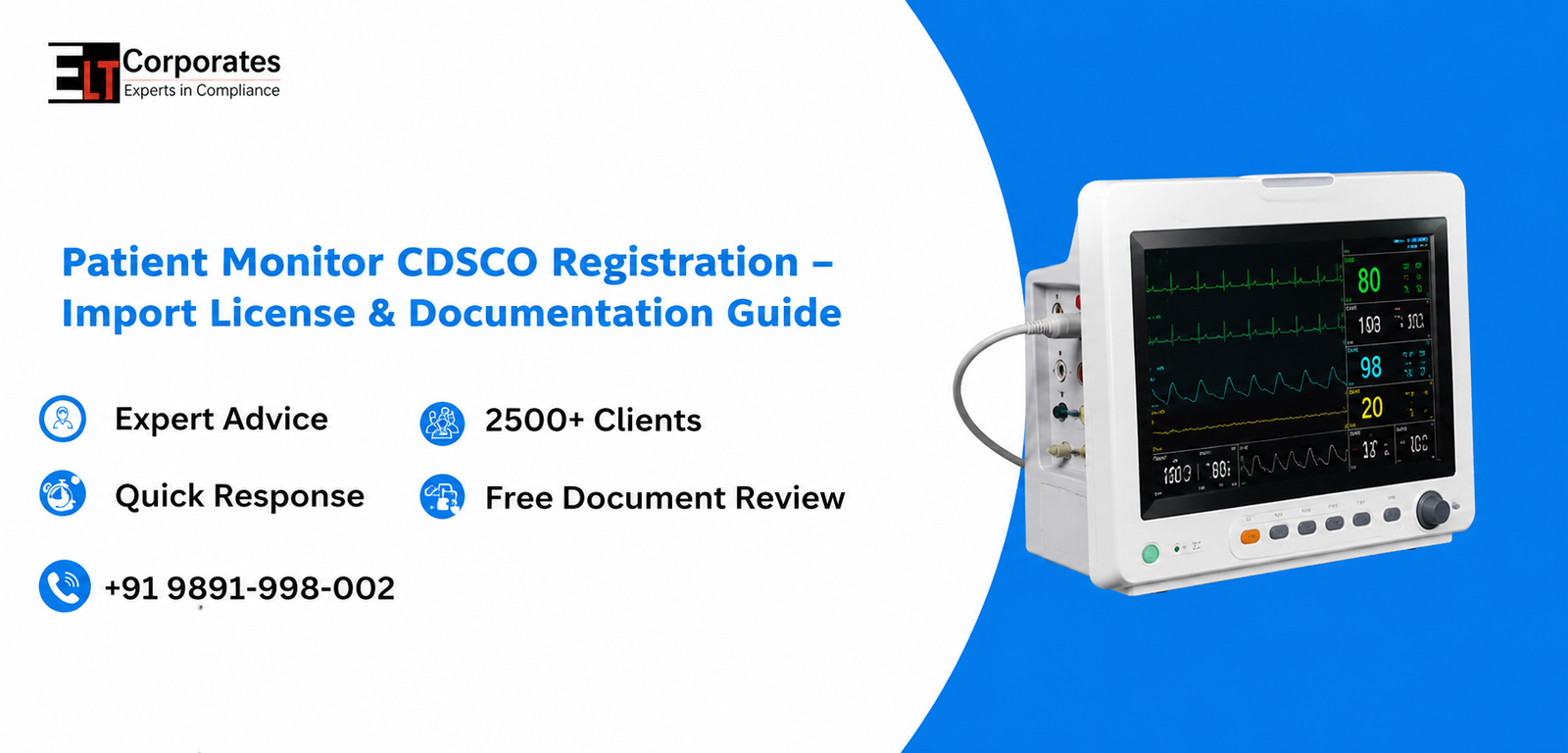
Patient monitors are life-critical medical devices used in hospitals, ICUs, operation theatres, and emergency units to continuously track vital parameters such as heart rate, blood pressure, oxygen saturation (SpO₂), respiratory rate, and temperature. In India, importing and selling patient monitors requires mandatory registration and licensing under the Central Drugs Standard Control Organisation (CDSCO) — the apex regulatory authority for medical devices under the Ministry of Health and Family Welfare.
This guide provides a comprehensive overview of the CDSCO registration process for patient monitors, including applicable regulations, import licensing requirements, and the documentation needed for successful compliance.
Regulatory Framework
The Medical Devices Rules, 2017 (MDR 2017)
Patient monitors fall under the purview of the Medical Devices Rules, 2017, notified under the Drugs and Cosmetics Act, 1940. These rules govern the manufacture, import, sale, and distribution of medical devices in India and are the primary legal basis for CDSCO registration.
Risk-Based Classification
Under MDR 2017, medical devices are classified based on their associated risk:
| Class | Risk Level | Description |
| Class A | Low Risk | Non-invasive, minimal patient contact |
| Class B | Low-Moderate Risk | Non-invasive, measuring or monitoring |
| Class C | Moderate-High Risk | Invasive or life-supporting |
| Class D | High Risk | Implantable or sustaining life |
Patient monitors are generally classified as Class B or Class C devices depending on their intended use and features. A basic bedside monitor may qualify as Class B, while a multi-parameter ICU monitor with invasive capabilities may be classified as Class C.
Schedule M (Medical Devices)
Schedule M of the Drugs and Cosmetics Act outlines Good Manufacturing Practices (GMP) for medical devices. Foreign manufacturers must demonstrate compliance with equivalent quality standards such as ISO 13485 to qualify for registration.
Types of Registrations/Licenses Required
1. Import License (Form MD-15)
Any entity wishing to import patient monitors into India must obtain an Import License in Form MD-15 from CDSCO. This license is issued to the Indian authorised agent/importer on behalf of the foreign manufacturer.
Key points:
- The Import License is device-specific and manufacturer-specific.
- A separate license is required for each model/variant.
- It is valid for a period of five years and can be renewed.
2. Registration Certificate for the Device
Before an Import License is granted, the foreign manufacturer must have their device registered with CDSCO. This involves submitting technical and safety documentation for evaluation.
3. Indian Authorised Agent (IAA) Appointment
The foreign manufacturer must appoint an Indian Authorised Agent (IAA) who acts as the regulatory interface with CDSCO. The IAA is responsible for:
- Submitting all regulatory filings
- Responding to queries from CDSCO
- Ensuring post-market surveillance
- Maintaining records of imports and distribution
Step-by-Step Registration Process
Step 1: Device Classification Confirmation
Before initiating registration, confirm the device’s regulatory classification under MDR 2017 Schedule I. For patient monitors, review the intended use, features (invasive vs. non-invasive), and applicable standards to determine if the device is Class B or Class C.
Step 2: Appointment of Indian Authorised Agent
The foreign manufacturer executes a formal Letter of Authorisation (LoA) appointing an IAA registered in India. The IAA must hold a valid Import License (Form MD-5) for wholesale distribution of medical devices.
Step 3: Online Application on SUGAM Portal
CDSCO processes all medical device registrations through its online portal — SUGAM. The applicant (IAA) creates an account and submits the application electronically along with scanned supporting documents.
Step 4: Technical Dossier Submission
A comprehensive Technical Dossier must be submitted as part of the application. See the Documentation Checklist section below for the full list of required documents.
Step 5: Application Review and Scrutiny
CDSCO’s Notified Body or technical committee reviews the application. They may raise queries (Deficiency Letters) seeking clarifications or additional documents. The applicant must respond within the specified timeframe.
Step 6: Site Inspection (if applicable)
For Class C and Class D devices, CDSCO may conduct a factory inspection of the foreign manufacturer’s facility or accept an equivalent audit report from a recognised body (such as a CE/ISO auditor).
Step 7: Grant of Import License (Form MD-15)
Upon satisfactory review, CDSCO grants the Import License (Form MD-15), enabling the device to be legally imported into India.
Documentation Checklist for Patient Monitor Registration
A. Administrative Documents
- Covering Letter — Addressed to the Central Licensing Authority (CDSCO), summarising the application
- Application Form — Duly filled Form MD-14 (application for import license) or as applicable
- Proof of Incorporation — Certificate of Incorporation of the foreign manufacturer
- Letter of Authorisation — Appointing the Indian Authorised Agent, notarised and apostilled
- Undertaking from Manufacturer — Declaring the accuracy of information and compliance with MDR 2017
- IAA License Copy — Valid Wholesale Drug License (Form MD-5) of the Indian Authorised Agent
B. Technical & Quality Documents
- ISO 13485 Certificate — Quality Management System certificate of the manufacturer (valid and issued by accredited body)
- CE Marking Certificate / US FDA 510(k) / TGA / Health Canada Approval — Free Sale Certificate from the country of origin
- IEC/ISO Standards Compliance — Test reports demonstrating compliance with applicable standards:
- IEC 60601-1 (General Safety and Performance)
- IEC 60601-1-2 (EMC)
- IEC 60601-1-6 (Usability)
- IEC 60601-2-49 (Multi-parameter patient monitors — specific requirements)
- ISO 80601-2-61 (SpO₂ monitoring, if applicable)
- Risk Management File — As per ISO 14971 (Risk Management for Medical Devices)
- Design and Development Documentation — Summary of design history file
- Software Documentation — If the monitor has embedded software, Software Safety Classification per IEC 62304
C. Device-Specific Documents
- Device Description and Intended Use — Detailed description of the patient monitor including:
- Intended purpose and patient population
- Parameters measured (ECG, SpO₂, NIBP, EtCO₂, temperature, etc.)
- Accessories and peripheral components
- Technical Specifications Sheet — Including power requirements, display specs, alarm systems, connectivity features
- Instruction for Use (IFU) — Complete user manual in English (or English + Hindi if applicable)
- Labelling — Device labelling compliant with MDR 2017 Schedule VII requirements
- Shelf Life / Expiry Information — If applicable
D. Clinical & Performance Evidence
- Clinical Evidence — Summary of clinical investigations or literature establishing the safety and performance of the monitor
- Post-Market Surveillance Plan — How the manufacturer will monitor device safety post-approval
- Vigilance/Adverse Event Reporting SOP — Procedure for reporting adverse events to CDSCO
E. Financial & Fee Documents
- Application Fee Payment Proof — Fee paid via SUGAM portal (varies by device class; refer to current CDSCO fee schedule)
- Power of Attorney — If submitted through a regulatory consultant on behalf of the IAA
Key Regulatory Standards for Patient Monitors
| Standard | Scope |
| IEC 60601-1 | General safety and essential performance |
| IEC 60601-1-2 | Electromagnetic compatibility (EMC) |
| IEC 60601-1-6 | Usability engineering |
| IEC 60601-1-8 | Alarm systems |
| IEC 60601-2-49 | Particular requirements for multi-parameter patient monitors |
| ISO 80601-2-61 | SpO₂ monitoring equipment |
| ISO 80601-2-30 | NIBP measurement |
| ISO 80601-2-56 | Temperature measurement |
| ISO 14971 | Risk management |
| IEC 62304 | Medical device software lifecycle |
| ISO 13485 | Quality management systems |
Timelines and Fees
Processing Timelines (Indicative)
| Stage | Approximate Timeline |
| Application submission to acknowledgement | 7–15 working days |
| Scrutiny and Deficiency Letter (if raised) | 30–60 days |
| Response to Deficiency | 30 days (extendable) |
| Technical review and approval | 60–120 days (Class B); 90–180 days (Class C) |
| Total estimated time (no major deficiencies) | 4–9 months |
Timelines can vary significantly based on CDSCO’s workload, completeness of submissions, and whether a site inspection is required.
Application Fees (Approximate)
Fees are prescribed in the Second Schedule of MDR 2017 and are subject to revision. As a general reference:
- Class B Device Import License: ₹3,000 – ₹5,000
- Class C Device Import License: ₹5,000 – ₹10,000
Confirm the latest fees on the SUGAM portal at the time of application.
Common Reasons for Rejection or Deficiency
Understanding common pitfalls helps avoid delays:
- Incomplete Technical Dossier — Missing IEC 60601 test reports or outdated certificates
- Invalid ISO 13485 Certificate — Expired or not covering the specific device category
- Inadequate Letter of Authorisation — Not notarised/apostilled, or lacking specific powers
- Non-compliant Labelling — Missing batch number, manufacturer address, or intended use in required format
- Missing Risk Management Documentation — No ISO 14971 file or an incomplete summary
- Incorrect Classification — Applying under wrong device class leads to mismatched documentation requirements
- Software not addressed — For monitors with digital connectivity or advanced software, IEC 62304 compliance must be documented
Post-Registration Obligations
Once the Import License is granted, the importer must comply with ongoing obligations:
- Import Records Maintenance — Keep records of all imports, quantities, batch numbers, and distribution.
- Adverse Event Reporting — Report serious adverse events or device malfunctions to CDSCO within prescribed timelines (typically 10–30 days depending on severity).
- Post-Market Surveillance (PMS) — Conduct periodic safety reviews and maintain PMS reports.
- Recall Management — In case of safety issues, coordinate with CDSCO for field safety corrective actions or recalls.
- License Renewal — Renew the Import License before expiry (every 5 years) by submitting a renewal application on SUGAM.
- Change Notification — Notify CDSCO of any significant changes to the device design, labelling, or manufacturing site.
Summary: Registration at a Glance
| Aspect | Details |
| Regulatory Body | CDSCO (Central Drugs Standard Control Organisation) |
| Governing Rules | Medical Devices Rules, 2017 (under Drugs and Cosmetics Act, 1940) |
| Applicable Class | Class B or Class C (depending on features) |
| License Type | Import License – Form MD-15 |
| Application Portal | SUGAM |
| Who Applies | Indian Authorised Agent (IAA) on behalf of foreign manufacturer |
| License Validity | 5 years (renewable) |
| Key Standards | IEC 60601-1, IEC 60601-2-49, ISO 13485, ISO 14971 |
| Estimated Timeline | 4–9 months |
Conclusion
Registering a patient monitor with CDSCO is a multi-step regulatory process that demands meticulous documentation, adherence to international safety standards, and proactive engagement with India’s regulatory framework. A well-prepared Technical Dossier, compliant device labelling, valid quality certifications, and a reliable Indian Authorised Agent are the cornerstones of a successful application.
Engaging a regulatory consultant experienced in CDSCO submissions is strongly recommended for first-time applicants, as it significantly reduces the risk of deficiencies and accelerates market entry.
Comments are closed