
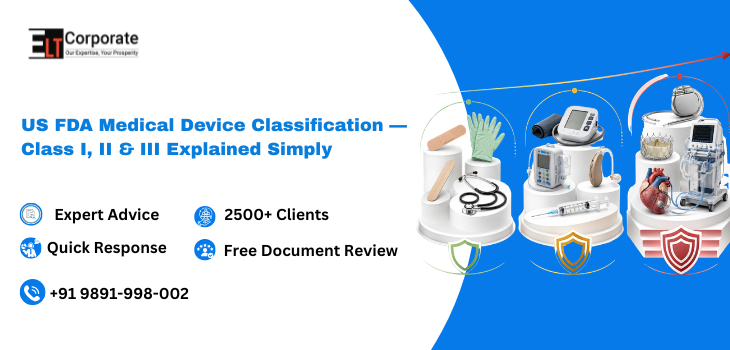
If you are planning to enter the US medical device market, understanding FDA device classification is one of the first and most important regulatory steps.
Because in the United States, everything depends on classification:
- your approval pathway,
- testing requirements,
- documentation depth,
- clinical evidence,
- review timelines,
- and overall regulatory cost.
Many manufacturers assume FDA approval starts with filing documents. In reality, it starts with identifying the correct device classification.
This guide explains FDA Class I, Class II, and Class III medical devices in a simple and practical way for manufacturers, exporters, and regulatory teams.
What Is FDA Medical Device Classification?
The US FDA classifies medical devices according to the level of risk they pose to patients and users.
The higher the risk, the stricter the regulatory controls.
Medical devices are divided into three categories:
| Device Class | Risk Level | Regulatory Control |
| Class I | Low Risk | General Controls |
| Class II | Moderate Risk | General + Special Controls |
| Class III | High Risk | Premarket Approval (PMA) |
The classification system is regulated by the US Food and Drug Administration (FDA) under the Federal Food, Drug, and Cosmetic Act.
Why FDA Classification Matters
Correct classification is critical because it determines:
- Whether you need FDA clearance or approval
- Which submission pathway applies
- Whether clinical data is required
- Testing standards and documentation
- Quality system expectations
- Review timelines
- Regulatory costs
An incorrect classification can lead to:
- FDA rejection,
- additional information requests,
- expensive delays,
- or submission withdrawal.
For global manufacturers and Indian exporters, this is one of the most common regulatory mistakes during US market entry.
Class I Medical Devices (Low Risk)
Overview
Class I devices are considered low-risk products with minimal potential harm to users.
These are usually simple products with well-understood technology and limited safety concerns.
Examples of Class I Devices
Examples include:
- Bandages
- Examination gloves
- Handheld surgical instruments
- Tongue depressors
- Elastic bandages
- Basic hospital supplies
Regulatory Requirements
Most Class I devices are regulated through:
- General controls
- Establishment registration
- Device listing
- Proper labeling
- Quality system compliance
A large number of Class I devices are exempt from FDA 510(k) premarket notification requirements.
However, exemption does not mean “unregulated.” Manufacturers must still comply with FDA requirements.
Key Insight
Many first-time exporters incorrectly assume Class I devices require no FDA obligations. In reality, registration, listing, labeling, and compliance requirements still apply.
Class II Medical Devices (Moderate Risk)
Overview
Class II devices carry moderate risk and require additional regulatory controls to ensure safety and effectiveness.
This is one of the largest and most commercially important FDA categories.
Examples of Class II Devices
Examples include:
- Infusion pumps
- Powered wheelchairs
- Diagnostic imaging systems
- Syringes
- Pregnancy test kits
- Surgical drapes
- Patient monitoring systems
Regulatory Requirements
Class II devices generally require:
- General controls
- Special controls
- Performance testing
- Risk analysis
- Labeling compliance
- Quality management systems
Most Class II devices require FDA 510(k) clearance before commercial marketing in the United States.
What Is 510(k) Clearance?
The 510(k) pathway is the most common FDA submission route for Class II devices.
Manufacturers must demonstrate that their device is “substantially equivalent” to a legally marketed predicate device already available in the US market.
The FDA reviews:
- intended use,
- design,
- technology,
- safety,
- and performance comparisons.
Typical 510(k) Documentation Includes
- Device description
- Predicate comparison
- Risk management
- Performance testing
- Biocompatibility data
- Sterilization validation
- Software documentation (if applicable)
- Labeling review
Why Class II Devices Are Popular for Exporters
Many Indian manufacturers target Class II devices because:
- market demand is strong,
- regulatory timelines are manageable,
- and the approval pathway is relatively predictable.
However, success depends heavily on:
- accurate classification,
- strong technical documentation,
- and proper testing strategy.
Class III Medical Devices (High Risk)
Overview
Class III devices are high-risk products that:
- sustain life,
- support life,
- are implanted,
- or present significant potential risk to patients.
These devices receive the highest level of FDA scrutiny.
Examples of Class III Devices
Examples include:
- Pacemakers
- Heart valves
- Implantable defibrillators
- Breast implants
- Neurostimulators
- Deep brain stimulation systems
Regulatory Requirements
Class III devices generally require:
- Premarket Approval (PMA)
- Clinical trials
- Extensive scientific evidence
- Long-term safety data
- Detailed manufacturing review
This is the most stringent FDA regulatory pathway.
What Is Premarket Approval (PMA)?
PMA is a scientific and regulatory review process used for high-risk devices.
Unlike 510(k), PMA requires manufacturers to independently prove:
- safety,
- effectiveness,
- and clinical benefit.
The FDA conducts a detailed review of:
- clinical trial data,
- manufacturing systems,
- design controls,
- and risk-benefit analysis.
PMA submissions are typically:
- more expensive,
- more time-consuming,
- and more complex than 510(k) submissions.
What Is the De Novo Pathway?
The De Novo pathway applies to novel medical devices that:
- do not have an existing predicate device,
- but are considered low to moderate risk.
This pathway creates a new classification category for innovative technologies.
De Novo Is Common For:
- digital health devices,
- AI-based systems,
- innovative diagnostics,
- and emerging technologies.
If approved, future manufacturers may later use that device as a predicate for 510(k) submissions.
How to Determine Your Device Classification
Correct classification requires more than comparing products visually.
Manufacturers should:
- search the FDA Product Classification Database,
- identify the correct product code,
- review FDA classification regulations,
- analyze intended use,
- and evaluate technological characteristics.
Even small design differences can significantly change classification and regulatory requirements.
Importance of FDA Product Codes
FDA product codes are extremely important because they define:
- device classification,
- applicable regulations,
- submission type,
- testing expectations,
- and review standards.
Ignoring product codes is one of the biggest mistakes companies make during US market entry planning.
Common FDA Classification Mistakes
1. Incorrect Classification
Selecting the wrong class leads to:
- incorrect submissions,
- review deficiencies,
- or outright rejection.
2. Assuming Similar Products Have the Same Classification
Two devices may appear similar but differ in:
- intended use,
- indications,
- technology,
- or risk profile.
This can completely change the FDA pathway.
3. Ignoring Predicate Device Strategy
For 510(k) submissions, predicate selection is critical.
Weak predicate strategy can delay or weaken approval chances.
4. Overlooking Software or Sterility Requirements
Software functionality, cybersecurity, sterilization method, or implant duration may increase regulatory scrutiny.
Key Differences Between Class I, II & III Devices
Class I
- Lowest risk
- Minimal regulatory controls
- Many devices exempt from 510(k)
Class II
- Moderate risk
- Requires testing and additional controls
- Usually needs 510(k) clearance
Class III
- Highest risk
- Requires clinical evidence
- Subject to PMA review
Practical Insight for Indian Medical Device Exporters
For Indian manufacturers entering the US market, FDA classification should be addressed before:
- product development,
- testing,
- labeling,
- or distributor negotiations.
A poor classification strategy can waste:
- time,
- testing budgets,
- regulatory resources,
- and market opportunities.
Most successful exporters begin with:
- classification assessment,
- product code identification,
- predicate analysis,
- and pathway planning.
This creates a clearer regulatory roadmap and reduces submission risks later.
Comments are closed