Introduction
The Indian medical device regulatory framework is developing to support innovation while maintaining product safety, quality and performance. One important regulatory development in 2026 is the amendment to Rule 63 of the Medical Devices Rules, 2017.
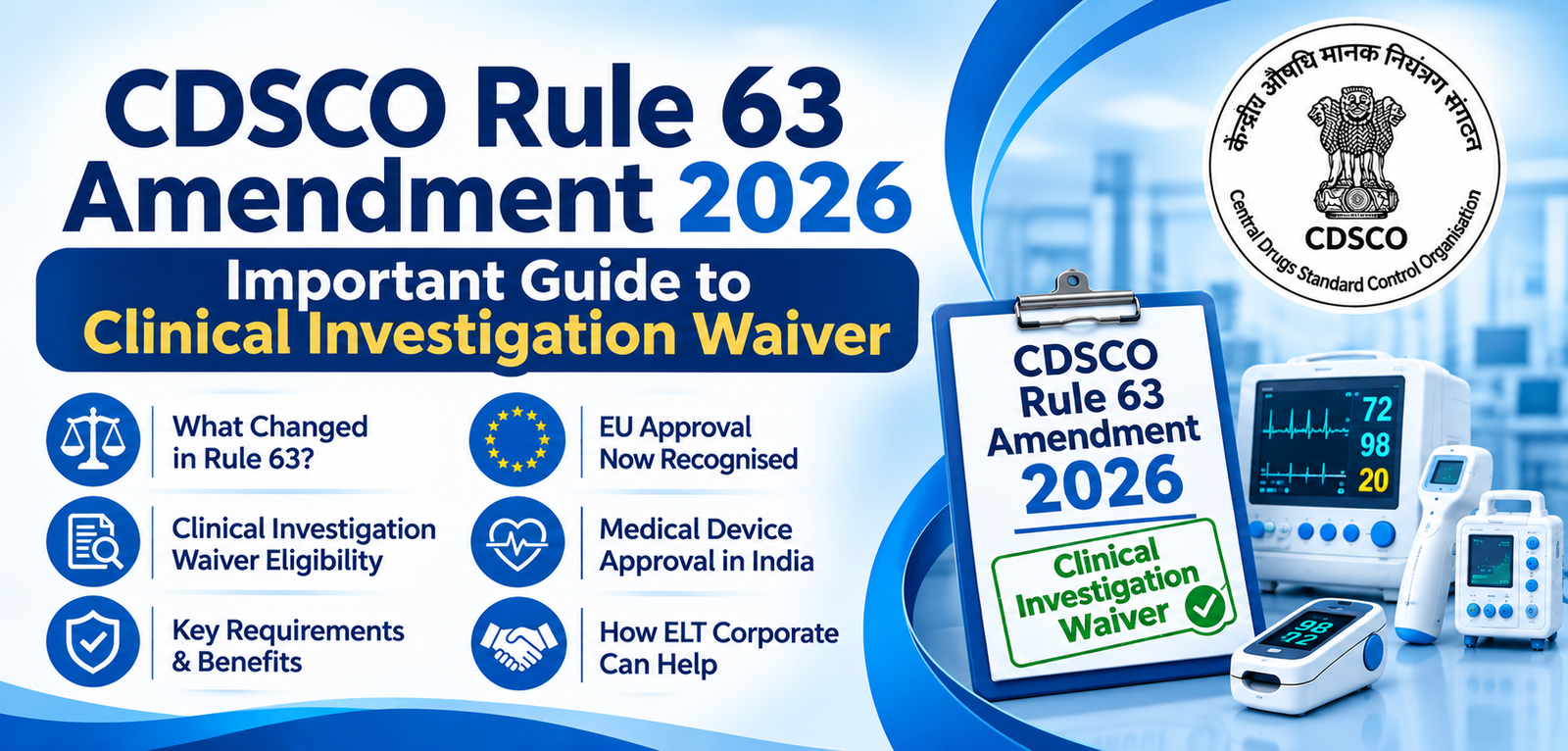
The CDSCO Rule 63 Amendment 2026 is particularly relevant for manufacturers and importers dealing with innovative medical devices that do not have a predicate device in India.
Before this amendment, Rule 63 recognised certain stringent regulatory jurisdictions, including the United States, United Kingdom, Australia, Canada and Japan, for the relevant clinical investigation waiver provision. The amendment adds European Union countries to this list.
This change may help eligible manufacturers bring certain medical technologies to the Indian market through a more streamlined regulatory pathway. However, applicants must still meet the applicable requirements and obtain the necessary regulatory approval or license.
In this guide, we explain the amendment, its meaning, eligibility considerations, potential benefits and practical implications for medical device manufacturers and importers.
What Is the CDSCO Rule 63 Amendment 2026?
The CDSCO Rule 63 Amendment 2026 refers to the amendment made to Rule 63, sub-rule (1), proviso (iv), of the Medical Devices Rules, 2017.
The Central Government issued the Medical Devices (Third Amendment) Rules, 2026 through notification G.S.R. 744(E), dated 14 August 2026. The final notification was published in the Gazette of India on 19 August 2026.
The amendment inserts the words “or European Union countries” after the words “or Japan” in the relevant proviso of Rule 63.
In simple terms, the amendment expands the list of recognised regulatory jurisdictions for the relevant clinical investigation waiver provision.
Why Was Rule 63 Amended?
The amendment supports regulatory alignment with recognised international medical device regulatory systems.
Its key objectives include:
- Expanding the list of recognised stringent regulatory jurisdictions.
- Supporting eligible innovative medical devices without predicate devices.
- Reducing unnecessary duplication in clinical investigation requirements where the waiver provision applies.
- Supporting a more efficient medical device approval pathway.
- Facilitating access to eligible advanced medical technologies in India.
The Government has also explained that this change is intended to reduce regulatory burden and associated timelines for eligible manufacturers and importers.
What Changed Under the CDSCO Rule 63 Amendment 2026?
The main change is the addition of European Union countries to the existing list of recognised stringent regulatory jurisdictions.
Before the amendment, the relevant list included:
- United States of America
- United Kingdom
- Australia
- Canada
- Japan
After the amendment, European Union countries are also included.
| Regulatory position | Before amendment | After amendment |
| United States | Included | Included |
| United Kingdom | Included | Included |
| Australia | Included | Included |
| Canada | Included | Included |
| Japan | Included | Included |
| European Union countries | Not included in this list | Added |
This change is important for eligible medical devices that have already received approval in the European Union and are being considered for regulatory approval in India.
What Is a Clinical Investigation for Medical Devices?
A clinical investigation is a systematic study conducted on human participants to evaluate the safety, performance or clinical effectiveness of a medical device.
It helps generate clinical evidence about how a medical device performs when used for its intended purpose.
For example, a manufacturer developing a new medical implant may need clinical evidence to demonstrate that the product performs safely and effectively.
Clinical investigation requirements depend on the applicable regulatory provisions, device category, risk, available clinical evidence and the regulatory authority’s assessment.
What Is a Predicate-Free Medical Device?
A predicate-free medical device is a device for which there is no suitable legally marketed predicate device available for comparison under the applicable Indian regulatory framework.
Such devices may involve new technology, a new intended purpose or a different design approach.
Because there may be no suitable predicate device, regulators may need to assess the available safety, performance and clinical evidence carefully.
The CDSCO Rule 63 Amendment 2026 is relevant to this category because the amended provision expands the recognised jurisdictions for the specified waiver pathway.
Who Can Benefit From the CDSCO Rule 63 Amendment 2026?
The amendment may be relevant to the following stakeholders:
1. Foreign Medical Device Manufacturers
Manufacturers based in European Union countries may benefit if their medical devices satisfy the applicable conditions under Rule 63.
They should review their EU approval, technical documentation, clinical evidence and intended use before preparing an Indian application.
2. Indian Authorised Agents
An Indian Authorised Agent representing a foreign manufacturer may need to assess whether the device qualifies for the relevant waiver provision.
The agent also plays an important role in coordinating regulatory documentation and communication with the Indian authorities.
3. Medical Device Importers
Importers planning to introduce eligible EU-approved medical devices into India may find the amendment relevant to their regulatory planning.
However, they must still follow the applicable import licensing process.
4. Innovative Medical Device Companies
Companies introducing new medical technologies without predicate devices may review the amended provision to understand whether the expanded list of recognised jurisdictions is relevant to their products.
What Documents Should Manufacturers Review?
The exact documentation depends on the device, application pathway and requirements communicated by the regulatory authority. Manufacturers should generally review the following records before relying on the amended provision:
- EU marketing authorisation or applicable approval evidence.
- Details of the foreign regulatory authority.
- Device description and intended use.
- Device classification and risk category.
- Technical documentation.
- Clinical evaluation report.
- Available clinical investigation reports.
- Safety and performance information.
- Risk management documentation.
- Quality management system documents.
- Details of the Indian Authorised Agent, where applicable.
- Proposed Indian import or registration application documents.
The CDSCO Rule 63 Amendment 2026 changes the recognised jurisdiction list in the relevant proviso; it does not remove the need to prepare appropriate supporting evidence.
Does EU Approval Mean Automatic CDSCO Approval in India?
No. This is one of the most important points manufacturers and importers should understand.
EU approval may be relevant to the clinical investigation waiver provision under amended Rule 63. However, it does not replace the Indian regulatory approval or licensing process.
Applicants should separately assess:
- Whether the device falls within the relevant Rule 63 provision.
- Whether the device is genuinely eligible for the waiver.
- Whether the EU approval relates to the same device and intended purpose.
- Whether the required clinical and technical evidence is available.
- Whether the applicable CDSCO application and licensing requirements have been fulfilled.
The CDSCO Rule 63 Amendment 2026 should therefore be understood as an expansion of the recognised jurisdiction list, not as a general exemption from Indian medical device regulations.
How Does the Amendment Affect Medical Device Importers?
The amendment may provide an additional regulatory consideration for importers bringing eligible medical devices from European Union countries into India.
Potential practical benefits include:
- An additional recognised regulatory jurisdiction for the relevant waiver provision.
- Better regulatory planning for eligible predicate-free devices.
- Potential reduction in duplication of clinical investigation requirements.
- More opportunities to evaluate innovative EU-approved medical technologies for the Indian market.
However, importers should not assume that the waiver will apply automatically. They should verify eligibility and the complete import licensing requirements before planning commercial distribution.
What Should Manufacturers Do After the CDSCO Rule 63 Amendment 2026?
Manufacturers and their Indian representatives can take the following steps:
Step 1: Review the device classification
Identify the applicable risk class and regulatory pathway under the Medical Devices Rules, 2017.
Step 2: Check EU approval status
Confirm that the device has the relevant approval or authorisation from the appropriate EU regulatory system.
Step 3: Review clinical evidence
Prepare available clinical evaluation reports, investigation reports and supporting safety and performance information.
Step 4: Assess waiver eligibility
Evaluate whether the device satisfies the specific conditions of Rule 63. Do not assume that EU approval alone is sufficient.
Step 5: Prepare the Indian application
Organise the technical and regulatory documents required for the relevant CDSCO application.
Step 6: Complete the applicable licensing process
Follow the relevant import or manufacturing licensing requirements before placing the medical device on the Indian market.
The CDSCO Rule 63 Amendment 2026 should be considered during regulatory planning, particularly where a manufacturer is introducing an innovative device without a predicate device.
How ELT Corporate Can Help With CDSCO Regulatory Compliance
Understanding a regulatory amendment is only the first step. Manufacturers and importers must also determine how the amendment applies to their particular medical device.
ELT Corporate can assist businesses with:
- Medical device regulatory pathway assessment.
- CDSCO registration and licensing guidance.
- Medical device classification support.
- Review of technical and regulatory documentation.
- Indian Authorised Agent coordination for foreign manufacturers.
- Import license application support.
- Regulatory query and documentation assistance.
- Guidance on applicable clinical investigation requirements.
Our team helps manufacturers and importers understand the relevant regulatory requirements and prepare their applications in line with the applicable Indian medical device framework.
Conclusion
The CDSCO Rule 63 Amendment 2026 is an important development for the Indian medical device industry because it adds European Union countries to the recognised stringent regulatory jurisdictions under the relevant clinical investigation waiver provision.
This may create a more streamlined regulatory opportunity for eligible predicate-free medical devices that have received approval in the EU.
However, the amendment does not provide automatic CDSCO approval or remove all clinical evidence and licensing requirements. Manufacturers and importers should carefully evaluate their device, approval status and applicable regulatory pathway before submitting an application.
Staying updated with the Medical Devices Rules, 2017 and official CDSCO notifications can help businesses plan their medical device registration and import activities more effectively.
Frequently Asked Questions
Q1. What is the CDSCO Rule 63 Amendment 2026?
The CDSCO Rule 63 Amendment 2026 is an amendment to the Medical Devices Rules, 2017 that adds European Union countries to the recognised stringent regulatory jurisdictions under the relevant clinical investigation waiver provision.
Q2. When did the Rule 63 Amendment 2026 come into effect?
The Medical Devices (Third Amendment) Rules, 2026 were notified on 14 August 2026 and published in the Gazette of India on 19 August 2026. The amendment came into force upon final publication.
Q3. Which countries are recognised under the amended Rule 63?
The relevant list includes the United States, United Kingdom, Australia, Canada, Japan and, following the amendment, European Union countries.
Q4. Does EU approval remove the need for CDSCO registration?
No. EU approval does not automatically grant permission to import or sell a medical device in India. Applicants must follow the applicable Indian registration and licensing requirements.
Q5. Does the amendment apply to all medical devices?
No. The relevant waiver provision concerns eligible medical devices without predicate devices. The specific regulatory conditions must be assessed for each device.
Q6. Can a foreign manufacturer benefit from the Rule 63 amendment?
A foreign manufacturer may benefit if its device satisfies the applicable conditions, including the relevant approval and clinical evidence requirements. The Indian regulatory application must still be completed as required.
Q7. What is a clinical investigation waiver for medical devices?
A clinical investigation waiver is a regulatory provision under which an eligible applicant may not need to conduct a separate clinical investigation in India, subject to the conditions and assessment under the applicable rules.
Q8. Does the Rule 63 amendment reduce medical device approval time in India?
It may reduce regulatory burden and associated timelines for eligible devices. However, actual processing time depends on the application, supporting documents and regulatory assessment.
Comments are closed