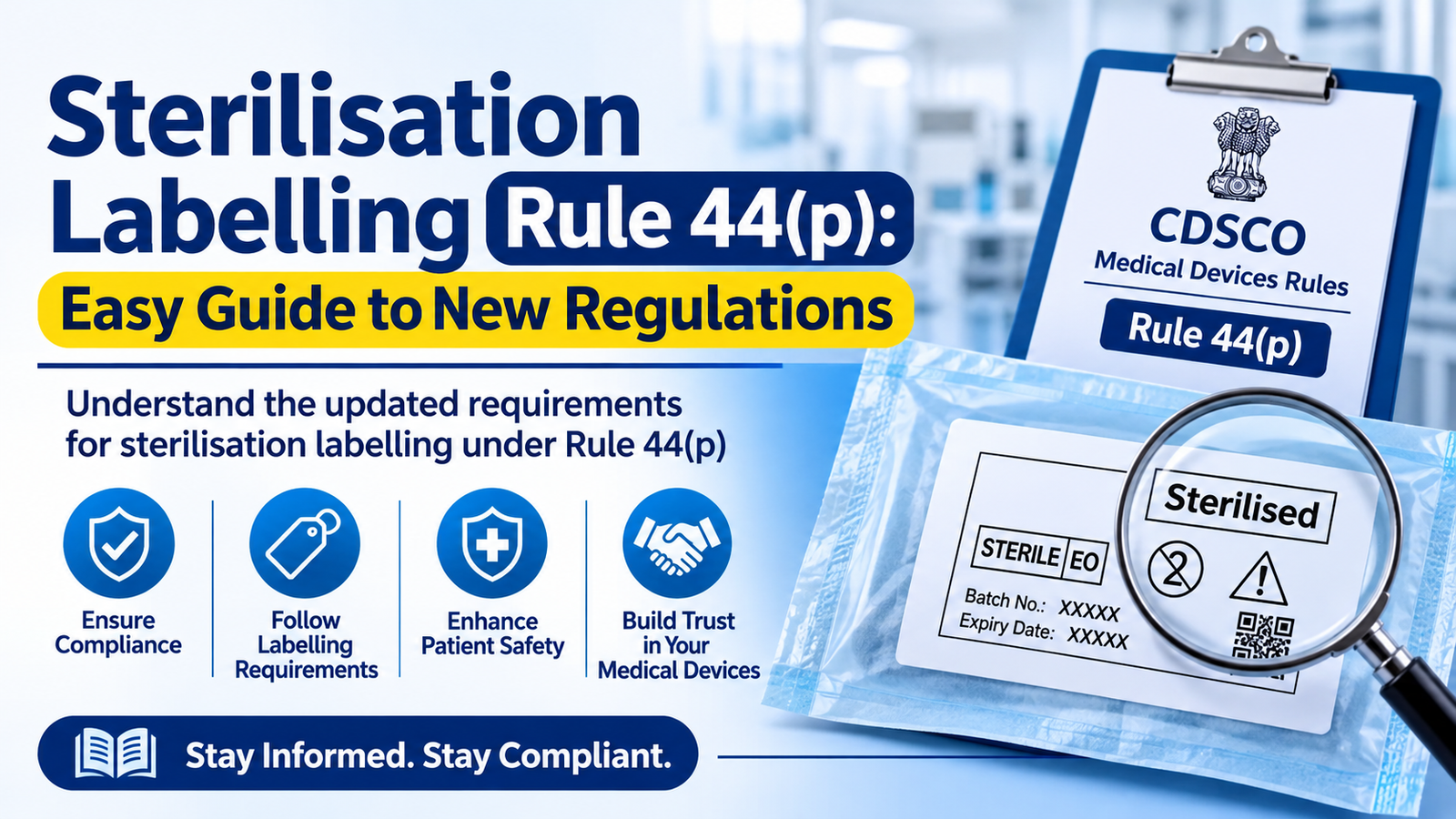
The Medical Devices (Second Amendment) Rules, 2026 introduce important changes to India’s medical device regulatory framework. These changes focus on outsourced sterilisation, product labelling requirements and standardised testing fees.
Under the new Rule 44(p), manufacturers outsourcing sterilisation to another licensed facility must mention the sterilisation site’s manufacturing license number on the medical device label. The amendment also introduces a Ninth Schedule containing prescribed fees for specified medical device tests and evaluations.
What Are the New Sterilisation Labelling Requirements in India?
Understanding Sterilisation Labelling Rule 44(p) is important for manufacturers who depend on third-party sterilisation facilities. This amendment explains the labelling responsibilities of manufacturers and helps businesses maintain transparency in their outsourced sterilisation activities.
The Government of India has introduced important amendments to the Medical Devices Rules, 2017 through the Medical Devices (Second Amendment) Rules, 2026.
These amendments bring important changes for medical device manufacturers, particularly businesses that outsource sterilisation activities to external facilities.
One of the significant changes is the introduction of Rule 44(p), which establishes a specific labelling requirement for manufacturers using third-party sterilisation facilities.
The amendment also introduces the Ninth Schedule, which provides a framework for medical device testing and evaluation requirements.
Understanding Sterilisation Labelling Rule 44(p) is important for manufacturers, importers, regulatory professionals and businesses involved in medical device manufacturing.
This article explains the new requirements in simple question-and-answer language to help businesses understand the amendment and prepare for regulatory compliance.
What Is Sterilisation Labelling Under Rule 44(p)?
Sterilisation Labelling Rule 44(p) is a new provision introduced through the Medical Devices (Second Amendment) Rules, 2026.
It applies when a medical device manufacturer outsources sterilisation activities to another facility that holds a valid manufacturing license for carrying out the relevant sterilisation process.
Under this provision, manufacturers must mention the manufacturing license number of the sterilisation facility on the medical device label.
In simple terms, when a company manufactures a medical device but uses an external licensed facility for sterilisation, the license number of that external facility must be included on the product label.
Key requirements include:
- The external sterilisation facility must hold the applicable valid license.
- Its manufacturing license number must be mentioned on the medical device label.
- Manufacturers must review their existing labelling and packaging information.
- Relevant regulatory and quality documentation should be maintained.
Why Has the Government Introduced Rule 44(p)?
The introduction of Sterilisation Labelling Rule 44(p) also helps manufacturers establish better coordination with external sterilisation providers. By maintaining accurate licence information, businesses can improve product traceability and follow the updated regulatory requirements.
Why is this amendment important for medical device manufacturers?
The main objective is to improve transparency and accountability in outsourced sterilisation activities.
Medical device manufacturers sometimes depend on external facilities to sterilise their products. The new provision makes it easier to identify the licensed facility responsible for this activity.
The amendment also simplifies the regulatory framework by removing the requirement for a separate loan license for qualifying outsourced sterilisation activities when the external facility already holds the applicable license.
The major objectives are:
- Improve transparency in outsourced sterilisation.
- Identify the licensed sterilisation facility.
- Simplify licensing arrangements.
- Improve regulatory traceability.
- Strengthen accountability in medical device manufacturing.
What Information Must Be Mentioned on the Medical Device Label?
Under Sterilisation Labelling Rule 44(p), manufacturers should carefully verify the licence details received from their sterilisation partners. Incorrect or incomplete information on product labels may create avoidable regulatory compliance issues.
What exactly should manufacturers include on their product labels?
Under Rule 44(p), the manufacturing license number of the facility where the sterilisation activity is performed must be mentioned.
The amendment provides the following identification formats:
- Sterilization sites Manufacturing License Number
- Ster. Mfg. Lic. No.
- S.M. L.
Manufacturers should ensure that the license number is accurate and corresponds to the external sterilisation facility.
Example:
Suppose ABC Medical Devices manufactures sterile surgical products but outsources sterilisation to XYZ Sterilisation Facility.
If XYZ holds the applicable manufacturing license, ABC must include XYZ’s license number on the medical device label in accordance with Rule 44(p).
This requirement helps identify the facility responsible for sterilisation.
Importantly, this additional requirement does not replace other applicable medical device labelling requirements.
When Will the New Sterilisation Labelling Requirements Become Mandatory?
When should manufacturers complete the required labelling changes?
The Medical Devices (Second Amendment) Rules, 2026 were notified on 14 August 2026 through G.S.R. 743(E).
The amendment provides a six-month transition period for compliance with the new requirement.
Compliance deadline: 14 February 2027
Manufacturers should use this transition period to review their existing product labels and update their packaging and regulatory documentation.
| Particulars | Details |
| Amendment | Medical Devices (Second Amendment) Rules, 2026 |
| Notification | G.S.R. 743(E) |
| Notification Date | 14 August 2026 |
| Relevant Provision | Rule 44(p) |
| Transition Period | Six months |
| Compliance Date | 14 February 2027 |
What Is the Ninth Schedule Under the Medical Devices Rules, 2017?
The Ninth Schedule is another important addition under the Medical Devices (Second Amendment) Rules, 2026.
It introduces a structured framework for medical device testing and evaluation requirements.
The schedule identifies different categories of medical device tests and evaluations, helping applicants and manufacturers understand the applicable testing framework.
These include:
- Implantation testing
- Sterility testing
- Surgical dressing testing
- Syringes and needles testing
- Physical and physicochemical testing
- Surgical suture testing
- Optical and related evaluations
- Absorbency and other material-related evaluations
- Condom testing
- Intrauterine device testing
- Bacterial endotoxin testing
The Ninth Schedule provides a reference for the prescribed testing and evaluation framework under the amended rules.
Why is the Ninth Schedule important?
It helps create greater consistency in the testing and evaluation process and provides applicants with clearer information about the regulatory testing requirements.
What Is the Importance of the 5% Annual Revision Under the Ninth Schedule?
Does the amendment provide for changes in testing requirements over time?
The Ninth Schedule provides for an automatic annual revision of the prescribed testing and evaluation fees by 5%.
For manufacturers and applicants, this means that the applicable regulatory requirements should be reviewed before submitting testing applications.
Businesses should also ensure that their regulatory teams refer to the latest applicable schedule when planning testing and evaluation activities.
What Changes Have Been Introduced Under Rules 19 and 69?
The amendment also introduces changes to Rules 19 and 69 of the Medical Devices Rules, 2017.
What is the change under Rule 19?
A new sub-rule (3) has been inserted into Rule 19.
It connects the applicable testing and evaluation requirements with the Ninth Schedule.
This provides a clearer reference for applicants seeking testing and evaluation services.
What is the change under Rule 69?
Rule 69 has also been amended to require an application in Form MD-33 to be accompanied by the applicable fee specified in the Ninth Schedule.
Applicants should therefore review the relevant requirements before submitting Form MD-33.
| Rule | Amendment | Impact |
| Rule 19(3) | Introduces a reference to the Ninth Schedule | Clarifies testing and evaluation requirements |
| Rule 69 | Revises the requirements for Form MD-33 applications | Clarifies the application procedure |
Who Is Affected by Sterilisation Labelling Rule 44(p)?
Which businesses should pay attention to the new amendment?
Sterilisation Labelling Rule 44(p) is particularly relevant to businesses involved in outsourced medical device sterilisation.
The following stakeholders should review the updated requirements.
- Medical Device Manufacturers
Manufacturers using external sterilisation facilities must ensure that the required license number appears on product labels.
- Contract Manufacturers
Businesses involved in contract manufacturing should review their arrangements with sterilisation service providers.
- Sterilisation Service Providers
External sterilisation facilities should provide accurate licensing information to the manufacturers using their services.
- Medical Device Importers
Importers should review applicable labelling requirements and ensure that imported products meet the relevant regulatory provisions.
- Regulatory Affairs Professionals
Regulatory professionals should assess the amendment and help businesses update their documentation and compliance procedures.
What Documents Should Manufacturers Review for the New Requirements?
What documentation should businesses check before implementing the amendment?
Manufacturers should review their existing regulatory and quality management records.
Important documents include:
| Document | Purpose |
| Manufacturing License | Confirms applicable manufacturing authorisation |
| Sterilisation Facility License | Verifies the external facility’s licensing status |
| Product Labels | Ensures required license information is included |
| Packaging Artwork | Supports updated labelling requirements |
| Sterilisation Agreement | Documents the outsourced activity |
| Quality Agreement | Defines responsibilities between both parties |
| Sterilisation Validation Records | Supports evidence of a controlled process |
| Testing Records | Maintains relevant testing and evaluation documentation |
The documentation required may vary depending on the medical device, manufacturing arrangement and applicable regulatory requirements.
How Can Manufacturers Prepare for the New Amendment?
What practical steps should manufacturers take before the compliance deadline?
Businesses should begin reviewing their existing sterilisation arrangements and labelling systems.
The following steps can help manufacturers prepare.
Step 1: Identify Outsourced Sterilisation Activities
Identify medical devices for which sterilisation is performed by an external facility.
Step 2: Verify the Facility’s Manufacturing License
Confirm that the external facility holds the applicable valid license for the sterilisation activity.
Step 3: Obtain the Correct License Number
Collect the relevant manufacturing license information from the sterilisation provider.
Step 4: Review Existing Product Labels
Check whether the existing labels meet the updated requirements under Rule 44(p).
Step 5: Update Packaging Artwork
Make the necessary changes to product labels and packaging information.
Step 6: Coordinate With the Sterilisation Facility
Ensure that both parties maintain accurate licensing and quality documentation.
Step 7: Review Testing and Evaluation Requirements
Understand the Ninth Schedule and the applicable testing procedures.
Step 8: Maintain Compliance Records
Keep updated records of licenses, sterilisation agreements, validation documents and product labels.
Following these steps can help businesses prepare for the amended regulatory framework.
What Are the Benefits of the New Medical Devices Amendment?
How will the amendment help the medical device industry?
The new provisions aim to make certain regulatory processes clearer and improve transparency in medical device manufacturing.
Major benefits include:
- Simplified Outsourcing: Provides a simpler licensing arrangement for qualifying outsourced sterilisation activities.
- Improved Transparency: Helps identify the licensed sterilisation facility.
- Better Traceability: Supports the identification of sterilisation service providers.
- Clearer Testing Framework: Introduces the Ninth Schedule for testing and evaluation requirements.
- Regulatory Clarity: Helps manufacturers understand their responsibilities.
- Better Compliance Planning: Provides a transition period for implementing labelling changes.
How ELT Corporate Can Help With Medical Device Regulatory Compliance
ELT Corporate provides regulatory consultancy and compliance assistance to medical device manufacturers, importers and other businesses operating in India’s medical device industry.
Understanding Sterilisation Labelling Rule 44(p) and implementing the updated requirements may involve reviewing licenses, packaging information, quality documents and regulatory procedures.
Our team can assist businesses with:
- CDSCO Registration: Assistance with applicable medical device registration requirements.
- Medical Device Licensing: Guidance on manufacturing and import licensing procedures.
- Regulatory Documentation: Assistance with preparing and reviewing regulatory documents.
- Medical Device Labelling: Guidance on applicable product labelling and packaging requirements.
- Sterilisation Compliance: Support in understanding outsourced sterilisation arrangements and documentation.
- Testing and Evaluation Guidance: Assistance in understanding the Ninth Schedule and applicable testing requirements.
- Regulatory Consultancy: Guidance on changes introduced under the Medical Devices Rules, 2017.
ELT Corporate helps businesses understand regulatory requirements and prepare for compliance with India’s medical device regulatory framework.
Conclusion
The Medical Devices (Second Amendment) Rules, 2026 introduce important regulatory changes for medical device manufacturers in India.
The introduction of Sterilisation Labelling Rule 44(p) makes it necessary for manufacturers outsourcing sterilisation activities to mention the external facility’s manufacturing license number on the medical device label.
The introduction of the Ninth Schedule also provides a structured framework for medical device testing and evaluation requirements.
Additionally, amendments to Rules 19 and 69 clarify the connection between testing procedures, evaluation requirements and Form MD-33 applications.
Manufacturers should review their sterilisation arrangements, verify the relevant licenses, update product labels and understand the revised testing framework.
Taking timely action can help businesses prepare for the new requirements and maintain regulatory compliance.
Frequently Asked Questions
Q1. What is Sterilisation Labelling Rule 44(p)?
Sterilisation Labelling Rule 44(p) is a provision introduced under the Medical Devices (Second Amendment) Rules, 2026. It requires manufacturers outsourcing sterilisation to mention the external facility’s manufacturing license number on the medical device label.
Q2. When will Rule 44(p) become mandatory?
The new labelling requirement becomes mandatory from 14 February 2027, following the six-month transition period provided under the amendment.
Q3. Does Rule 44(p) apply to all medical device manufacturers?
It applies specifically to manufacturers outsourcing sterilisation activities to another facility holding the applicable license for carrying out the sterilisation process.
Q4. What license number must be printed on the medical device label?
Manufacturers must mention the manufacturing license number of the external sterilisation facility using the prescribed identification wording or abbreviation.
Q5. Is a separate loan license required for outsourced sterilisation?
The amended framework removes the requirement for a separate loan license for qualifying outsourced sterilisation activities when the external facility already holds the applicable valid license.
Q6. What is the Ninth Schedule under the Medical Devices Rules, 2017?
The Ninth Schedule establishes a prescribed framework for different medical device tests and evaluations, including sterility testing, implantation testing and bacterial endotoxin testing.
Q7. What is the annual revision provision under the Ninth Schedule?
The amendment provides for an automatic annual revision of the prescribed testing and evaluation fees by 5%.
Q8. What changes have been made to Rule 19 and Rule 69?
Rule 19 has been amended to link testing and evaluation requirements with the Ninth Schedule. Rule 69 has been amended to specify the applicable fee requirement for applications submitted in Form MD-33.
Comments are closed