
Introduction
An FDA License in India is an important regulatory requirement for businesses involved in activities such as manufacturing, selling, stocking, distributing, or importing certain drugs and pharmaceutical products. The license helps ensure businesses follow applicable laws and safety requirements before starting regulated activities.
In India, the term FDA license is commonly used to describe drug licenses issued by the relevant State Drug Control Department or Food and Drug Administration. However, not every license is issued by the same authority. The correct authority depends on the business activity, product category, and applicable regulations.
For example, drug retail and wholesale licenses are generally handled by the relevant state licensing authority, while certain drug import permissions and specialised approvals fall under the Central Drugs Standard Control Organisation. Official information is available from the CDSCO website and the Online National Drugs Licensing System.
What Is an FDA License in India?
An FDA License in India is a regulatory license or permission required for specified pharmaceutical and drug-related business activities. It confirms that the applicant has met the relevant licensing requirements for the activity covered by the license.
Depending on the business, the required approval may relate to:
- Retail sale of medicines.
- Wholesale distribution of drugs.
- Manufacturing of pharmaceutical products.
- Import of drugs into India.
- Other specialised drug-related activities.
The applicable requirements depend on the type of product and the business operation. For example, a pharmacy selling medicines to consumers will not necessarily require the same license as a company manufacturing pharmaceutical formulations.
Important: An FDA drug license is not the same as an FSSAI license for food businesses, a cosmetic manufacturing license, or a medical device license. Identify the correct regulatory category before applying.
Who Needs an FDA License in India in 2026?
Businesses should check their licensing requirements before beginning regulated activities involving drugs.
1. Retail Medical Stores
A pharmacy or medical store selling medicines directly to consumers generally needs the applicable retail drug license. Requirements may include suitable premises and a registered pharmacist, depending on the license category and applicable rules.
2. Pharmaceutical Wholesalers
Businesses supplying medicines to pharmacies, hospitals, clinics or other authorised buyers may require a wholesale drug license. The applicant must meet the relevant premises and competent-person requirements.
3. Drug Manufacturers
Companies manufacturing pharmaceutical products for sale or distribution must obtain the appropriate manufacturing license and satisfy applicable requirements for technical staff, facilities, equipment, quality control and product permissions.
4. Drug Importers
Businesses importing drugs into India may need applicable CDSCO registration and import permissions. The requirements vary according to the product and the nature of the import. CDSCO explains its drug import and registration process on its official Import and Registration page.
5. Other Regulated Businesses
Businesses involved in specialised drug categories should confirm whether additional permissions, registrations or product-specific approvals apply.
What Are the Different Types of FDA Drug Licenses in India?
The license you need depends on the activity your business plans to carry out. Common categories include:
| Business activity | Type of approval to check |
| Retail sale of medicines | Applicable retail drug license |
| Wholesale supply of medicines | Applicable wholesale drug license |
| Pharmaceutical manufacturing | Applicable drug manufacturing license |
| Importing drugs | Relevant CDSCO registration and import license |
| Special categories of drugs | Category-specific license or permission |
For certain retail and wholesale drug licenses, the Drugs and Cosmetics Rules, 1945 prescribe different application and license forms. For example, Forms 20 and 21 and their related forms apply to specified categories of drug sales. Always confirm the correct form for your products and activity with the relevant authority.
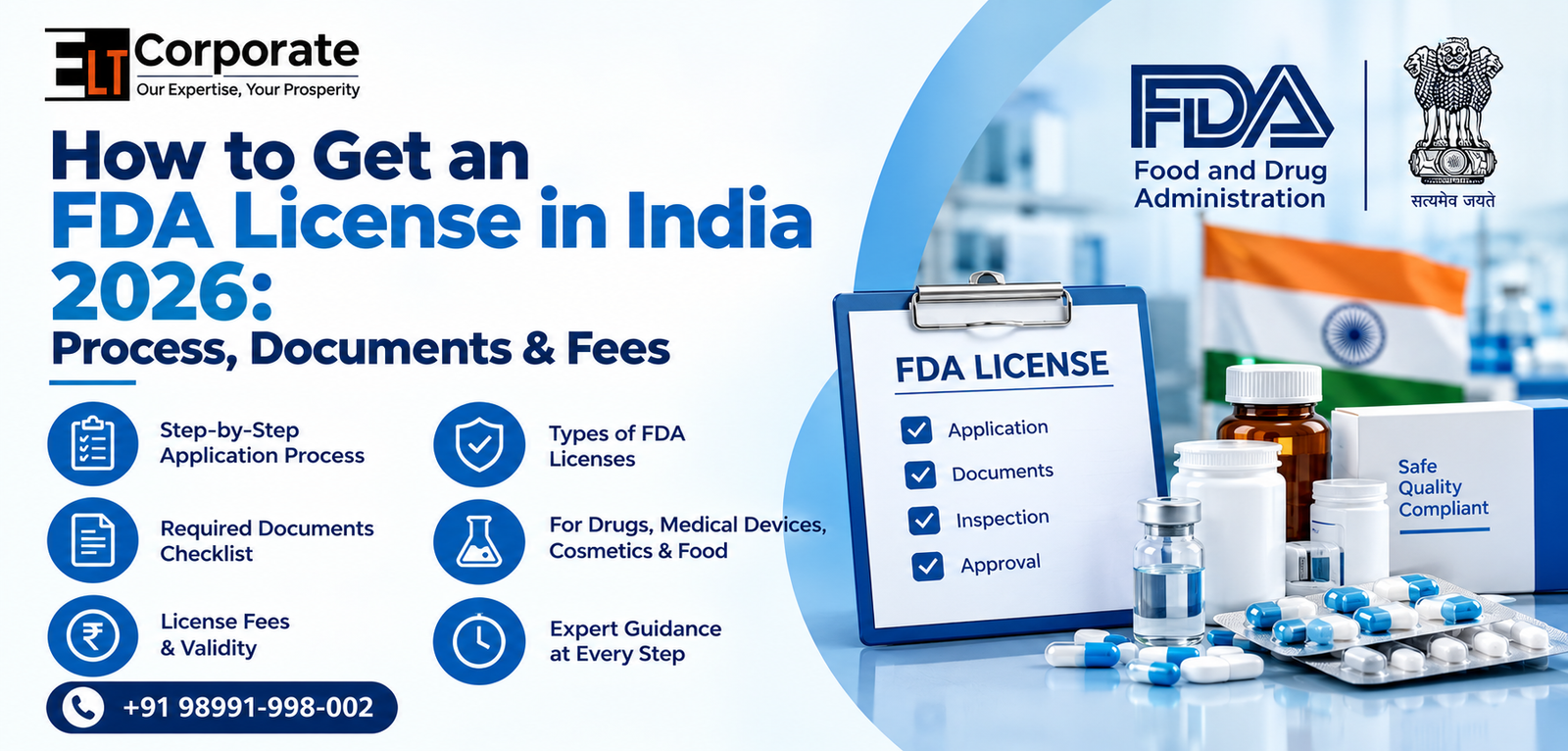
How to Get an FDA License in India: Step-by-Step Process
The process for an FDA License in India can vary between states and license categories. The following steps provide a general overview.
Step 1: Identify the Correct License
First, decide whether your business needs a retail, wholesale, manufacturing, or import-related license. Check the product category and whether any additional approval is necessary.
Applying under the wrong category can lead to delays or a request to submit a corrected application.
Step 2: Check Business and Premises Requirements
Confirm that your business premises meet the applicable requirements. Depending on the license, the authority may examine the premises’ suitability, storage arrangements, equipment, records, and other conditions.
Retail and wholesale applicants should also check the applicable requirements for a registered pharmacist or competent person.
Step 3: Prepare the Required Documents
Collect the application form, business registration documents, premises proof, identity documents, and activity-specific supporting records. Manufacturing and import applications may require additional technical or product documentation. Ensure that names, addresses, and business details are consistent across all documents.
Step 4: Register on the Relevant Government Portal
The application portal depends on the license type and state. State drug licensing services may be available through the ONDLS portal. Certain central drug import and registration activities are handled through CDSCO’s online systems, including SUGAM.
Step 5: Complete the Application and Pay the Applicable Fee
Enter the required information, select the appropriate license category, and upload the supporting documents. Pay the prescribed government fee through the designated payment process.
Before submitting, check that the form is complete and that the documents are readable and up to date.
Step 6: Respond to Queries or Inspection Requirements
The licensing authority may review the application, ask for clarification, request additional documents or arrange an inspection, depending on the license category.
Respond to any official query within the specified period and provide accurate supporting information.
Step 7: Receive and Review the License
If the application meets the applicable requirements, the authority may grant the license. Review the license carefully for the business name, address, authorised activities, product category, and any conditions.
Do not assume that applying for an FDA License in India automatically authorises every drug-related activity. Operate only within the scope of the approval granted.
What Documents Are Required for an FDA License in India?
The required documents depend on the license category and the state or central authority handling the application. Commonly requested documents may include:
- Completed application form and fee receipt.
- PAN, identity proof, and address proof, as applicable.
- Business constitution documents, such as a partnership deed or company incorporation documents.
- Proof of ownership or a valid rent or lease agreement for the premises.
- Site plan and premises details, where required.
- Details and qualifications of the registered pharmacist or competent person, where applicable.
- Affidavits or declarations required by the relevant authority.
- Details of storage facilities and equipment, where relevant.
- Manufacturing facility, technical staff and quality-control documents for manufacturing applications.
- Product, manufacturer and supporting regulatory documents for applicable import applications.
For example, the Delhi Drugs Control Department lists documents such as the application form, fee receipt, site plan, proof of premises and business constitution documents for relevant sales license applications. Requirements in another state or for a different license may vary.
How Can You Prepare Your Documents Correctly?
Use the current checklist issued by the relevant licensing authority. Check the validity of premises documents, ensure that names and addresses match, and prepare any technical documents required for your particular activity.
Submitting a complete and consistent application can help reduce avoidable delays, although it does not guarantee approval.
What Are the Fees for an FDA License in India in 2026?
There is no single fee for every FDA drug license in India. Government fees can differ according to the license type, product category, application, and applicable state or central rules. Additional costs may arise from premises preparation, technical documentation, professional assistance, or other compliance requirements.
Before paying, check:
- The applicable license category and application form.
- The current government fee schedule.
- Whether inspection or other prescribed charges apply.
- Whether separate fees are required for additional products, premises, or permissions.
- The payment instructions on the official portal.
For current requirements, consult the relevant state drug licensing department or ONDLS. For applicable drug imports, consult the CDSCO Import and Registration Division. Avoid relying on an old fee list without checking whether it is still applicable.
How Long Does It Take to Get an FDA License in India?
The processing time depends on the license category, the authority’s procedures, the completeness of the application, and whether clarification or an inspection is required.
An application with missing documents or inconsistent details may take longer to process. For this reason, applicants should review the latest checklist, submit accurate information, and monitor their application status through the appropriate portal.
There is no universal approval timeline for every type of FDA License in India, so applicants should check the applicable service standards with the relevant licensing authority.
What Common Mistakes Should Applicants Avoid?
Applicants can reduce avoidable problems by checking the following before submission:
- Choosing the wrong license: Confirm the activity and product category first.
- Submitting incomplete documents: Use the latest official checklist.
- Providing inconsistent details: Match business names and addresses across documents.
- Overlooking premises requirements: Verify the applicable conditions before committing to a location.
- Ignoring official queries: Monitor the application and respond within the prescribed period.
- Assuming one license covers everything: Check whether separate approvals are required for manufacturing, sales, imports or specific products.
These checks can make the application process clearer and help applicants understand their compliance responsibilities.
How ELT Corporate Helps with FDA Licensing
ELT Corporate provides regulatory compliance assistance to businesses that need help understanding drug licensing requirements in India. Our support can include:
- License category guidance: Helping you identify the relevant license category based on your proposed business activity.
- Document preparation: Assisting with the organisation and review of supporting documents.
- Application support: Helping you understand application requirements and submission procedures.
- Regulatory guidance: Explaining applicable compliance requirements and official processes.
- Query assistance: Helping you understand requests for clarification and prepare relevant responses.
Whether you are setting up a pharmaceutical business, planning to distribute medicines or exploring drug import requirements, ELT Corporate can help you understand the next steps. The final decision to grant a license rests with the relevant government authority.
For assistance, visit ELT Corporate.
Conclusion
Obtaining the correct drug license is an important step for businesses entering India’s pharmaceutical sector. The process starts with identifying the appropriate license, checking eligibility, preparing the documents, submitting the application, and meeting any additional requirements set by the licensing authority.
Before applying for an FDA License in India, verify the latest government rules, fees, and document checklist for your particular business activity. Proper preparation can help you avoid common application errors and understand the requirements that apply to your business.
Frequently Asked Questions
Q1. What is an FDA License in India?
It is a commonly used term for a drug license issued by the relevant state drug control authority or FDA. The exact license depends on the business activity, such as retail sales, wholesale distribution or manufacturing.
Q2. Who issues drug licenses in India?
State and Union Territory drug licensing authorities issue many drug sales and manufacturing licenses. CDSCO handles specified central regulatory functions, including applicable drug import permissions and specialised approvals.
Q3. Can I apply for an FDA license online?
Yes, online application facilities are available for many license categories. Depending on the application, you may need to use the relevant state portal, ONDLS or a CDSCO online system.
Q4. What documents are required for an FDA license?
Common documents include an application form, business constitution documents, identity proof, premises documents, site plans, and the applicable fee receipt. Additional documents may be required for manufacturing, imports or particular drug categories.
Q5. How much does an FDA license cost in India in 2026?
The fee depends on the license category and applicable rules. Check the latest official fee schedule before submitting your application because there is no single fee for every type of drug license.
Q6. How long does it take to obtain a drug license?
The timeline varies according to the license category, application completeness, regulatory review, and any inspection or clarification requirements. Check the relevant authority’s current processing standards.
Q7. Is an FDA license the same as a CDSCO license?
No. The terms refer to different regulatory contexts. State authorities handle many drug sales and manufacturing licenses, while CDSCO handles specified central approvals. The correct authority depends on the activity and product.
Q8. Can ELT Corporate help with the licensing process?
ELT Corporate can assist businesses with understanding licensing requirements, organising documents, and navigating application procedures. License approval remains subject to the applicable rules and the decision of the licensing authority.
Comments are closed