
South Korea is one of Asia’s most sophisticated and profitable markets for medical devices, and for Indian companies looking to export to South Korea, there is a Ministry of Food and Drug Safety (MFDS) that is the gatekeeper that you have to be able to satisfy. MFDS approval isn’t a formality. It is an extremely thorough, document-intensive procedure—similar in spirit to CDSCO registration in India, but with distinct Korean documentary requirements.
For Indian manufacturers, this process comes with an additional layer of difficulty in naming the right Korean License Holder (KLH) or an In-Country Caretaker (ICCT) as well as managing device classifications under Korean rules (which aren’t always in line with the Indian CDSCO classes) and then assembling an MFDS-compliant dossier in a particular format for documents. This checklist outlines precisely what you need to know.
Understanding MFDS and Why It Matters for Indian Manufacturers
MFDS regulates medical devices in South Korea under the Medical Device Act, classifying products into four risk classes—Class I (lowest risk) through Class IV (highest risk)—broadly similar in principle to the EU MDR and India’s MDR 2017 framework but with distinct documentary and testing expectations of its own.
Indian manufacturers exporting to Korea cannot file directly with MFDS. A Korean-based entity must act as the local license holder, taking on regulatory responsibility, distribution oversight, and post-market vigilance obligations on your behalf. This makes the accuracy and completeness of your documentation package even more critical, since your Korean partner will be relying entirely on the dossier you provide.
Who Needs This Checklist?
- Indian medical device manufacturers seeking to export to South Korea for the first time
- Manufacturers renewing or amending an existing MFDS license
- Companies transitioning from a Korean distributor-led registration to a manufacturer-controlled one
- Indian OEMs whose Korean buyers require a complete technical file for local registration
- Regulatory teams preparing for MFDS GMP (KGMP) audits alongside product approval
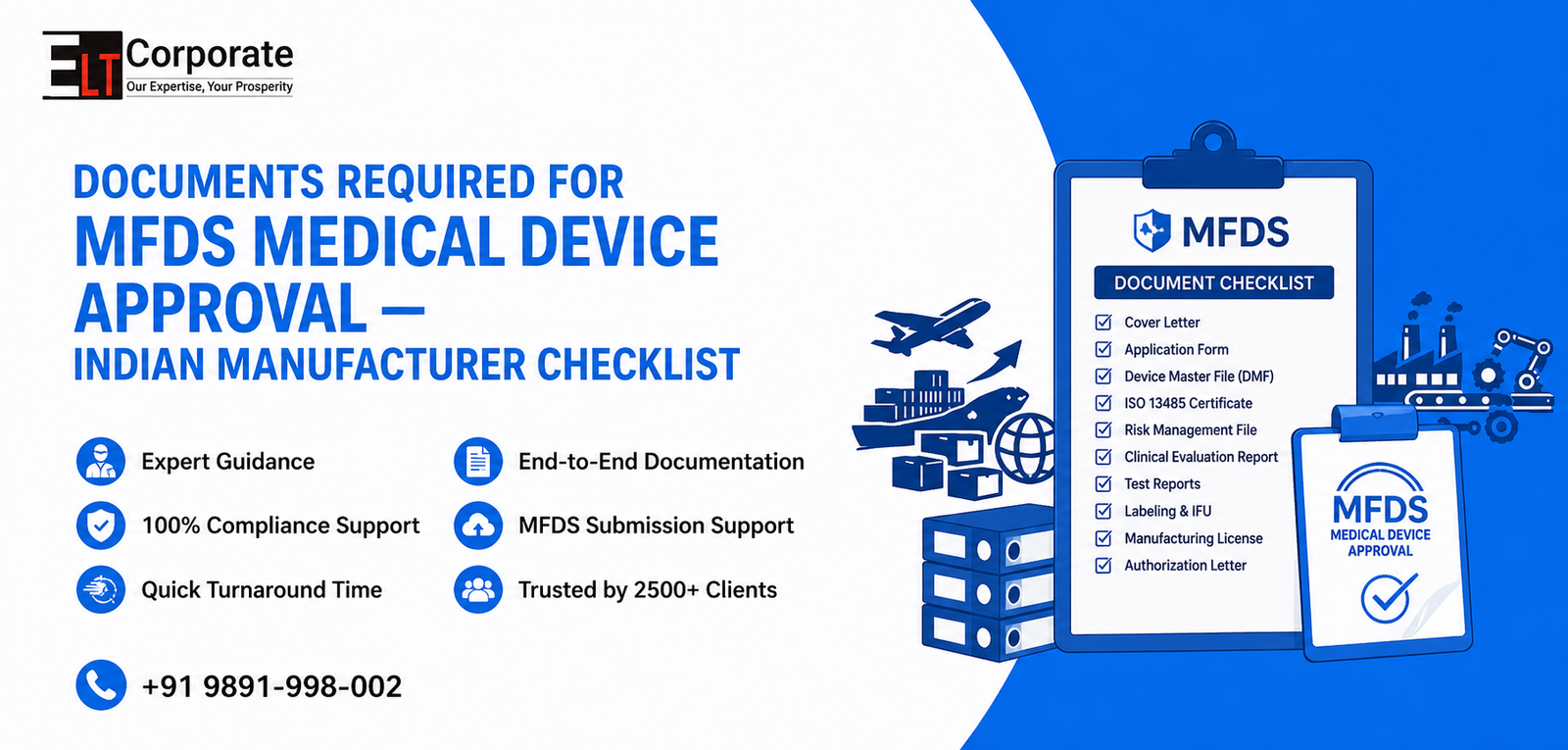
Complete Document Checklist for MFDS Medical Device Approval
Section A — Applicant and Corporate Documents
1. Certificate of Incorporation / Business Registration Proof of legal existence of the Indian manufacturing entity.
2. “Free Sale Certificate (FSC)” / Certificate to Foreign Government (CFG) Issued by CDSCO (or the relevant home-country authority), confirming the device is legally manufactured and freely sold in India. This must typically be apostilled or legalized.
3. Power of Attorney / Letter of Authorisation Formal authorization appointing the Korean License Holder (KLH) or In-Country Caretaker (ICCT) to act on the manufacturer’s behalf for all MFDS interactions.
4. Business Agreement with Korean License Holder Contract: defining regulatory responsibilities, distribution rights, and vigilance obligations between the Indian manufacturer and the Korean entity.
Section B — Device Technical Documentation
5. Device Description and Intended Use Full technical description covering device name, model/catalogue numbers, intended clinical use, target patient population, and mechanism of action.
6. Classification Rationale Documented justification for the device’s classification under Korean Medical Device Act rules (Class I–IV), including comparison against Korean classification guidance where the product falls into a borderline category.
7. Technical Specifications and Design Documents Engineering drawings, material specifications, dimensional data, and performance specifications relevant to the device category.
8. Risk Management File (ISO 14971) A complete risk management report covering hazard identification, risk estimation and evaluation, control measures, and residual risk/benefit-risk conclusion—MFDS reviewers place significant weight on this document.
9. Biocompatibility Information (ISO 1093 Series) is required for all devices that have direct or indirect contact and is adapted to the duration of contact and type of tissue.
10. Sterilization Validation (where appropriate) Data for validation as in accordance with ISO 11135 (ethylene oxide) or ISO 11137 (radiation) and residual sterilant tests when relevant.
11. Electronic Safety as well as EMC Testing (for electronic/active devices) Test reports as per IEC 60601 Series standards in the case of devices that incorporate electronic or electrical components.
12. Evaluation report or clinical evaluation report or clinical data: Based on the classification, either a text-based medical evaluation or data from clinical trials might be required to prove the claims of safety and effectiveness.
Section C — Quality Management System Documents
13. ISO 13485 Certificate: A valid QMS certificate covering the manufacturing scope relevant to the device being registered.
14. GMP/KGMP Compliance Documentation Evidence of conformity in accordance with Korean Good Manufacturing Practice requirements that may require an individual KGMP audit for devices of higher quality.
15. Post-Market Surveillance Plan Documented processes for capturing complaints and adverse event information as well as field performance data after the device has been placed and made available on the Korean market.
16. Vigilance and Recall Procedures Defined process for reporting serious incidents to MFDS and executing recalls or field safety corrective actions if needed.
Section D—Labelling Documents
17. Korean-Language “Labelling and Packaging” Artwork All device labels and packaging must be translated into Korean, including manufacturer details, model number, lot/batch number, and applicable warnings.
18. Instructions for Use (IFU) — Korean Translation A fully translated IFU covering intended use, contraindications, warnings, storage conditions, and disposal guidance.
Step-by-Step MFDS Approval Process for Indian Manufacturers
Step 1 — Classification Confirmation: Determine the correct Korean device class before assembling documentation, as this dictates the depth of clinical and technical evidence required.
Step 2 — Appoint a Korean License Holder: Identify and formally engage a KLH/ICCT who will submit the application and hold local regulatory responsibility.
Step 3—Dossier Compilation: Assemble and translate all technical, QMS, and labeling documents into the format expected by MFDS.
Step 4 — KGMP Audit (if applicable): For higher-risk devices, undergo a Korean GMP audit, which may be conducted remotely or on-site at the Indian manufacturing facility.
Step 5 — Application Submission: The KLH files the complete application with MFDS through the applicable electronic submission system.
Step 6 — Query Response: Respond promptly and precisely to any MFDS deficiency letters or requests for additional data.
Step 7 — Approval and Market Entry: Upon approval, the device receives its MFDS registration number, permitting legal sale and distribution in South Korea.
Common Reasons for Delay or Rejection
- Incomplete or non-notarised Free Sale Certificate
- Risk management file not aligned with device-specific hazards
- Missing or outdated biocompatibility data for patient-contacting materials
- Korean translation errors or inconsistencies in labelling
- Classification mismatch discovered late in the review process
Conclusion
MFDS approval takes patience and precise paperwork—but once your classification, risk file, and Korean license holder are sorted, the process becomes far more predictable. At Medical Device Registration, we help Indian manufacturers navigate exactly this, so your export to South Korea doesn’t get stuck in documentation delays.
Frequently Asked Questions
Q1. Can an Indian manufacturer file directly with MFDS?
No. A Korean license holder or in-country caretaker must submit the application and hold regulatory responsibility on the manufacturer’s behalf.
Q2. Do you think a free sale certificate from CDSCO is always mandatory?
In general, yes, since it indicates that the device has been legally sold in its country of origin; however, the specific requirements may differ by class of device.
Q3. How long will MFDS approval usually take?
Timelines vary significantly by device class and completeness of documentation, ranging from a few months for low-risk devices to considerably longer for higher-risk or clinical-data-dependent products.
Q4. Is KGMP audit mandatory for all devices?
Not always — it typically applies to higher-risk device classes, though requirements should be confirmed based on specific classification.
Q5. Does labeling need to be in Korean only?
Yes, Korean-language labeling and IFUs are required for market entry, though bilingual labeling is often used in practice for manufacturer traceability.
Comments are closed