
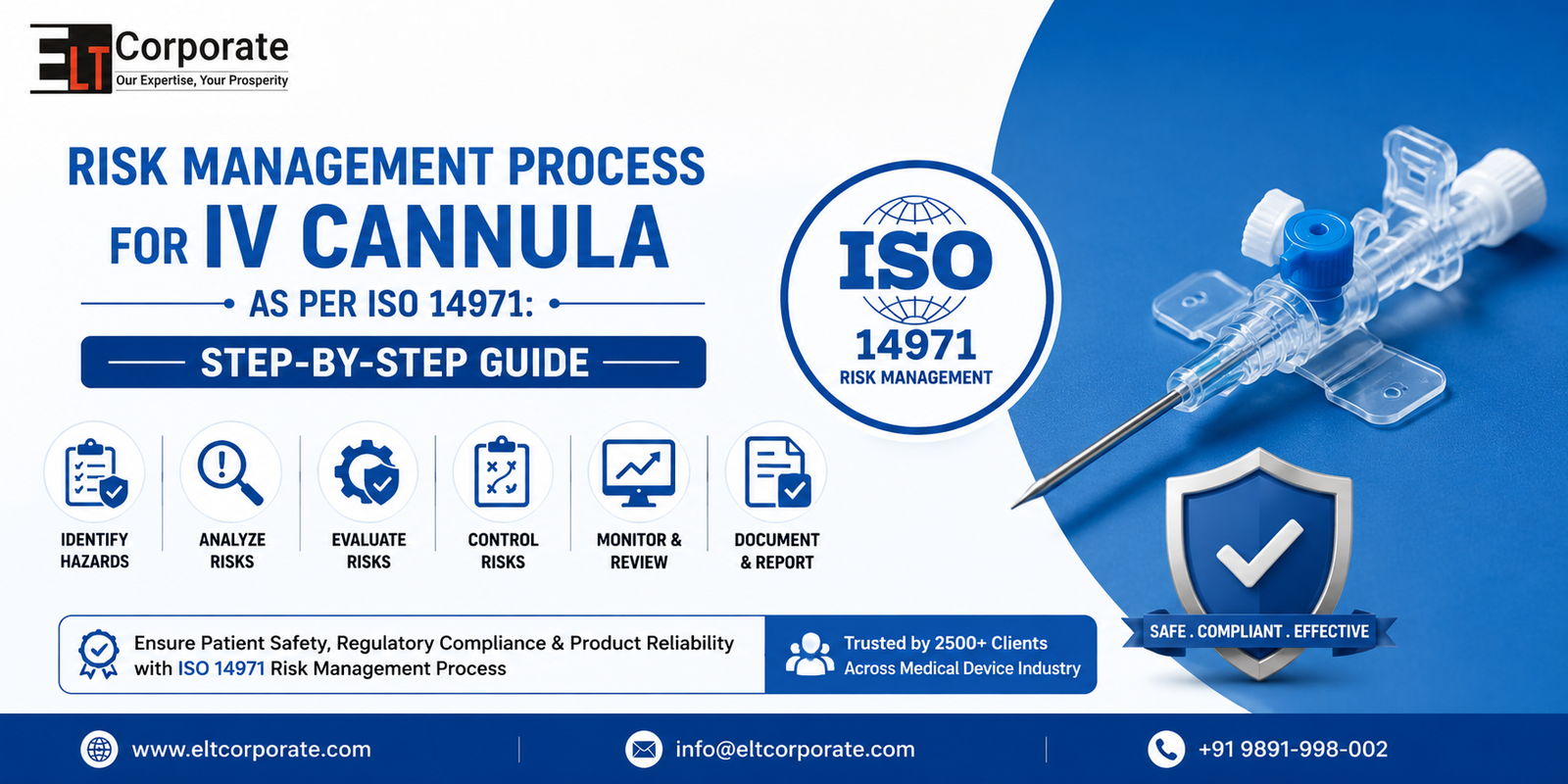
In the IV cannula, you will find one of the most commonly used surgical devices that are used in hospitals, clinics, and homes across the world. Because they are placed into the skin and remain in close contact with bloodstreams for long periods of time, a minor flaw in design or manufacturing could result in serious injury to patients. This is the reason CDSCO, together with other worldwide regulators, places a heavy weight on a documented and standardized risk management system for each IV cannula procedure. ISO 14971 is the globally recognized framework that is used to prove this.
When you produce IV cannulas in the US or import them to India A robust ISO 14971 risk management file is among the most scrutinized parts that comprise the CDSCO document of technical details. This guide will walk you through the entire process step-by-step.
What is ISO 14971?
ISO 14971 is an international standard that reads “Medical devices—Application of risk management to medical devices.” It is a procedure for manufacturers to determine the risks that come with medical devices as well as estimate and evaluate risk and manage the risks and evaluate the effectiveness of control measures throughout the lifecycle of the product, beginning with design and continuing to post-market usage.
An IV cannula is a must; this isn’t just a theoretical procedure. The device is placed inside the blood vessel, is operated by clinicians under pressure of time, and is used by a broad variety of patients, including infants and elderly patients as well as immunocompromised patients. A properly implemented risk management system is what differentiates a safe CDSCO-compliant product from one that has been recalled.
Why Risk Management Matters Specifically for IV Cannulas
IV cannulas have a unique set of risks not present in other categories of devices:
- Needle-stick injury on healthcare personnel: the insertion or removal
- Infections in the bloodstream that are a result of catheters (CRBSI) from inadequate aseptic packaging or design
- Expansion and Phlebitis due to incompatibility of the material and poor design of the tip
- Catheter fractures or embolisms due to substandard polymer quality
- The air embolism due to a faulty connector or flashback chamber design
- Occlusion or restriction of flow impacting the accuracy of delivery of drugs and fluids
Because these devices are produced and used in huge numbers, even a minor defect rate could result in many adverse events, making an adequately documented risk file vital in order to ensure regulatory approval as well as the safety of patients.
Step-by-Step ISO 14971 Risk Management Process for IV Cannula
Step 1—Establish the Risk Management Plan
Each risk management document starts with a strategy that defines the purpose of the instrument (peripheral IV cannulas, IV safety with wings, non-winged/winged, and various sizes of gauges) as well as the risk acceptability standards your organization will use and the person who is responsible for it, as well as the points of review that span the entire lifecycle of the device.
Step 2—Intended Use and Reasonably Foreseeable Misuse
Before identifying potential hazards The intended purpose of the use should be defined clearly as short-term peripheral venous access to administer drugs or fluids or for blood sample collection. It is equally important to document any foreseeable errors, such as having a cannula inserted again in the wrong gauge for the indication for the clinical procedure or an extended time of use beyond the limits recommended.
Step 3—Hazard Identification
This is the fundamental technological step. In the case of an IV cannula, hazards are typically identified by:
- Biological hazards (non-biocompatible materials, non-sterile product)
- Mechanical risks (catheter shearing needle breakage, flashback, visibility)
- Safety-related risks from use (incorrect technique of insertion, accidental needle-stick)
- Chemical dangers (residual plasticiser, ethylene oxide leaching)
- Hazards associated with packaging (compromised the sterile barrier in transportation)
Every hazard is tied to a specific risk and could lead to a sequence of events that could lead to injuries to users or patients.
Step 4—Risk Estimation
For each hazard that is identified, the degree of damage (e.g., localized infection or potentially life-threatening embolism) and the chance of its occurrence are calculated, usually with the help of the risk matrix. This method is based heavily on biocompatibility test results and mechanical performance tests (tensile strength as well as flexibility and kink resistance) and sterilization verification.
Step 5—Risk Evaluation
Every risk estimate is evaluated against the accepted guidelines in Step 1. Risks that exceed the threshold of acceptable must be subjected to risk control. Risks that are in an acceptable range are recorded and tracked.
Step 6—Risk Control Measures
If the risk is greater than acceptable levels, measures to control them are enacted according to the hierarchy according to ISO 14971:
- Inherent safety through design: such as including needle-shielding mechanism that is passive to protect against needle-stick injuries
- Protection measures within the manufacturing process or device, like enhanced catheter tip geometry to lessen the risk of trauma to the vessel
- Safety information: clear labels, IFU warnings on maximum time of stay, and instructions on insertion techniques.
Each control measure should be tested for its effectiveness, and any risk that is created through the control’s own implementation must be evaluated again.
Step 7—Residual Risk Evaluation
Once the controls have been implemented, after the control is implemented, those who remain (residual) risk associated with every hazard are assessed. If it is not satisfactory, further control is required. If the results are acceptable, it moves to an overall risk evaluation.
Step 8—Overall Residual Risk and Benefit-Risk Analysis
Beyond individual risks, ISO 14971 requires an evaluation of the risks associated with the instrument in general in relation to its clinical benefits. For cannulas for IV, the established clinical benefit of the vascular access usually supports the benefit-risk ratio to be favorable as long as the residual risks are properly monitored and documented.
Step 9—Risk Management Report
An official report will be prepared that summarizes the entire processHazard identification and risk analysis, assessment of controls used, confirmation of the effectiveness of controls, and benefit-risk assessment. The report is a required element of the CDSCO technical dossier.
Step 10—Production and Post-Production Monitoring
Risk management doesn’t end with approval. Manufacturers need to maintain a process to collect post-market information, such as complaints, vigilance reports, and performance data from field inspections, and feed this data to the risk database and update it when new data suggests a previously unidentified risk or overestimated risk.
Common Gaps Seen in IV Cannula Risk Management Files
- Generic risk files that are copied from other categories of devices without any cannula-specific risks
- Missing linkage between biocompatibility/mechanical test data and risk estimation
- Lack of documented evidence to verify control measure effectiveness (e.g., the needle-stick prevention mechanism that has not been tested with actual users)
- There is no post-market feedback loop that updates the risk file to reflect real-world information.
Conclusion
A complete, device-specific ISO 14971 risk management file is more than just a legal formality—it’s the foundation of a secure IV cannula and is an essential element of an effective CDSCO registration. Manufacturers and importers must ensure that their risk management documents reflect the real risks as well as the testing information and the control measures that are unique to their particular product instead of using generic templates.
If you require assistance from a professional in the preparation of compliance with CDSCO ISO 14971 risk management file for your IV cannula Our team of regulatory experts can assist you in constructing a solid and adequacy-based dossier, starting with hazard identification and ending with the final risk management document.
Frequently Asked Questions
Q1. Do you consider ISO 14971 mandatory for CDSCO registration of IV cannulas?
Yes. CDSCO requires a written risk management plan that is aligned to ISO 14971 as part of the technical dossier for IV cannulas because they are infected devices that contact patients.
Q2. What is the frequency at which the risk management document is reviewed and updated?
It’s a living document. It should be reviewed and revised as modifications in design are made and new hazards are discovered or post-market data (complaints or vigilance reports) suggests an unassayed risk.
Q3. Can a generic risk management template be used for IV cannulas?
No. Reviewers expect hazards, test data, and control measures specific to IV cannulas—such as needle-stick protection and catheter fracture risk—not a generic device template.
Q4. What data supports the risk estimation step?
Risk estimation typically draws on biocompatibility testing, mechanical performance data (tensile strength, kink resistance), sterilization validation, and any available clinical or literature evidence.
Q5. Who is responsible for maintaining the risk management file after approval?
The legal manufacturer (or the Indian authorized agent for imported products) is responsible for maintaining and updating the file throughout the device’s lifecycle, including post-market surveillance.
Comments are closed