
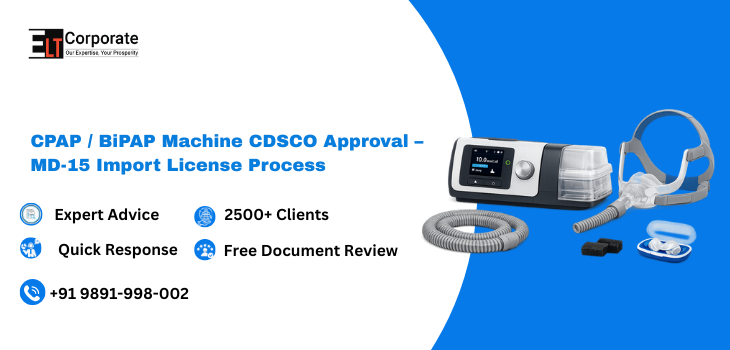
Sleep-disordered breathing affects millions of Indians. With rising awareness of obstructive sleep apnoea (OSA), obesity hypoventilation syndrome, chronic obstructive pulmonary disease (COPD), and other respiratory conditions, the demand for CPAP (Continuous Positive Airway Pressure) and BiPAP (Bilevel Positive Airway Pressure) machines in India is growing rapidly — across hospitals, sleep clinics, home care providers, and individual patients.
If you are a foreign manufacturer, Indian importer, or distributor seeking to bring CPAP or BiPAP machines into the Indian market, obtaining a CDSCO Import Licence (Form MD-15) is a non-negotiable legal requirement under the Medical Devices Rules, 2017 (MDR 2017). Operating without this licence — importing, stocking, distributing, or selling CPAP/BiPAP machines — is a criminal offence under the Drugs and Cosmetics Act, 1940.
We provide complete, end-to-end CDSCO import licence services for CPAP and BiPAP machines — from device classification and dossier preparation to SUGAM portal filing, Third Party Audit coordination, query resolution, and final MD-15 licence issuance.
What is the CDSCO MD-15 Import Licence?
The MD-15 is the formal Import Licence for Medical Devices issued by the Central Drugs Standard Control Organisation (CDSCO) under the Ministry of Health and Family Welfare, Government of India. It is issued pursuant to a successful application in Form MD-14 filed through the CDSCO SUGAM online portal.
The MD-15 import licence authorises the named Indian entity — the Indian Authorised Agent (IAA) or importer — to import specific CPAP/BiPAP device models from a specific overseas manufacturer for commercial sale and distribution in India. The licence is:
- Device-specific — covers only the models listed in the application
- Manufacturer-specific — tied to a single overseas manufacturing facility
- Importer-specific — issued in the name of the Indian IAA / importer
- Valid for 5 years from the date of issue
Without a valid MD-15 licence, no CPAP or BiPAP machine can legally enter the Indian market through commercial channels.
Understanding CPAP and BiPAP — Device Overview
CPAP (Continuous Positive Airway Pressure) Machines
CPAP machines deliver a single, continuous level of pressurised air through a mask worn over the nose or nose and mouth during sleep. They are the first-line treatment for obstructive sleep apnoea (OSA). CPAP devices range from basic fixed-pressure units to advanced auto-titrating CPAP (APAP) machines that automatically adjust pressure based on real-time patient need.
BiPAP (Bilevel Positive Airway Pressure) Machines
BiPAP machines deliver two distinct pressure levels — a higher inspiratory positive airway pressure (IPAP) during inhalation and a lower expiratory positive airway pressure (EPAP) during exhalation. BiPAP is used for patients who cannot tolerate CPAP, and for a wider range of conditions including:
- Complex sleep apnoea
- COPD and chronic respiratory failure
- Obesity hypoventilation syndrome
- Neuromuscular diseases affecting breathing
- Acute respiratory distress (in clinical settings)
Related Device Categories Also Covered
The regulatory framework for CPAP/BiPAP also covers related devices that may require the same or similar registration pathway:
- APAP (Auto-titrating PAP) machines
- ASV (Adaptive Servo-Ventilation) machines
- AVAPS (Average Volume-Assured Pressure Support) devices
- Non-Invasive Ventilation (NIV) devices for home care
- Travel CPAP machines
- CPAP/BiPAP accessories (masks, humidifiers, tubing, filters) — where classified as medical devices
Regulatory Classification of CPAP / BiPAP Under MDR 2017
Under the Medical Devices Rules, 2017, medical devices are classified on a risk basis — Class A (lowest risk) through Class D (highest risk). Correct classification is the essential first step because it determines the conformity assessment route, the required documentation, and whether a Third Party Audit (TPA) is mandatory.
| Device Type | Risk Classification | Licensing Authority | TPA Required |
| Basic CPAP — fixed pressure, home use | Class B | CDSCO (Central) | No (self-certification with documentation) |
| APAP — auto-titrating, home use | Class B / C | CDSCO (Central) | Borderline — assessed case by case |
| BiPAP — home care, non-life-sustaining | Class B / C | CDSCO (Central) | Depends on intended use |
| BiPAP — clinical / life-sustaining use | Class C | CDSCO (Central) | Yes — TPA mandatory |
| ASV / AVAPS — complex non-invasive ventilation | Class C | CDSCO (Central) | Yes — TPA mandatory |
| NIV — non-invasive ventilation for acute care | Class C | CDSCO (Central) | Yes — TPA mandatory |
| CPAP / BiPAP with heated humidifier | Class B / C | CDSCO (Central) | Depends on primary device class |
| CPAP / BiPAP masks (patient interface) | Class B | CDSCO (Central) | Generally not required |
Important: Classification is not always straightforward for CPAP/BiPAP devices because the same device platform may be intended for home care (lower risk) or clinical life-sustaining use (higher risk). The intended use stated in the device’s labelling and Instructions for Use is a critical determinant of classification. Our regulatory team conducts a formal classification analysis for every device before application.
Who Needs to Apply for CDSCO CPAP / BiPAP Import Licence?
- Foreign CPAP / BiPAP manufacturers seeking to enter the Indian market — must appoint an Indian Authorised Agent (IAA) to file the import application on their behalf
- Indian importers and distributors of international CPAP/BiPAP brands (ResMed, Philips Respironics, Fisher & Paykel, DeVilbiss, BMC, 3B Medical, Löwenstein Medical, and others)
- Medical equipment companies expanding their respiratory product portfolio into India
- Home care equipment providers supplying CPAP/BiPAP to patients at home
- Hospitals and sleep clinics that import equipment directly for institutional use
- E-commerce sellers offering CPAP/BiPAP machines through online platforms
- Sleep medicine distributors supplying to pulmonologists, ENT specialists, and sleep labs
Complete Document Checklist for CPAP / BiPAP CDSCO Import Licence
A well-prepared, complete dossier is the single most important factor in achieving timely CDSCO approval. Below is the comprehensive document checklist for CPAP / BiPAP import licence applications.
SECTION A — Indian Applicant / IAA Documents
1. Application in Form MD-14 Accurately completed application form filed through the CDSCO SUGAM portal, with correct details of the applicant (IAA/importer), the foreign manufacturer, and the CPAP/BiPAP device models to be imported.
2. Certificate of Incorporation / Business Registration Proof of legal registration of the Indian entity — Certificate of Incorporation (for companies), Partnership Deed (for firms), or LLP Agreement and Certificate.
3. Import Export Code (IEC) Valid IEC issued by the Directorate General of Foreign Trade (DGFT). Mandatory prerequisite for all import applications.
4. GST Registration Certificate Valid GSTIN of the Indian applicant entity.
5. Authorisation Letter from Foreign Manufacturer A formally notarised and apostilled letter from the overseas CPAP/BiPAP manufacturer explicitly:
- Appointing the Indian entity as their exclusive / authorised agent for India
- Listing all CPAP/BiPAP device models covered by the authorisation
- Confirming the manufacturer’s support for the Indian registration process
- Stating the territory of appointment (India)
6. Indian Authorised Agent (IAA) Agreement Formal agreement between the foreign manufacturer and the Indian IAA defining their regulatory roles and responsibilities under MDR 2017 — including who is responsible for vigilance reporting, label compliance, and post-market obligations in India.
7. Affidavit / Undertaking by Indian Applicant Sworn affidavit on non-judicial stamp paper by the proprietor / directors of the Indian entity, declaring:
- Compliance with all conditions of the Medical Devices Rules, 2017
- Truth and accuracy of all submitted information
- Commitment to maintain post-market surveillance and vigilance obligations in India
8. Power of Attorney (if filing through regulatory consultant) Duly executed POA authorising the regulatory consultant to file and manage the application on the applicant’s behalf.
SECTION B — Device Technical Documents
9. Device Description and Intended Use A comprehensive written description of the CPAP / BiPAP device covering:
- Full device name, model number(s), and all variants included in the application
- Operating principle — how the device generates and delivers positive airway pressure
- Intended clinical use and target patient population
- Clinical setting — home care, hospital, ICU, transport, or combined
- Intended users — patients (self-use), caregivers, or trained clinicians
- Contraindications and clinical limitations
- Description of all components — device unit, mask interface, tubing, humidifier, power supply, carrying case
- Description of all software and connectivity features (data logging, wireless connectivity, app integration, cloud monitoring)
10. Technical Specifications Detailed performance specifications including:
- Pressure delivery range (CPAP: typically 4–20 cmH₂O; BiPAP IPAP/EPAP ranges)
- Pressure accuracy and stability
- Flow rate range
- Ramp-up feature specifications
- Humidifier specifications (if integrated — temperature range, water capacity)
- Alarm types and alarm performance specifications
- Data recording and connectivity specifications (Bluetooth, Wi-Fi, SD card)
- Battery backup specifications (for travel models)
- Noise level (dBA)
- Dimensions and weight
- Power supply requirements (voltage, frequency, power consumption)
- Environmental operating conditions (temperature, humidity range)
- IP rating (dust/water resistance, if applicable)
11. Essential Principles Checklist (Schedule III — MDR 2017) A comprehensive document demonstrating how the CPAP/BiPAP device satisfies each applicable Essential Principle of Safety and Performance under Schedule III of the Medical Devices Rules, 2017 — with specific references to the standards, test reports, and clinical data used to demonstrate conformity with each principle.
12. Risk Management File (ISO 14971:2019) Complete risk management documentation for the device, prepared in accordance with ISO 14971:2019, including:
- Risk management plan
- Hazard identification for all life-cycle phases
- Risk estimation and evaluation for each hazard
- Risk control measures and their effectiveness verification
- Residual risk assessment and acceptability determination
- Benefit-risk analysis conclusion
- Post-production information input and update process
For life-sustaining BiPAP and ASV devices, CDSCO gives particular attention to the risk management file. It must be comprehensive, device-specific, and reference objective evidence for every risk control measure claimed.
13. Software Documentation Modern CPAP and BiPAP devices incorporate sophisticated embedded software for pressure control algorithms, data logging, alarm management, and wireless connectivity. Software documentation must include:
- Software description and functional overview
- Software safety classification per IEC 62304 (Class A, B, or C)
- Software architecture and component description
- Software development lifecycle documentation
- Software verification and validation records
- Cybersecurity risk assessment and mitigations per IEC 81001-5-1
- Software version history and change control procedures
- Description of any mobile apps or cloud platforms associated with the device
14. Usability Engineering File (IEC 62366-1) Documentation of the usability engineering process applied to the CPAP/BiPAP interface design — including:
- Intended use environment description (bedroom, home, hospital)
- User population analysis (patients with OSA, caregivers, clinicians)
- Identification of use-related hazards
- Formative usability evaluations during design development
- Summative usability evaluation (human factors validation study)
- Residual use-related risk assessment
This is particularly important for home-use CPAP/BiPAP devices where untrained patients self-apply and manage the device.
SECTION C — Test Reports and Standards Compliance
All test reports must be from NABL-accredited laboratories or internationally accredited laboratories (ILAC MRA, A2LA, DAKKS, UKAS, etc.).
15. IEC 60601-1 — General Safety and Essential Performance The foundational standard for all electrically powered medical devices. Tests cover electrical safety, mechanical safety, thermal safety, radiation safety, and essential performance requirements. Mandatory for all CPAP and BiPAP devices.
16. IEC 60601-1-2 — Electromagnetic Compatibility (EMC) Ensures the device does not emit electromagnetic interference that could affect other medical equipment and operates correctly in the EMC environment of homes and healthcare facilities. Critical for devices used in hospitals, ICUs, and bedrooms with multiple electronic devices.
17. IEC 60601-1-6 — Usability (General) Usability requirements for medical electrical equipment — to be demonstrated in conjunction with the IEC 62366-1 usability engineering file.
18. IEC 60601-1-8 — Alarm Systems Requirements for alarm systems in medical electrical equipment. For BiPAP devices used for life-sustaining ventilation, alarm performance is safety-critical and receives close CDSCO scrutiny.
19. IEC 60601-1-11 — Home Healthcare Environment Additional requirements for medical electrical equipment used in the home healthcare environment — covering the electromagnetic, mechanical, and operational conditions unique to home use. Mandatory for all CPAP/BiPAP devices intended for home use.
20. ISO 80601-2-70 — Ventilatory Support Equipment for Ventilatory Impairment (Sleep Apnoea) This is the primary product-specific standard for CPAP and BiPAP devices used in the treatment of sleep-disordered breathing. It specifies particular requirements for basic safety and essential performance of sleep apnoea therapy equipment. Compliance with this standard is the most important single test report for CPAP/BiPAP CDSCO registration.
21. ISO 80601-2-72 — Home Healthcare Ventilators (if applicable) For BiPAP devices intended for long-term home mechanical ventilation in patients with chronic respiratory failure — this standard covers particular requirements for home life-supporting and non-life-supporting ventilators. Required where the BiPAP device is positioned for long-term home ventilation beyond sleep apnoea treatment.
22. ISO 80601-2-80 — Non-Invasive Ventilatory Support Equipment for Ventilatory Impairment Covers non-invasive ventilatory support equipment for patients with ventilatory impairment — relevant for advanced BiPAP, ASV, and AVAPS devices.
23. ISO 80601-2-74 — Respiratory Humidifiers (if applicable) For CPAP/BiPAP systems with integrated or companion heated humidifiers — covers particular requirements for respiratory humidifiers used with ventilatory support equipment.
24. IEC 62304 — Medical Device Software (Software Lifecycle) Mandatory for devices with embedded control software — covering software development lifecycle requirements from planning through maintenance. Required for all modern CPAP/BiPAP devices with digital control systems, data logging, and app connectivity.
25. IEC 62366-1 — Usability Engineering Test report or evaluation evidence demonstrating that the device’s usability engineering process has been applied and validated — complementing the Usability Engineering File in the technical dossier.
26. Biocompatibility Reports (ISO 10993 series) — for Patient-Contacting Components For CPAP/BiPAP masks, nasal pillows, oral interfaces, and any other component intended to be in direct contact with a patient’s skin, mucous membranes, or airways — biocompatibility testing per the ISO 10993 series (including ISO 10993-1, ISO 10993-5, ISO 10993-10 as applicable) must be documented.
SECTION D — Quality Management System Documents
27. ISO 13485:2016 Certificate Valid ISO 13485 quality management system certificate issued by an accredited certification body. The certificate must:
- Be current and within its validity period at the time of application
- Specifically include sleep therapy / respiratory / CPAP/BiPAP devices in its product scope
- Be issued by a certification body accredited under IAF or an equivalent international accreditation body
28. Quality Management System Overview / QMS Manual Summary A summary of the manufacturer’s QMS structure, quality policy, key processes, and how the system ensures continued compliance of CPAP/BiPAP devices placed on the market.
29. Post-Market Surveillance (PMS) Plan Documented plan for systematic collection, analysis, and action on post-market data about the device’s real-world safety and performance — covering data sources, review frequency, responsible personnel, and criteria for corrective actions.
30. Vigilance Procedures Documented procedures for detecting, evaluating, and reporting serious incidents involving CPAP/BiPAP devices to CDSCO — within prescribed timeframes (typically 30 days for serious incidents). Also covers Field Safety Corrective Action (FSCA) management and Field Safety Notice (FSN) communication to customers.
31. Periodic Safety Update Report (PSUR) — if available For devices already marketed in other countries, a PSUR summarising post-market safety and performance data, benefit-risk conclusions, and corrective actions taken — demonstrating that the device’s real-world safety profile is consistent with its intended use claims.
SECTION E — Clinical Evaluation Documents
32. Clinical Evaluation Report (CER) A systematic and documented clinical evaluation demonstrating that the CPAP/BiPAP device achieves its intended clinical performance and is safe for the intended patient population. The CER must:
- Follow a structured clinical evaluation methodology
- Include a systematic literature review on the clinical use of CPAP/BiPAP for the intended indications
- Reference clinical data from the specific device or equivalent marketed devices
- Include a clinical evaluation of any specific performance claims (e.g., efficacy in AHI reduction, patient compliance data, auto-titration algorithm performance)
- Conclude on the acceptability of the device’s benefit-risk profile
33. Clinical Investigation Data (if applicable) For novel CPAP/BiPAP designs, new algorithms (such as new auto-titration approaches or new ASV algorithms), or specific clinical performance claims not supported by published literature or equivalent device data — clinical investigation results may be required to support the CER.
34. Post-Market Clinical Follow-Up (PMCF) Plan A plan specifying how the manufacturer will continue to collect and analyse clinical data after market entry in India — feeding into the ongoing clinical evaluation cycle.
SECTION F — Labelling and Instructions for Use
35. Device Label (Schedule V — MDR 2017) Proposed label for the CPAP/BiPAP device and its packaging, including all mandatory elements:
- Device name and model number
- Manufacturer’s name, address, and contact details
- Country of manufacture
- Indian Authorised Agent’s name, address, and contact details
- Unique Device Identification (UDI) — GTIN, serial number / lot number
- Manufacturing date
- Intended use (brief description)
- Power supply specifications
- Applicable symbols (ISO 15223, IEC 60601)
- Applicable warnings
- Storage and transport conditions
36. Instructions for Use (IFU) / User Manual A comprehensive user manual in English — and, where required, in regional Indian languages for home-use devices — covering:
- Intended use, indications, and contraindications
- Patient and caregiver safety information
- Device setup — assembly of device, mask, tubing, humidifier
- Initial use and pressure setting guidance (for clinician-prescribed settings)
- Auto-titration feature operation (for APAP/BiPAP models)
- Humidifier setup and water management
- Mask fitting and adjustment guide
- Cleaning and disinfection instructions — device, mask, tubing, humidifier chamber
- Filter replacement schedule
- Data download and app connectivity instructions (where applicable)
- Alarm meanings and responses
- Battery management (for travel models)
- Troubleshooting guide
- Maintenance and service intervals
- Technical specifications (complete)
- Accessories and spare parts list with ordering information
- Storage, transport, and disposal instructions
- Symbols glossary
SECTION G — Documents from Foreign Manufacturer
37. Free Sale Certificate (FSC) / Market Authorisation from Country of Origin Issued by the competent regulatory authority in the manufacturer’s home country, confirming the CPAP/BiPAP device is legally marketed there:
- USA: FDA 510(k) clearance (most CPAP/BiPAP devices) or De Novo classification order
- European Union: CE Certificate issued under EU MDR 2017/745 (or MDD 93/42/EEC for transitional period devices) by an EU Notified Body
- Australia: TGA (Therapeutic Goods Administration) ARTG registration
- Canada: Health Canada Medical Device Licence
- Japan: PMDA approval
The FSC must be apostilled or legalised by the Indian Embassy / Consulate in the manufacturer’s country.
38. Manufacturing Licence of Foreign Facility Proof that the manufacturing site holds a valid manufacturing licence, establishment registration, or equivalent regulatory authorisation in the country of manufacture.
39. GMP Compliance Evidence Evidence of Good Manufacturing Practices compliance at the manufacturing facility:
- ISO 13485 certificate covering the CPAP/BiPAP manufacturing scope, or
- FDA Establishment Registration and Device Listing (for US manufacturers), or
- CE Annexe certification confirming QMS assessment by the EU Notified Body
40. Site Master File (SMF) A comprehensive document describing the manufacturing site — location, infrastructure, organisational structure, manufacturing processes, quality management system overview, and regulatory compliance history.
41. Declaration of Conformity A formal, signed declaration by the foreign manufacturer that the CPAP/BiPAP device model(s) covered by the application conform to all applicable requirements of the Medical Devices Rules, 2017 and meet all Essential Principles of Safety and Performance.
Step-by-Step MD-15 Import Licence Process for CPAP / BiPAP
Step 1 — Free Regulatory Assessment
Our team reviews your CPAP/BiPAP device specifications, intended use, and existing regulatory certifications to determine the correct MDR 2017 classification and identify documentation gaps before application.
Step 2 — Device Classification Determination
We formally determine the device’s classification under MDR 2017 — critical for establishing the conformity assessment route, required standards, and whether TPA is mandatory.
Step 3 — Documentation Gap Analysis
We systematically review all available technical documents against CDSCO requirements — identifying missing tests, incomplete clinical evaluation, outdated ISO 13485 certificates, or other gaps that need to be addressed before filing.
Step 4 — Foreign Manufacturer Document Coordination
We work with you and the overseas manufacturer to obtain all required foreign documents — FSC, SMF, ISO 13485 certificate, Declaration of Conformity, and authorisation letter — and coordinate apostille or legalisation where required.
Step 5 — Technical Dossier Preparation
We prepare or review the complete technical dossier — Essential Principles Checklist, Risk Management File summary, Clinical Evaluation Report, usability documentation, software documentation, and labelling review — to CDSCO-submission standard.
Step 6 — Test Report Verification
We verify that all required IEC/ISO test reports are available, within their validity period, and issued by acceptable accredited laboratories. We advise on any missing or expiring test reports and coordinate additional testing where needed.
Step 7 — SUGAM Portal Application Filing
We manage the complete SUGAM portal submission — account setup, DSC coordination, Form MD-14 completion, document upload, and government fee payment.
Step 8 — Third Party Audit (TPA) Coordination
For Class C CPAP/BiPAP devices, CDSCO appoints a Third Party Auditor. We prepare the dossier for TPA review, respond to TPA queries, and manage the TPA process to minimise audit findings and delays.
Step 9 — CDSCO Query Response
If CDSCO raises technical or administrative queries during their review, our regulatory experts prepare precise, well-documented written responses — resolving issues efficiently to avoid multiple query rounds.
Step 10 — MD-15 Licence Issuance
Upon successful evaluation, CDSCO issues the Form MD-15 Import Licence for the CPAP/BiPAP device(s), available through the SUGAM portal. We deliver the licence to you with full explanation of the conditions and your post-licence obligations.
Step 11 — Post-Licence Compliance Setup
We help you establish post-market surveillance procedures, vigilance reporting mechanisms, label compliance for imported shipments, and a renewal tracking calendar.
Government Fee for CPAP / BiPAP CDSCO Import Licence
| Application Type | Government Fee |
| Import Licence — Class B CPAP/BiPAP (Form MD-14) | ₹5,000 per device |
| Import Licence — Class C CPAP/BiPAP (Form MD-14) | ₹50,000 per device |
| Renewal of Import Licence (Form MD-14) | 50% of original licence fee |
| Amendment to existing licence | ₹2,500 – ₹10,000 |
| Addition of new device model to existing licence | As applicable per device class |
Government fees are paid online through the SUGAM portal. Fees are subject to revision. Always verify current fees on the SUGAM portal before filing.
Estimated Timeline for CPAP / BiPAP CDSCO Registration
| Device Type | Estimated Timeline |
| Class B — Basic fixed CPAP, home use | 3 – 5 months |
| Class B/C — APAP / auto-titrating CPAP | 4 – 8 months |
| Class C — BiPAP for clinical / life-sustaining use | 6 – 12 months |
| Class C — ASV / AVAPS / advanced NIV | 8 – 14 months |
Timelines depend on documentation completeness, test report availability, CDSCO workload, and — for Class C devices — TPA scheduling and review duration.
Post-Registration Compliance Obligations
Holding an MD-15 licence comes with ongoing obligations that must be maintained throughout the licence’s 5-year validity:
Label Compliance Every CPAP/BiPAP unit imported into India must bear a label compliant with Schedule V of MDR 2017 — including the Indian Authorised Agent’s name and address, UDI, and all other mandatory elements.
Vigilance Reporting Any serious incident involving an imported CPAP/BiPAP device in India must be reported to CDSCO within prescribed timeframes. Field Safety Corrective Actions (recalls, safety notices) must be initiated and managed promptly.
Periodic Safety Update Reports (PSURs) Class C CPAP/BiPAP devices require periodic PSURs summarising post-market safety and performance data and the benefit-risk conclusion.
Post-Market Surveillance Continuous monitoring of real-world device performance, customer and clinician feedback, global safety signals, and published literature must be maintained and documented.
Change Notifications Significant changes to device design, software, labelling, intended use, or manufacturing process must be notified to CDSCO before implementation. Failure to notify significant changes is a regulatory violation.
Licence Renewal Renewal application must be submitted before the MD-15 licence expiry date. We provide renewal tracking and manage the complete renewal process.
Why Choose Our CDSCO Registration Services for CPAP / BiPAP?
Respiratory Device Specialisation We have specific experience registering CPAP, BiPAP, APAP, ASV, and NIV devices with CDSCO. We understand the unique classification nuances, the primary product standard (ISO 80601-2-70), and the clinical evidence expectations that CDSCO applies to sleep therapy devices.
ISO 80601 Series Expertise The ISO 80601-2 family of standards is complex and evolving. We verify compliance across the full applicable standards set — ISO 80601-2-70, -72, -74, -80 — and ensure no applicable standard is missed in your dossier.
Software and Connectivity Regulatory Support Modern CPAP/BiPAP devices are increasingly software-intensive — with auto-titration algorithms, cloud connectivity, mobile apps, and data analytics. We provide specialised support for IEC 62304 software documentation and IEC 81001-5-1 cybersecurity assessments.
Clinical Evaluation Expertise Sleep medicine has a rich body of clinical literature. Our clinical evaluation team prepares CERs for CPAP/BiPAP devices that are well-grounded in published evidence and meet CDSCO’s expectations for clinical substantiation.
TPA Process Management For Class C BiPAP and ASV devices, we have extensive experience preparing dossiers for TPA review and managing the audit process — minimising findings and ensuring rapid resolution of any issues raised.
Major Brand Experience We have worked with leading respiratory device brands entering the Indian market. Our understanding of the specific documentation challenges associated with complex, globally marketed CPAP/BiPAP platforms informs every client engagement.
End-to-End Accountability From the first free consultation to MD-15 receipt and ongoing post-market compliance, we provide complete, accountable service — not a checklist and a disappearance.
Frequently Asked Questions
Q1. Are CPAP and BiPAP machines regulated as medical devices in India? Yes. CPAP and BiPAP machines are listed as notified medical devices under Schedule I of the Medical Devices Rules, 2017. They require CDSCO import licence (Form MD-15) before they can be legally imported, distributed, or sold in India.
Q2. Can a hospital import CPAP/BiPAP machines for its own use without a CDSCO import licence? No. Even for institutional end-use procurement, CPAP and BiPAP machines must be registered with CDSCO. Government hospitals, procurement agencies, and GeM (Government e-Marketplace) all mandate CDSCO registration before purchase.
Q3. Is CE marking or FDA 510(k) clearance sufficient to sell CPAP/BiPAP in India? No. CE and FDA clearances are accepted as supporting documentation in the CDSCO application but do not substitute for a separate CDSCO import licence. India requires its own independent registration process.
Q4. Can multiple CPAP/BiPAP models be covered under a single MD-15 licence? Generally, the application is manufacturer-specific — all models from a single manufacturer can be included in one application if they belong to the same product platform and share substantially the same technical documentation. Significantly different models or platforms may require separate applications. Our team advises on the optimal registration strategy for your product portfolio.
Q5. What is a Third Party Audit (TPA) and which CPAP/BiPAP devices require it? A TPA is an independent review of the technical dossier by a CDSCO-appointed auditor, required for Class C medical devices. BiPAP devices intended for clinical or life-sustaining use, ASV devices, and AVAPS devices are typically Class C and require TPA. Basic home-use CPAP devices (Class B) do not require TPA.
Q6. My CPAP device has a companion mobile app for patient monitoring. Does the app need separate registration? If the mobile app merely serves as a data display or patient engagement tool without independently performing a diagnostic or therapeutic function, it is typically considered an accessory to the registered device and is covered under the device registration. If the app independently performs a medical function (e.g., auto-titration decisions, apnoea detection), it may need to be evaluated as a Software as a Medical Device (SaMD) and may require separate registration. We can assess the regulatory status of your app.
Q7. What happens if I sell CPAP/BiPAP machines in India without an MD-15 licence? This is a criminal offence under the Drugs and Cosmetics Act, 1940. Consequences include product seizure and destruction, cancellation of IEC and other licences, financial penalties, imprisonment of up to 3 years, and severe reputational damage. Healthcare providers procuring unregistered devices are also exposed to regulatory risk.
Q8. How do I register CPAP/BiPAP accessories (masks, humidifiers, tubing)? CPAP/BiPAP masks, patient interfaces, and humidifiers that independently meet the definition of a medical device under MDR 2017 require their own separate CDSCO registration. Standard disposable tubing and basic accessories may be exempt, but this must be assessed case by case. Our team provides regulatory classification opinions for accessories as part of our portfolio registration strategy services.
Get Your MD-15 Import Licence for CPAP / BiPAP — Start Today
India’s sleep medicine and respiratory care market is growing rapidly. With rising OSA diagnosis rates, increasing home care adoption, and a growing network of sleep labs and pulmonology practices across India’s Tier 1 and Tier 2 cities, the market opportunity for CPAP and BiPAP devices has never been greater.
But access to this market begins with regulatory compliance. The MD-15 import licence is your gateway — and with the right regulatory partner, the process is structured, predictable, and efficiently manageable.
Comments are closed