
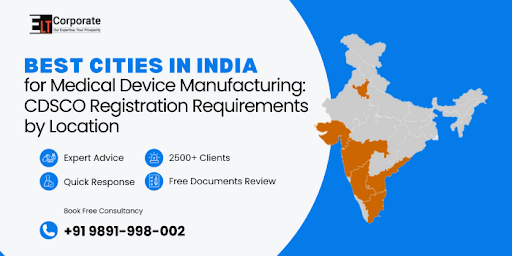
India has become one of the fastest-growing places to manufacture medical devices, thanks to strong government backing, clearer rules, and a growing need for healthcare in the country. The CDSCO registration procedure is uniform across India. Manufacturing licenses are issued by SLA for Class A & B and by CDSCO for Class C & D. However, the location where a firm makes its products has a big impact on how easily it can fulfil compliance, testing, and licensing criteria.
This article tells you which cities in India are ideal for making medical devices and how to get a Medical Device Manufacturing License under MDR 2017 for medical device manufacturing in those locations.In practice, regional ecosystems differ across India, and manufacturers should consider this before setting up operations, and manufacturers should think about this before starting up.
Why is the location important for manufacturing medical devices in India?
The Medical Device Rules (MDR) of 2017 say that the rules for medical devices are the same throughout the country. However, the manufacturing ecosystem surrounding a city, which includes testing labs, experienced workers, the efficiency of state licensing authorities, logistics, and regulatory assistance, may have a big effect on how quickly a business can register with CDSCO.
Cities that already have medical device clusters are good for manufacturers:
- Make documents quicker
- Easily go to authorised testing centres
- Work together better with the State Licensing Authorities
- Answer questions from the CDSCO or SLA right away.
This is why picking the correct city is more than simply a practical choice; it’s also a strategic one.
An Overview of CDSCO Registration for Makers of Medical Devices
Before you compare cities, you need to know how the rules work. In India, medical devices are put into four groups depending on how risky they are: Class A, B, C, and D.
The State Licensing Authority (SLA) gives out manufacturing permits for Class A and B devices. Class C and D devices: The Central Licensing Authority (CDSCO) gives out licenses to manufacture these devices.
Every maker must follow:
- MDR 2017 compliance
- ISO 13485 QMS
- Device Master File (DMF)
- Plant Master File (PMF)
Top Indian Cities for Medical Device Manufacturing and CDSCO Registration
1. Hyderabad, Telangana
Hyderabad is one of India’s strongest medical device manufacturing locations.
Manufacturers benefit from:
- Dedicated medical device zones
- Strong state regulatory support and inspection coordination ecosystem
- regulatory ecosystem and inspection coordination
- Good availability of testing and validation services
It is particularly suitable for manufacturers of Class B and Class C devices, diagnostics, and disposables.
2. Visakhapatnam (AMTZ), Andhra Pradesh
The Andhra Pradesh MedTech Zone (AMTZ) is India’s first dedicated medical device manufacturing park.
Key advantages include:
- Shared infrastructure for testing and calibration
- Regulatory facilitation support for MDR 2017 compliance
- Reduced setup complexity for new manufacturers
While AMTZ offers advanced common facilities, manufacturers must still verify whether device-specific testing is available for their product category. Also, AMTZ does not provide testing for all device categories, and external NABL labs may still be required.
3. Bengaluru, Karnataka
Bengaluru is ideal for companies focused on regulated medical software, AI-enabled devices, wearables, and R&D-intensive products that fall under CDSCO’s notified medical device categories.
Why Bengaluru works well:
- Strong R&D and innovation ecosystem
- Skilled biomedical and software talent
- Access to testing labs and notified bodies
- Efficient coordination for Class A and B licenses through the state authority
4. Chennai, Tamil Nadu
Chennai has long been a manufacturing powerhouse and is well-suited for implantable devices, surgical instruments, and high-precision equipment.
Manufacturers benefit from:
- Established industrial infrastructure
- Skilled manufacturing workforce
- Reliable logistics and export connectivity
- Strong regulatory experience at the state level
It is a preferred location for Class C and D manufacturing units requiring robust quality systems.
5. Pune and Mumbai Region, Maharashtra
The Pune–Mumbai belt offers a strong combination of:
- Engineering expertise
- Contract manufacturing support
- Access to testing labs and consultants
- Regulatory familiarity with both CDSCO and SLAs
This region is particularly suitable for mid-scale manufacturers and companies planning both domestic sales and exports.
6. Ahmedabad, Gujarat
Ahmedabad is gaining traction due to Gujarat’s manufacturing-friendly policies.
Advantages include:
- Cost-effective industrial land
- Proactive state licensing authority
- Strong chemical and polymer ecosystem for disposables
- Ease of scaling manufacturing operations
It is well-suited for Class A and B device manufacturers.
Does CDSCO Registration Change by City?
From a legal standpoint, no. CDSCO registration requirements remain the same across India.
However, in practice:
- Class A & B approvals depend on state-level efficiency
- Access to testing facilities varies by location
- Regulatory readiness differs across industrial clusters
Manufacturing licenses are site-specific, meaning the approval must match the actual manufacturing location, regardless of city.
How to Pick the Best City for CDSCO Registration?
Manufacturers should think about:
- Class A–D for device risk
- Needs for testing and validation
- Availability of infrastructure that meets ISO standards
- The State Licensing Authority’s experience
- Support for long-term scalability and compliance
Choosing the correct city might make it much easier to deal with rules and problems after getting clearance.
In conclusion
Picking the correct place is very important for the success of medical device manufacturing in India. Even though CDSCO registration for medical device production doesn’t affect the legislation, it has a big effect on how well firms can follow the MDR 2017 rules.
Different cities, such as Hyderabad, Visakhapatnam (AMTZ), Bengaluru, Chennai, Pune, and Ahmedabad, are better for different types of devices, depending on how complicated and big they are. Aligning your manufacturing strategy with the correct environment makes licensing go more smoothly, compliance happen quicker, and growth in India’s regulated medical device industry last.
Does CDSCO registration depend on the city of manufacturing?
No, CDSCO rules are uniform nationwide, but licensing efficiency varies by state authority and ecosystem.
Which city is best for Class C and D medical device manufacturing?
Hyderabad, Chennai, and AMTZ Visakhapatnam are preferred due to infrastructure and regulatory support.
Can I manufacture in one city and register in another?
No, manufacturing licenses are site-specific and must match the actual manufacturing location.
Is AMTZ mandatory for medical device manufacturing?
No, AMTZ is optional but beneficial for companies seeking shared infrastructure.
Who approves Class A and B manufacturing licenses?
Class A and B licenses are approved by the State Licensing Authority, not directly by CDSCO.
Comments are closed