India’s medical device industry is growing, and regulatory compliance is an important part of doing business in this sector. Manufacturers, importers, distributors and authorised agents must understand the rules that apply before placing medical devices in the Indian market.
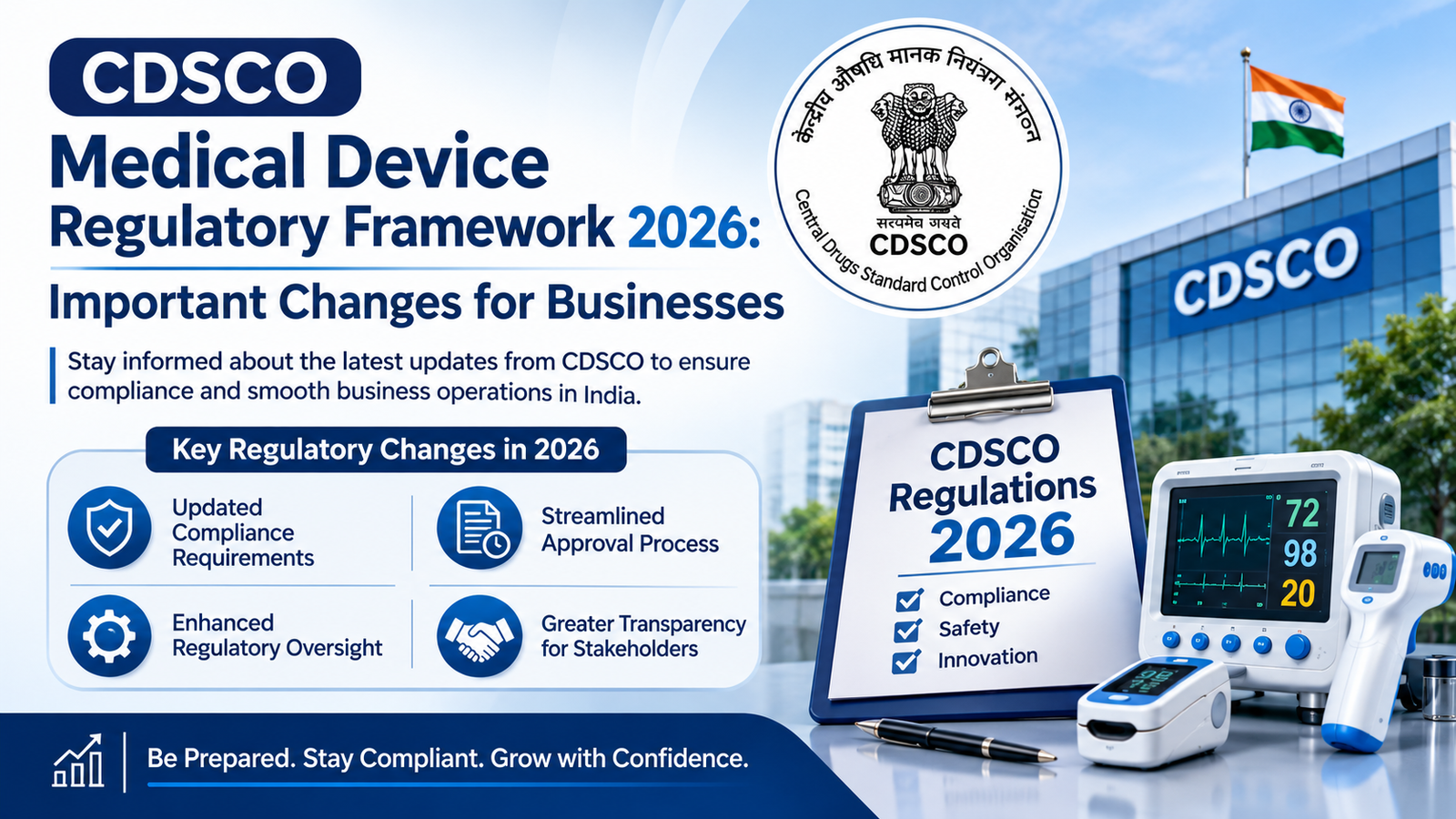
The CDSCO Medical Device Regulatory Framework 2026 is particularly important because the government has notified further amendments to the Medical Devices Rules, 2017. These changes cover areas such as outsourced sterilisation, product labelling, testing and evaluation procedures, quality management systems and recognition of overseas regulatory jurisdictions.
Businesses should understand which changes are final and which proposals are still under consideration. This helps prevent confusion, incomplete applications and avoidable compliance problems.
This article explains the key regulatory developments in simple language and highlights practical steps medical device businesses can take to prepare.
What Is the CDSCO Medical Device Regulatory Framework 2026?
The CDSCO Medical Device Regulatory Framework 2026 refers to the rules, amendments, notifications and regulatory requirements governing medical devices in India.
The Central Drugs Standard Control Organisation, under the Ministry of Health and Family Welfare, is India’s central regulatory authority for medical devices. The main regulatory foundation is the Medical Devices Rules, 2017, along with subsequent amendments and applicable notifications.
These requirements help ensure that medical devices meet the necessary standards of safety, quality and performance before they are manufactured, imported or supplied in India.
The framework is relevant to:
- Indian medical device manufacturers.
- Foreign medical device manufacturers.
- Medical device importers.
- Indian authorised agents.
- Medical device distributors and sellers.
- Medical device testing laboratories.
The requirements applicable to a business depend on the device’s classification, intended purpose and the activity being carried out.
Important Amendments to Medical Devices Rules in 2026
The Ministry of Health and Family Welfare notified important amendments to the Medical Devices Rules, 2017 in August 2026. These include the Medical Devices Rules, 2026 and the Medical Devices Rules, 2026.
A. Changes in Outsourced Sterilisation Requirements
One important update concerns manufacturers that outsource the sterilisation of medical devices to another licensed facility.
Under the amended Rule 44, a manufacturer using an external facility that holds a valid license to carry out medical device sterilisation does not need a separate loan license for that outsourced sterilisation activity.
However, the sterilisation facility’s license number must be mentioned on the device label. The amendment specifies wording such as:
- Sterilisation site’s Manufacturing License Number.
- Ster. Mfg. Lic. No.
- S.M.L.
This labelling requirement becomes mandatory after the transition period specified in the notification. Manufacturers should review their packaging artwork, label templates and quality procedures in advance.
B. New Testing and Evaluation Requirements
The 2026 amendment introduced a Ninth Schedule to the Medical Devices Rules, 2017. It provides a prescribed schedule for certain medical device tests and evaluations.
This is relevant to businesses that need testing or evaluation through the applicable medical device testing laboratories. The amendment also addresses how charges are determined for tests that are not specifically listed in the schedule.
Manufacturers and applicants should:
- Identify the tests relevant to their medical devices.
- Check the applicable testing requirements.
- Confirm the latest procedure with the relevant laboratory.
- Keep test reports and supporting records properly organised.
The schedule and related provisions should be checked in the official notification before arranging testing.
C. European Union Added to Recognised Regulatory Jurisdictions
Another important update relates to Rule 63 of the Medical Devices Rules, 2017.
The amendment adds European Union countries to the recognised regulatory jurisdictions listed in the relevant provision. This is significant for certain medical devices without predicate devices that may qualify for a waiver of clinical investigation requirements in India, subject to the conditions under the rules.
However, this does not mean that every EU-approved medical device automatically receives CDSCO approval in India. Businesses must still check eligibility, submit the required documents and follow the applicable Indian regulatory process.
D. Quality Management System Requirements
The Third Amendment Rules, 2026 also address Quality Management System requirements in specified provisions relating to government medical device testing laboratories.
This highlights the importance of quality systems and documented procedures in medical device testing and regulatory oversight. Businesses should keep their quality records, testing documents and relevant compliance processes updated.
Medical Device Risk Classification in India
Medical devices in India are classified according to the level of risk they may present to patients, users and other people.
The four main risk classes are:
| Risk class | Risk level | General examples |
| Class A | Low risk | Certain simple surgical instruments |
| Class B | Low to moderate risk | Certain needles and basic medical devices |
| Class C | Moderate to high risk | Certain ventilators and other higher-risk devices |
| Class D | High risk | Certain heart valves and high-risk implantable devices |
The classification depends on factors such as the device’s intended purpose, duration of use, invasiveness and other applicable classification rules. A business should not decide the risk class only by looking at the product name.
Under the CDSCO Medical Device Regulatory Framework 2026, correct classification remains an important first step because it helps determine the applicable application pathway, licensing authority and supporting documents.
Medical Device Manufacturing License Requirements
Businesses manufacturing medical devices in India must identify the appropriate license or registration pathway according to the device’s risk class and applicable requirements.
Common application forms include:
- Form MD-3: Application for a manufacturing license for specified Class A or Class B medical devices.
- Form MD-5: Manufacturing license for specified Class A or Class B medical devices.
- Form MD-7: Application for a manufacturing license for specified Class C or Class D medical devices.
- Form MD-9: Manufacturing license for specified Class C or Class D medical devices.
Certain non-sterile and non-measuring Class A devices follow a separate registration pathway. Businesses should confirm whether their products fall within this category and check the current requirements before applying.
Manufacturers should prepare the required technical information, quality management documents, manufacturing site details, device specifications and other supporting records.
Medical Device Import License Requirements
Foreign manufacturers and Indian importers must follow the applicable CDSCO requirements before importing regulated medical devices into India.
For many regulated imports, the application process involves:
- Form MD-14: Application for an import license.
- Form MD-15: Import license issued by the licensing authority.
The application may require details of the foreign manufacturer, manufacturing site, Indian authorised agent, device specifications, quality certificates and other technical documents.
The CDSCO Medical Device Regulatory Framework 2026 is relevant to importers because regulatory amendments can affect documentation, labelling, testing and the evidence required for certain products.
Importers should also confirm that the device is correctly classified and that the proposed product labelling meets Indian requirements.
Medical Device Labelling and Packaging Compliance
Medical device labelling is an important part of regulatory compliance. Incorrect or incomplete labels may lead to regulatory queries, delays or other compliance problems.
Depending on the applicable requirements, labels may need to include:
- Name of the medical device.
- Name and address of the manufacturer.
- Manufacturing license or registration details, where applicable.
- Batch or lot number.
- Manufacturing and expiry dates, where applicable.
- Storage and handling conditions.
- Sterilisation details, where applicable.
- Other information required under the Medical Devices Rules.
The 2026 amendment introducing the sterilisation facility’s license number for certain outsourced sterilisation arrangements makes label review particularly important.
Manufacturers should review their label templates, packaging artwork and internal approval procedures to ensure that the updated requirements are followed within the applicable transition period.
Quality Management System and Technical Documentation
A Quality Management System helps manufacturers maintain consistent product quality and demonstrate that their processes are properly controlled.
A suitable quality system should cover important activities such as:
- Document and record control.
- Supplier evaluation.
- Production and process controls.
- Product inspection and testing.
- Complaint handling.
- Corrective and preventive action.
- Risk management.
- Product traceability.
- Control of non-conforming products.
Businesses should also maintain technical documents that explain the device’s design, intended purpose, specifications, performance and safety. These records may be required during licensing, inspections or regulatory reviews.
The CDSCO Medical Device Regulatory Framework 2026 makes it important for businesses to review their quality and testing arrangements in light of the applicable amendments.
What Should Medical Device Businesses Do in 2026?
Medical device businesses should take practical steps to understand and implement the relevant regulatory changes.
- Review your product classification: Confirm the correct risk class and intended purpose of each device.
- Check your existing license or registration: Verify that the details match the products, manufacturing sites and activities being undertaken.
- Review outsourced sterilisation arrangements: If sterilisation is performed by another facility, confirm that the facility holds the required valid license.
- Update product labels: Check whether the sterilisation facility’s license number needs to be included on the device label.
- Review testing requirements: Identify the tests relevant to your device and confirm the applicable procedures with the relevant testing laboratory.
- Maintain technical documents: Keep product specifications, test reports, risk management records and supporting documents organised.
- Review your quality system: Ensure that quality procedures reflect your actual manufacturing, testing and supplier-control activities.
- Monitor official notifications: Check the latest Gazette notifications and CDSCO updates instead of relying only on older guidance.
Following these steps can help businesses prepare for the CDSCO Medical Device Regulatory Framework 2026 and reduce avoidable compliance issues.
Common Compliance Mistakes to Avoid
Businesses may face regulatory delays or compliance concerns when they overlook basic requirements. Common mistakes include:
- Selecting the wrong risk classification.
- Applying through an incorrect form.
- Submitting incomplete technical documents.
- Using outdated product labels.
- Failing to verify the license status of an outsourced sterilisation facility.
- Not maintaining updated quality management records.
- Assuming that overseas approval automatically replaces Indian regulatory requirements.
- Overlooking applicable testing requirements.
- Not checking the latest amendments and official notifications.
A regulatory review before submitting an application can help identify these issues early.
How ELT Corporate Helps with CDSCO Medical Device Compliance
ELT Corporate provides regulatory support to businesses seeking to manufacture, import or distribute medical devices in India. Understanding the CDSCO Medical Device Regulatory Framework 2026 can be challenging, especially when businesses need to interpret new amendments and identify the requirements that apply to their products.
Our support may include:
- Guidance on medical device risk classification.
- Assistance with CDSCO manufacturing license applications.
- Support for medical device import license applications.
- Assistance with technical documentation and application preparation.
- Guidance on labelling and packaging requirements.
- Support with regulatory queries and application deficiencies.
- Guidance on applicable quality management system requirements.
- Assistance with understanding relevant regulatory updates.
ELT Corporate helps businesses understand the applicable process and prepare their regulatory documentation in an organised manner. The exact support required depends on the device, its classification and the business activity.
Conclusion
The Indian medical device sector is experiencing important regulatory developments in 2026. Changes relating to outsourced sterilisation, labelling, testing procedures and recognised overseas regulatory jurisdictions are particularly relevant for manufacturers and importers.
The CDSCO Medical Device Regulatory Framework 2026 should be reviewed carefully by every business involved in the medical device industry. Companies should check the latest notified rules, update their documentation and ensure that their products meet the applicable Indian regulatory requirements.
Staying informed and preparing documents in advance can help businesses avoid unnecessary delays and maintain regulatory compliance.
Frequently Asked Questions
Q1. What is the CDSCO Medical Device Regulatory Framework 2026?
The CDSCO Medical Device Regulatory Framework 2026 refers to the applicable Indian medical device regulations, including the Medical Devices Rules, 2017 and amendments notified during 2026. It covers requirements for manufacturing, importing, testing, labelling and supplying medical devices.
Q2. Which rules regulate medical devices in India?
Medical devices in India are primarily regulated under the Medical Devices Rules, 2017, issued under the Drugs and Cosmetics Act, 1940, along with subsequent amendments and applicable notifications.
Q3. What are the major medical device regulatory changes in 2026?
Important notified changes include labelling requirements for devices sterilised at outsourced facilities, a new schedule for testing and evaluation, and the addition of European Union countries to a recognised regulatory provision under Rule 63.
Q4. Is a separate loan license required for outsourced sterilisation?
Under the amended Rule 44, a manufacturer outsourcing sterilisation to another facility holding a valid license for the activity does not need a separate loan license for that outsourced sterilisation activity. The applicable sterilisation facility license number must be mentioned on the device label, subject to the transition period.
Q5. What are the four medical device risk classes in India?
Medical devices are classified into Class A, Class B, Class C and Class D according to their risk level. Class A represents the lowest risk category, while Class D represents the highest.
Q6. Does EU approval automatically provide CDSCO approval in India?
No. The addition of EU countries to Rule 63 does not provide automatic approval for every EU-approved device. Eligible devices must meet the conditions of the relevant provision and follow the applicable Indian regulatory process.
Q7. What documents are generally required for CDSCO medical device registration?
Depending on the device and application type, documents may include manufacturer details, device specifications, risk classification, quality management information, test reports, labelling details and other technical documents.
Q8. How can ELT Corporate help with CDSCO registration?
ELT Corporate can assist businesses with understanding the CDSCO Medical Device Regulatory Framework 2026, identifying applicable licensing requirements, preparing regulatory documentation and responding to regulatory queries.
Comments are closed