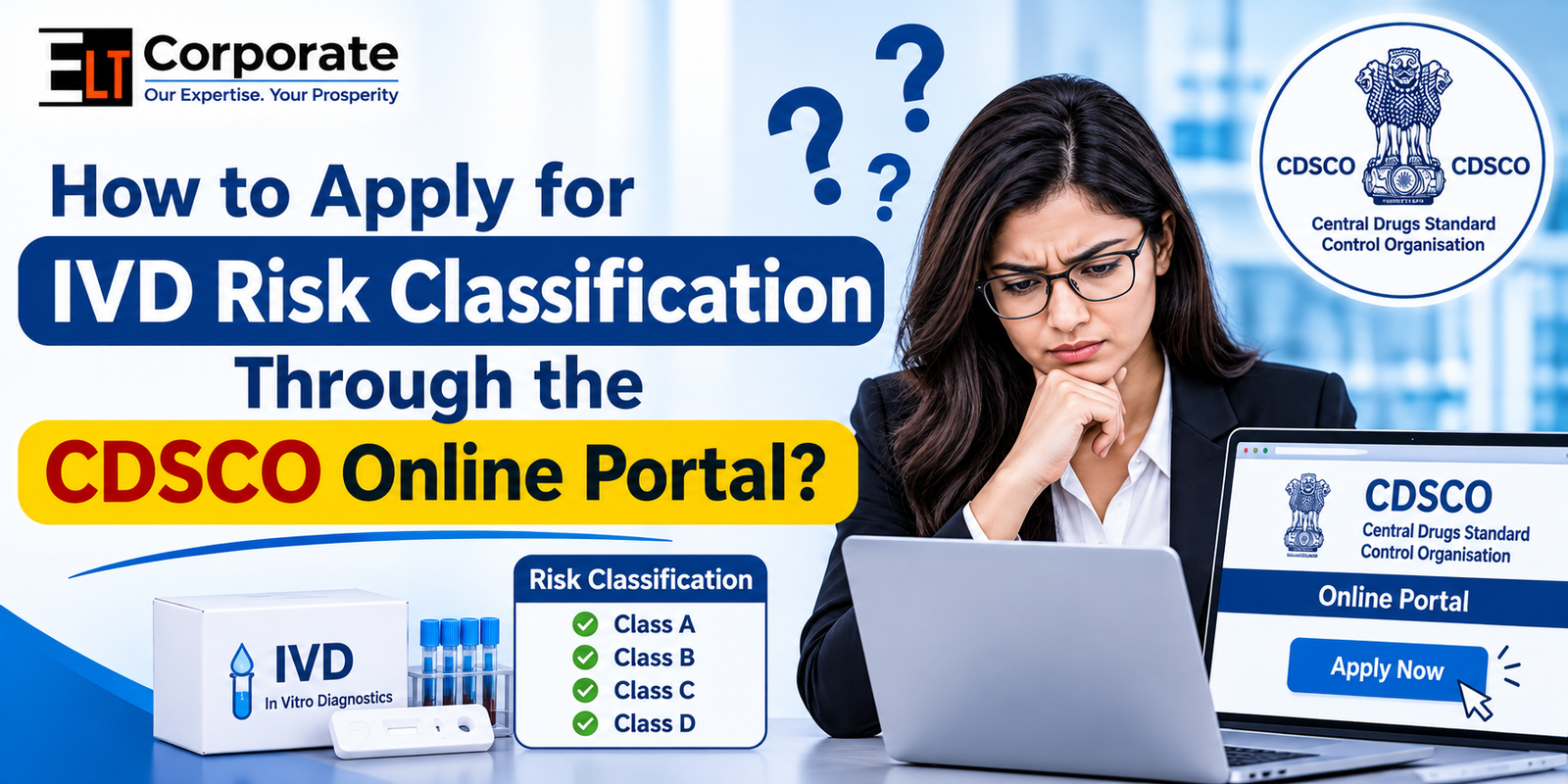
In India, In Vitro Diagnostic medical devices are used to detect diseases, monitor health conditions and examine biological samples such as blood, urine and other body fluids. Products such as pregnancy test kits, blood glucose monitoring kits, diagnostic reagents and infectious disease testing kits fall under this category.
Before manufacturing, importing or marketing an IVD medical device in India, businesses must understand its applicable regulatory requirements. One important step is determining the correct risk category of the product under the Medical Devices Rules, 2017.
IVD Risk Classification helps manufacturers and importers understand the potential risk associated with their diagnostic products. It also helps determine the applicable regulatory requirements and licensing pathway.
CDSCO introduced a dedicated provision for submitting applications for IVD risk classification through its Online System for Medical Devices, effective 18 February 2026. This provides an online route for applicants seeking classification of their IVD products.
What Is IVD Risk Classification?
IVD Risk Classification is the process of categorising In Vitro Diagnostic medical devices according to their potential risk to individual patients and public health.
Under the Medical Devices Rules, 2017, IVD products are divided into four categories. The classification depends on factors such as the intended use of the product, the purpose of testing, the importance of the diagnostic result and the potential consequences of an incorrect result.
For example, a basic laboratory reagent may have a lower risk than an IVD test used to screen donated blood for serious infectious diseases.
Correct classification helps manufacturers and importers identify the appropriate regulatory pathway before proceeding with other approval requirements.
Understanding the Four IVD Risk Classes in India
Before submitting an application, businesses should understand the four risk categories recognised under the Medical Devices Rules, 2017.
Class A – Low Risk
These devices generally have a low potential risk to individual health and public health.
Examples: Specimen receptacles and certain general laboratory reagents.
Class B – Low-Moderate Risk
These products have a higher risk level than Class A devices but generally pose a low-to-moderate risk.
Examples: Certain pregnancy test kits and glucose test strips.
Class C – Moderate-High Risk
These products may have significant consequences if the diagnostic result is incorrect.
Examples: Certain tuberculosis detection kits and tests for congenital disorders.
Class D – High Risk
These products have a high potential risk to individual health or public health.
Examples: Certain HIV, hepatitis B and hepatitis C screening tests and blood grouping reagents.
How to Apply for IVD Risk Classification Through the CDSCO Online Portal?
CDSCO has introduced an online facility for applicants who need to obtain the risk classification of an IVD medical device. Applicants can use the Online System for Medical Devices to submit the relevant details for regulatory assessment.
Follow these steps to prepare and submit your application.
Step 1: Visit the CDSCO Online Portal
First, visit the official CDSCO Online System for Medical Devices:
CDSCO Online System for Medical Devices
This portal provides facilities for online medical device applications, application tracking and regulatory services.
Step 2: Register or Log In
If you are a new applicant, check whether you already have an account before creating another one.
- Open the online portal.
- Select the appropriate user registration option.
- Enter your email address.
- Complete the required verification process.
- Log in using your registered credentials.
The portal also provides an option to check whether existing SUGAM credentials can be used for login.
Step 3: Check the Existing IVD Classification List
Before submitting a new application, check the official CDSCO IVD classification list.
This step is important because your product may already have an assigned risk class.
Review the product description, intended purpose and applicable classification details. If the product is not listed or its classification is unclear, you may need to seek classification from CDSCO.
Step 4: Select the IVD Risk Classification Application Facility
After logging in, locate the facility for IVD risk classification on the online system.
Select the relevant application option and follow the instructions displayed on the portal.
Make sure you are using the IVD-specific classification facility rather than the separate risk-classification facility for other medical devices.
The IVD application provision became available from 18 February 2026.
Step 5: Enter the Required Product Information
Provide complete and accurate information about your diagnostic product.
The information may include:
- Name of the IVD medical device.
- Product description.
- Intended use and intended purpose.
- Type of diagnostic test.
- Target disease or medical condition.
- Sample type, such as blood, urine or serum.
- Principle of operation.
- Details of the manufacturer.
- Technical and performance information.
The purpose of providing these details is to help the regulatory authority understand the product and assess its appropriate risk category.
Step 6: Upload Supporting Documents
Prepare the technical documents requested by the portal and applicable CDSCO checklist.
Depending on the product and application requirements, supporting information may include:
- Product description and specifications.
- Intended-use statement.
- Product catalogue or technical brochure.
- Instructions for Use.
- Test principle and methodology.
- Analytical and clinical performance information, where applicable.
- Manufacturer details.
- Existing classification or regulatory references, if available.
Important: The final document list should be checked against the latest CDSCO checklist and the requirements displayed in the application. Not every document will necessarily apply to every IVD product.
Step 7: Review and Submit Your Application
Before submitting, carefully check the information entered in the application.
- Verify the product name and intended use.
- Check that the technical information is consistent.
- Confirm that the supporting documents are readable.
- Check for missing information.
- Complete the required declarations.
- Submit the application through the portal.
Keep the application acknowledgement or reference number for future communication.
Step 8: Track Your Application Status
After submission, monitor the application through the online portal.
The regulatory authority may review the submitted information and request additional clarification or documents if necessary.
If a query is raised, read it carefully and provide a clear response with relevant supporting information.
Once the assessment is completed, refer to the official communication and classification outcome issued by the competent authority.
The steps above explain the general online workflow. Exact screen labels, mandatory fields, attachments and review stages should be followed as displayed in the live portal.
Documents Required for IVD Risk Classification
Preparing documents correctly is an important part of the application process. Incomplete or inconsistent product information may result in additional regulatory queries.
| Document or information | Purpose |
| Product description | Explains the diagnostic device |
| Intended use | Defines the purpose of the product |
| Product specifications | Provides technical details |
| Instructions for Use | Explains how the product is used |
| Test principle | Describes the diagnostic method |
| Performance information | Supports product safety and performance assessment |
| Manufacturer details | Identifies the responsible manufacturer |
| Product catalogue | Provides additional product information |
The exact requirements depend on the product and the latest CDSCO checklist.
Common Mistakes to Avoid During the Application
Applicants should pay attention to the following issues before submitting an IVD classification request.
- Selecting the wrong risk category: Do not select a category only because another similar-looking product has been assigned that class.
- Incorrect intended use: The intended purpose must clearly explain what the diagnostic product is designed to detect or measure.
- Incomplete technical documents: Missing product specifications and performance information may lead to additional questions.
- Inconsistent product information: The product name, description and technical details should match across the submitted documents.
- Not checking the existing classification list: Applicants should first check whether CDSCO has already published a classification for the product.
- Ignoring regulatory queries: Delayed or incomplete responses may affect the application review process.
Why Is Correct IVD Risk Classification Important?
Correct classification is important because it helps manufacturers and importers understand the regulatory requirements applicable to their products.
It helps businesses:
- Identify the appropriate licensing pathway.
- Understand the applicable regulatory obligations.
- Prepare the required technical documentation.
- Plan manufacturing or import activities.
- Avoid unnecessary application errors.
- Maintain regulatory compliance under the Medical Devices Rules, 2017.
For businesses planning to introduce new diagnostic products in India, IVD Risk Classification is an important part of their regulatory preparation.
How ELT Corporate Helps with IVD Risk Classification
ELT Corporate provides regulatory consultancy services to manufacturers, importers and distributors of medical devices in India. Our team assists businesses in understanding the IVD Risk Classification process and preparing the relevant regulatory documentation.
Our support includes:
- Product Classification Assistance: Helping businesses understand the applicable IVD risk categories.
- Documentation Support: Assisting with the preparation and review of technical documents.
- CDSCO Portal Guidance: Providing guidance on the online application process.
- Regulatory Compliance: Helping businesses understand applicable Medical Devices Rules, 2017 requirements.
- Application Review: Checking product information and supporting documents before submission.
- Query Assistance: Helping prepare responses to regulatory queries.
- Import and Manufacturing Guidance: Explaining the applicable licensing requirements after classification.
Our objective is to make the regulatory process easier to understand and help businesses prepare their applications accurately.
Contact ELT Corporate for professional assistance with IVD regulatory requirements in India.
Conclusion
Applying for the correct IVD classification is an important step for businesses planning to manufacture or import diagnostic medical devices in India. Applicants should understand the product’s intended use, technical specifications and applicable regulatory requirements before submitting their applications.
The CDSCO online facility makes it possible to submit classification requests electronically. However, applicants should carefully review the existing classification list, prepare accurate technical information and follow the latest portal instructions.
A properly prepared IVD Risk Classification application can help reduce avoidable documentation errors and support a smoother regulatory assessment. Businesses should also ensure that their subsequent manufacturing or import activities follow the applicable provisions of the Medical Devices Rules, 2017.
Frequently Asked Questions
Q1. What is IVD Risk Classification in India?
IVD Risk Classification is the process of categorising In Vitro Diagnostic medical devices according to their potential risk to individual health and public health under the Medical Devices Rules, 2017.
Q2. How many risk classes are available for IVD medical devices?
There are four risk classes under Indian regulations:
- Class A – Low Risk
- Class B – Low-Moderate Risk
- Class C – Moderate-High Risk
- Class D – High Risk
Q3. How can I apply for IVD Risk Classification through CDSCO?
Applicants can visit the CDSCO Online System for Medical Devices, log in, check the existing classification list and use the dedicated IVD classification application facility to submit the required product information.
Q4. When did CDSCO introduce the online IVD classification facility?
The dedicated online provision for IVD medical device risk classification became available on 18 February 2026.
Q5. Is IVD Risk Classification mandatory for every diagnostic product?
Products must be classified under the applicable regulatory framework. However, a separate classification request may not be necessary if the product is already covered by an existing CDSCO classification. Applicants should check the official list first.
Q6. What documents are required for IVD classification?
Documents may include the product description, intended use, technical specifications, product catalogue, Instructions for Use, test principle and relevant performance information. The exact checklist should be confirmed through CDSCO.
Q7. Can an IVD medical device manufacturer apply for classification online?
Yes. The dedicated CDSCO online facility allows applicants to submit requests for IVD medical device risk classification through the Online System for Medical Devices.
Q8. Can ELT Corporate help with CDSCO IVD classification?
Yes. ELT Corporate can assist with product classification guidance, technical documentation preparation, portal application guidance and regulatory compliance support for IVD medical devices.
Comments are closed