
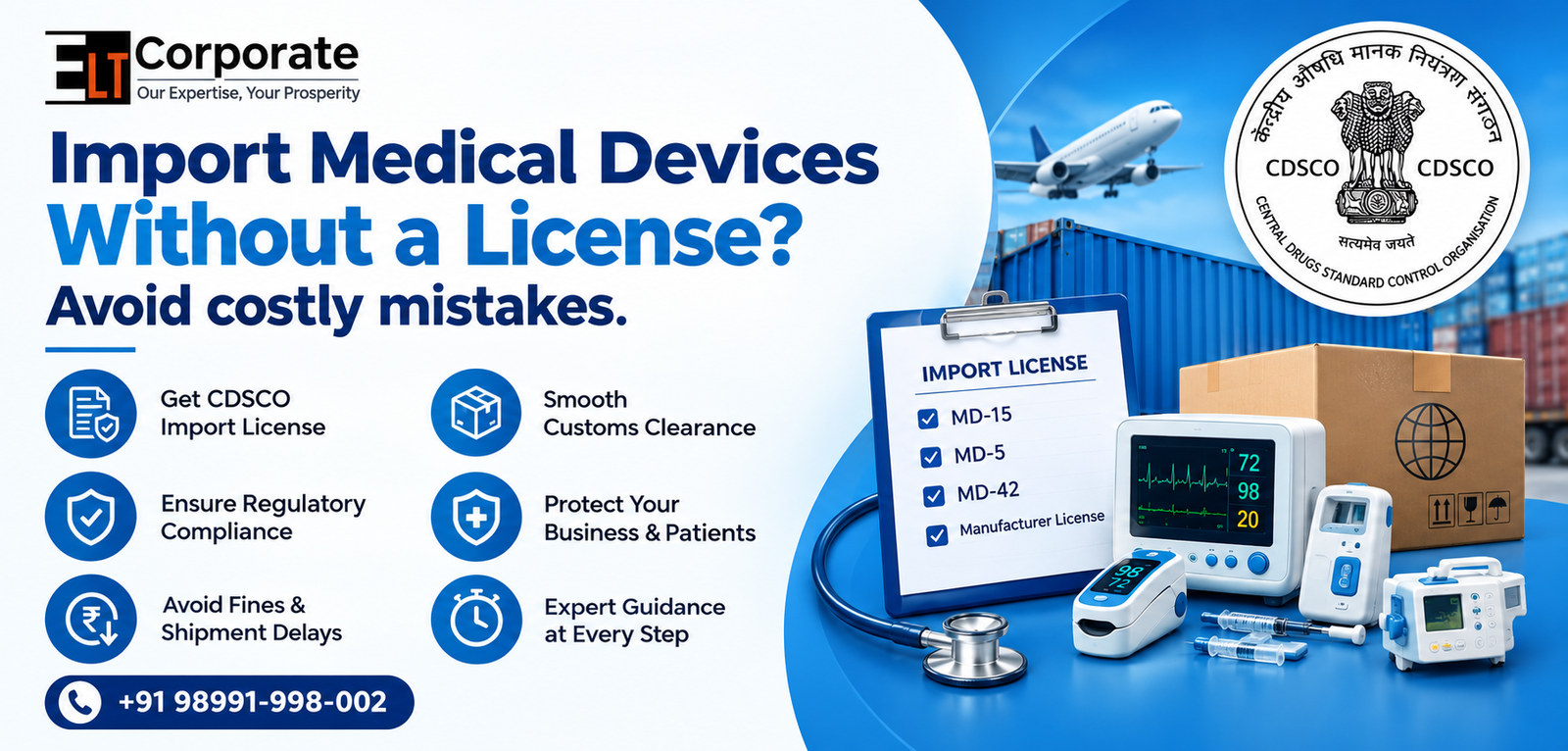
What Happens if You Import a Medical Device Without the Required License?
Importing medical devices into India requires businesses to follow applicable regulatory requirements. Before bringing a medical device into the country for commercial purposes, importers must determine whether the product requires a licence or other approval from the Central Drugs Standard Control Organisation.
What happens if you import medical devices without a license? Your shipment may face customs delays, regulatory scrutiny, detention, or other enforcement action, depending on the product, the applicable rules, and the circumstances. In serious cases, the importer may face penalties or prosecution under applicable law.
This guide explains the risks in simple language, the documents you may need, and how businesses can work towards compliance with support from ELT Corporate.
What Does It Mean to Import Medical Devices Without a License?
Businesses planning to Import Medical Devices Without a License should first check whether their product requires CDSCO approval. Understanding the applicable rules before shipment can help prevent regulatory issues and unnecessary business costs.
It means importing a medical device without obtaining the applicable import licence or regulatory permission when one is legally required.
In India, medical devices are regulated under the Medical Devices Rules, 2017, along with applicable provisions of the Drugs and Cosmetics Act, 1940. The exact requirements depend on the product’s classification, intended use, regulatory status, and the role of the importer.
For example, an importer may need to obtain the applicable CDSCO import licence before importing a regulated medical device for commercial distribution.
Not every product described as a medical device follows an identical approval process. Therefore, businesses should confirm the applicable requirements before placing an order with a foreign manufacturer.
Why Is a Medical Device Import License Important?
A license helps establish that the importer and product have met the relevant regulatory requirements. Depending on the circumstances, the process may involve product information, manufacturing details, quality documentation, and other supporting records.
Importing without the required approval can create problems for the importer, supplier, distributor, and customers who depend on the product.
What Happens if You Import Medical Devices Without a License in India?
Importing medical devices without a license can expose businesses to regulatory action if the required approval has not been obtained. Before shipment, importers should verify the applicable CDSCO requirements and prepare the necessary documents.
The consequences depend on the type of device, the applicable legal provisions, and the facts of the case. Potential risks include the following.
A. Can Customs Hold or Detain the Shipment?
Yes. If the required regulatory documents are missing or the shipment raises compliance concerns, the goods may be held for examination or further verification. Customs action will depend on the circumstances and the applicable import requirements.
Such delays can affect delivery schedules, increase storage costs, and disrupt business operations.
B. Can the Importer Face Financial Penalties?
Yes, where the conduct violates an applicable legal provision that provides for a penalty or other financial consequence. The exact consequences depend on the nature of the violation and the law applicable to the case.
Businesses should not assume that they can resolve every licensing issue simply by paying a fee after the goods arrive.
C. Can the Imported Medical Devices Be Seized or Confiscated?
Depending on the circumstances and applicable law, authorities may take action against non-compliant goods, including seizure or confiscation where legally authorised.
The outcome depends on the facts, the relevant statutory provisions, and the proceedings followed by the authorities.
D. Can the Importer Face Legal Proceedings?
Yes. Serious violations may lead to regulatory or legal proceedings. The consequences depend on the particular offence, the responsible party’s conduct, and the applicable legal provisions.
Importers should obtain professional advice promptly if they receive a notice, investigation request, or other communication from a regulatory authority.
E. Can Unlicensed Imports Damage Business Reputation?
Yes. Regulatory difficulties can affect relationships with overseas manufacturers, distributors, hospitals, and other buyers. Repeated compliance problems may also make future import planning more difficult.
For this reason, checking the applicable licence requirements before shipment is generally safer than trying to resolve a problem after the goods arrive.
Which Medical Device Import License Is Required in India?
Businesses planning to Import Medical Devices Without a License should first check whether their product requires a CDSCO import licence or qualifies for an applicable exemption.
For medical devices that require an import License, the standard application and licence forms under the Medical Devices Rules, 2017 are Form MD-14 and Form MD-15.
Form MD-14: Application for an import licence.
Form MD-15: Licence to import medical devices, when granted by the competent authority.
An authorised agent applies through the prescribed regulatory process and submits the required documents. The authority examines the application before deciding whether to grant the licence.
Does Every Medical Device Require an Import License?
Not necessarily. Certain devices may be subject to specific exemptions or different regulatory requirements. For example, the CDSCO has published an exemption concerning specified non-sterile and non-measuring Class A medical devices. Businesses should verify whether the particular product falls within an applicable exemption rather than assuming that all Class A devices are exempt.
If you are unsure whether you can import medical devices without a license, confirm the product’s classification and applicable regulatory requirements before shipping.
What Documents Are Required for a Medical Device Import License?
To avoid problems when attempting to Import Medical Devices Without a License, importers should verify product classification, manufacturer details, and the relevant approval requirements before shipping.
Answer: The required documents depend on the device, manufacturer, and application. Common documents may include the following:
Details of the Indian authorised agent.
Overseas manufacturer’s name and address.
Manufacturing site details.
Device Master File.
Plant Master File, where applicable.
Quality management system certificates.
Free Sale Certificate or marketing authorisation, where applicable.
Manufacturer’s declaration of conformity.
Power of Attorney and the required undertaking.
Product details, intended use, labelling, and instructions for use.
Prescribed application fee and supporting documents.
These requirements should be checked against the current rules and CDSCO checklist for the specific application. The official MD-14 specimen and import licence checklist provide useful guidance.
What Happens if Documents Are Missing?
Missing or inconsistent documents can lead to queries from the authority, requests for clarification, and delays in processing the application.
For example, if the device model listed in the application does not match the manufacturer’s technical documentation, the applicant may need to resolve the discrepancy before the application can proceed.
Preparing the documents carefully before submitting an application can help reduce avoidable delays.
Can You Sell Medical Devices Imported Without a License?
Answer: If a licence is legally required and has not been obtained, selling or distributing the imported devices may create additional regulatory risks.
A business should not assume that customs clearance alone proves compliance with all medical device requirements. Import permission, applicable sale and distribution requirements, labelling, and other obligations must be considered separately.
If you have already imported a device without the required authorisation, avoid further distribution until you have obtained advice on the applicable requirements and the appropriate corrective steps.
What Should You Do if Your Shipment Has Already Arrived?
If you have already imported a medical device and discovered a licensing issue, consider these steps:
Review the product classification and applicable regulatory requirements.
Gather the invoice, shipping documents, product details, and manufacturer records.
Check whether an exemption or specific permission applies.
Contact the relevant customs or regulatory authority, as appropriate.
Obtain professional regulatory advice before attempting to sell, distribute, re-export, or otherwise dispose of the goods.
Do not assume that a licence can automatically be obtained retrospectively or that a pending application permits commercial importation.
How Can Businesses Avoid Medical Device Import License Problems?
Before attempting to Import Medical Devices Without a License, importers should verify the product classification, review the manufacturer’s documents, and confirm whether an exemption applies. Proper preparation can help businesses follow the correct import procedure.
A proper compliance review helps businesses avoid accidentally attempting to Import Medical Devices Without a License when an import licence is legally required.
Businesses can reduce the risk of non-compliance by planning their import process before placing orders or arranging shipment.
A practical compliance checklist includes:
Identify the device’s regulatory classification.
Confirm whether an import licence is required.
Appoint an eligible Indian authorised agent, where applicable.
Collect the required manufacturer and product documentation.
Submit the correct application through the prescribed portal.
Obtain the required licence before proceeding with regulated commercial imports.
Check that the product, manufacturer, and relevant details are covered by the licence.
Maintain accurate import and distribution records.
Following these steps can help businesses avoid situations where they import medical devices without a license and subsequently face costly disruptions.
What Is the Difference Between a Medical Device Import License and a Manufacturing Licence?
A medical device import licence and a manufacturing licence serve different purposes.
License type | Purpose |
|---|---|
| Import licence | Permits the import of covered medical devices under the applicable regulatory framework. |
| Manufacturing licence | Authorises eligible manufacturing activities subject to the applicable requirements. |
| Sales and distribution permissions | Apply according to the relevant device, business activity, and regulatory requirements. |
For example, an overseas manufacturer supplying medical devices to India may need an Indian authorised agent to obtain the applicable import licence. An Indian business manufacturing medical devices domestically must assess the separate manufacturing requirements.
Choosing the correct licence is important because an approval for one activity does not automatically authorise another.
Learn more about medical device registration and compliance and CDSCO registration in India.
What Does Indian Law Say About Importing Medical Devices Without the Required Approval?
The applicable legal framework includes the Medical Devices Rules, 2017, and relevant provisions of the Drugs and Cosmetics Act, 1940. Depending on the circumstances, the Customs Act, 1962, may also be relevant.
For example, Sections 111 and 112 of the Customs Act address the confiscation of certain improperly imported goods and penalties for specified improper importation. Whether these provisions apply to a particular medical device shipment depends on the facts and applicable law.
Businesses should review the relevant legal provisions rather than assume that every unlicensed import results in the same penalty.
For authoritative information, consult the Medical Devices Rules, 2017 and the CDSCO Medical Device Division.
How Can ELT Corporate Help With Medical Device Import Licensing?
ELT Corporate provides regulatory compliance assistance to businesses seeking to import medical devices into India. Understanding the applicable requirements before shipment can help importers plan the process and prepare the necessary documentation.
Our support may include:
Licence requirement assessment: Helping businesses understand the applicable import licensing requirements for their products.
Documentation support: Assisting with the preparation and review of relevant application documents.
Application guidance: Supporting the application process for the applicable CDSCO import licence.
Manufacturer coordination: Helping organise the required information from overseas manufacturers.
Regulatory query support: Assisting businesses in understanding and responding to application-related queries.
Compliance guidance: Helping importers understand the importance of maintaining appropriate regulatory records.
If your business is planning to import medical devices or has concerns about an existing shipment, ELT Corporate can help you understand the next steps. The outcome and processing time depend on the applicable requirements and the decision of the competent authority.
Explore our medical device regulatory services to learn more.
Conclusion
Before deciding to Import Medical Devices Without a License, confirm the applicable regulations and obtain the necessary authorisation.
Importing medical devices into India without a required licence can create serious business and regulatory problems. Depending on the circumstances, these may include shipment delays, additional costs, confiscation, financial penalties, or legal proceedings.
Before placing an international order, businesses should confirm the product’s classification, identify the applicable approval requirements, and prepare the necessary documents. If a shipment has already arrived and a licensing issue has been identified, seek appropriate regulatory advice before selling or distributing the product.
The safest approach is to understand the applicable rules and obtain the required authorisation before proceeding with a regulated commercial import. ELT Corporate can assist businesses with understanding the licensing process and preparing for regulatory compliance.
Frequently Asked Questions
Q1. What happens if you import medical devices without a license in India?
If a license is legally required, importing without it may result in shipment delays, regulatory action, confiscation where authorised, financial penalties, or legal proceedings, depending on the circumstances.
Q2. Is a CDSCO licence mandatory for importing medical devices?
A CDSCO import license is required for medical devices covered by the applicable licensing provisions, subject to relevant exemptions and special permissions.
Q3. Which form is used to apply for a medical device import licence?
Form MD-14 is used to apply for an import license, and Form MD-15 is the licence issued when the application is approved under the applicable process.
Q4. Can I import medical devices while my licence application is pending?
You should not assume that a pending application authorises a commercial import. Confirm the applicable requirements and obtain the required approval before shipping the device.
Q5. Can customs stop a medical device shipment without the required licence?
Yes, a shipment may be held for examination or further verification if required regulatory documentation is missing or a compliance concern arises.
Q6. What documents are required for a CDSCO medical device import licence?
Depending on the application, documents may include manufacturer details, a Device Master File, quality certificates, a Free Sale Certificate where applicable, a Power of Attorney, and product information.
Q7. Can I sell a medical device imported without the required licence?
If the device requires an import license that has not been obtained, selling or distributing it may create further compliance risks. Seek regulatory advice before proceeding.
Q8. How can ELT Corporate help with a medical device import licence?
ELT Corporate can assist businesses with understanding licensing requirements, reviewing supporting documents, preparing applications, and navigating relevant regulatory procedures.
Comments are closed