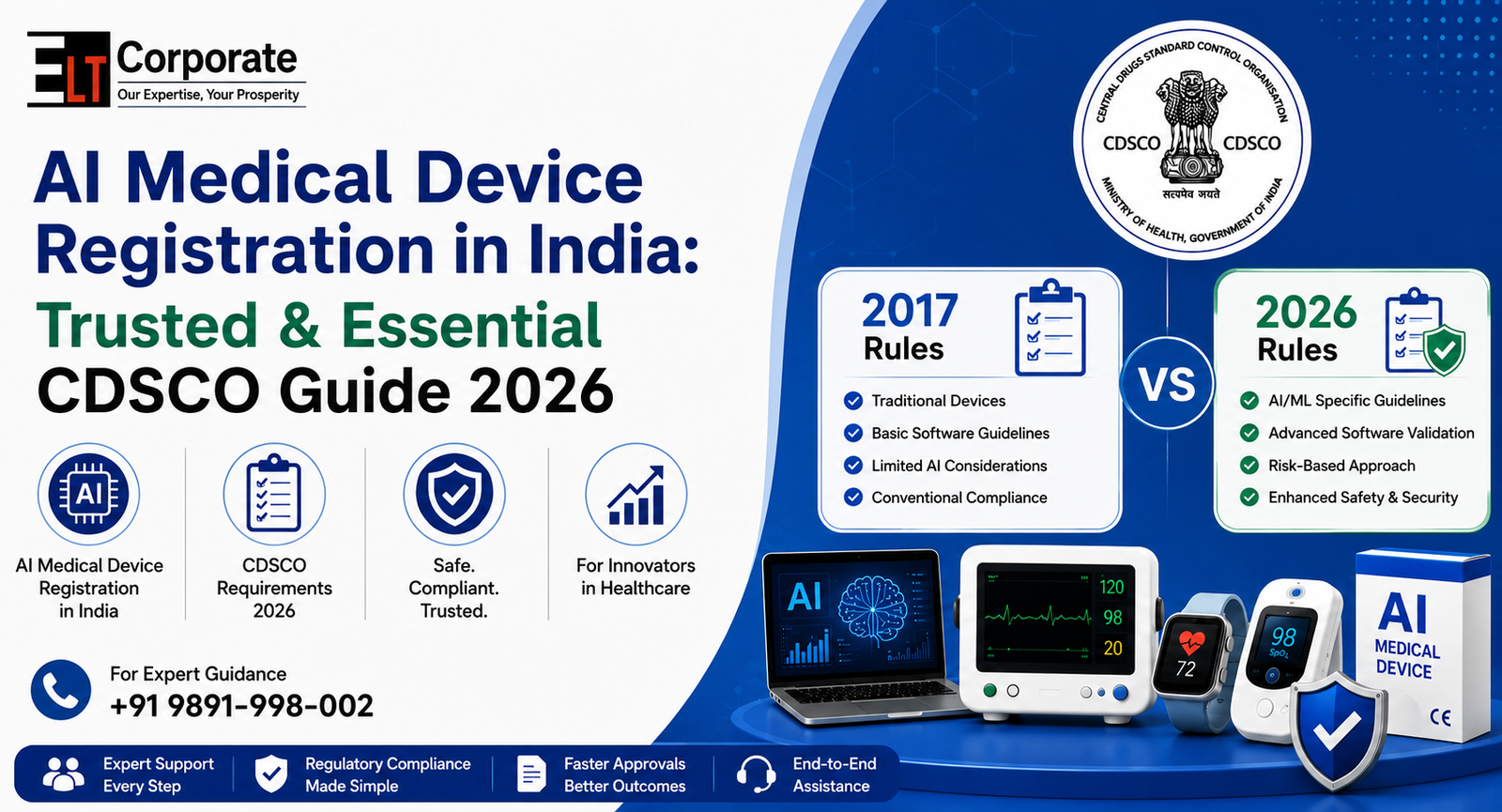
AI Medical Device Registration in India is becoming increasingly important for manufacturers, importers, and healthcare technology companies developing AI-powered medical software and devices. In 2026, businesses must understand the applicable CDSCO requirements, medical device classification, technical documentation, software validation, risk management, and licensing process before placing an AI-based medical device on the Indian market.
AI Medical Device Registration in India helps manufacturers understand the applicable regulatory pathway before introducing AI-powered medical products to the Indian market.
Artificial Intelligence is rapidly changing healthcare through AI-powered diagnostic software, medical imaging systems, clinical decision-support tools, patient monitoring applications, and other digital health technologies. However, when AI software is designed for a medical purpose, regulatory compliance becomes an important part of bringing the product to the Indian market.
AI Medical Device Registration in India generally involves determining whether the product falls within the regulatory definition of a medical device, identifying its risk classification, preparing the required technical and quality documentation, completing applicable testing or evaluation, and obtaining the appropriate CDSCO licence or approval.
In 2026, developers and manufacturers of AI-based medical software should pay particular attention to CDSCO’s Guidance Document on Medical Device Software under MDR-2017, published on 21 July 2026. The guidance addresses regulatory considerations for medical device software, including software lifecycle, risk management, and other technical requirements.
For businesses planning to introduce AI-enabled medical technology in India, understanding the regulatory pathway early can reduce documentation gaps, approval delays and compliance risks.
Quick Answer: What Is AI Medical Device Registration in India?
AI Medical Device Registration in India is the regulatory process for obtaining the applicable CDSCO authorization for an AI-enabled product that qualifies as a medical device under India’s medical device framework.
An AI product may require regulatory compliance when its intended medical purpose includes functions such as:
- Disease diagnosis
- Disease detection
- Patient monitoring
- Medical image analysis
- Clinical decision support
- Treatment planning
- Risk prediction
- Patient management
- Medical measurement or interpretation
The regulatory requirements depend on the product’s intended purpose, functionality, risk level, software architecture, and applicable classification.
What Is an AI Medical Device?
For manufacturers, AI Medical Device Registration in India is an important step when AI software performs a defined medical function.
An AI medical device is a medical device that uses artificial intelligence or machine-learning technologies to perform or support a medical function.
Examples may include:
- AI-powered radiology software
- AI-based ECG interpretation software
- AI pathology analysis systems
- AI-enabled diagnostic applications
- Clinical decision-support software
- AI-powered medical imaging tools
- Patient monitoring algorithms
- Predictive healthcare software
- AI-assisted surgical planning systems
- Machine-learning software used with medical hardware
However, not every AI healthcare application is automatically a medical device.
For example, an application that only stores appointment information or provides general wellness information may not necessarily have the same regulatory status as software that analyses a patient’s medical data to assist in diagnosis.
The intended medical purpose is therefore one of the first issues that manufacturers should assess.
Is AI Medical Device Registration Mandatory in India?
Whether registration or licensing is required depends on whether the AI product qualifies as a regulated medical device and how it is classified.
India regulates medical devices under the Medical Devices Rules, 2017. CDSCO states that medical devices are classified according to risk into four categories:
- Class A – Low Risk
- Class B – Low-Moderate Risk
- Class C – Moderate-High Risk
- Class D – High Risk
The classification is important because the applicable licensing authority, documentation, evaluation, and compliance requirements can vary according to the risk class.
For AI software, manufacturers should therefore avoid assuming that every product will follow the same registration pathway.
CDSCO Requirements for AI Medical Devices in India 2026
The requirements for AI Medical Device Registration in India depend on the device’s intended purpose, risk classification and software functionality.
The regulatory requirements for an AI medical device can vary according to its intended purpose, classification, and technology.
However, businesses should generally prepare the following areas.
1. Define the Intended Medical Purpose
The first step in AI Medical Device Registration in India is clearly defining what the product is intended to do.
The documentation should clearly explain:
- Intended medical purpose
- Target users
- Target patient population
- Medical conditions addressed
- Clinical environment
- Input data
- Output generated by the AI
- Role of healthcare professionals
- Limitations of the software
- Expected clinical use
A clear intended purpose helps establish the regulatory pathway and classification.
2. Determine Whether the AI Software Is a Medical Device
AI software should be assessed to determine whether it falls within the applicable medical-device framework.
For example, software that interprets medical images for diagnosis may have a substantially different regulatory profile from a general wellness application.
CDSCO has specifically published guidance relating to medical device software under MDR-2017.
For additional information on software regulation, you can also read our internal guide:
AI Medical Device Classification Under CDSCO
Correct risk classification is a fundamental part of AI Medical Device Registration in India and should be assessed before preparing the regulatory application.
Proper classification is an essential step in AI Medical Device Registration in India, as the applicable regulatory requirements depend on the device’s risk category and intended purpose.
Risk classification is one of the most important stages of AI medical device CDSCO approval.
CDSCO uses a risk-based classification system under MDR 2017. The classification considers factors associated with the intended use and risk of the device.
Class A
Class A represents low-risk devices.
Depending on the specific product and applicable exemptions, the regulatory requirements can be comparatively less burdensome.
Class B
Class B represents low-to-moderate-risk devices and may involve additional technical and quality requirements compared with Class A.
Class C
Class C represents moderate-to-high-risk devices.
AI software used for more significant diagnostic or clinical functions may require more extensive regulatory evidence depending on its intended purpose and classification.
Class D
Class D represents high-risk devices.
Products in this category can face substantially greater regulatory scrutiny because of the potential consequences associated with failure or incorrect performance.
Important: The exact classification should be determined based on the applicable CDSCO rules and classification provisions rather than simply based on the fact that a product uses AI
Key Documents Required for AI Medical Device Registration
Complete and consistent technical documentation can make AI Medical Device Registration in India more organized and easier to manage.
Preparing accurate technical documentation is another important part of AI Medical Device Registration in India.
A strong technical documentation package is essential for a successful application.
Depending on the product, the documentation may include:
Administrative Documents
- Application forms
- Manufacturer details
- Authorized representative details, where applicable
- Manufacturing site information
- Regulatory certificates
- Authorization documents
- Applicable fee documentation
Device Technical Documentation
The technical file may contain:
- Device description
- Intended use
- Product specifications
- Software architecture
- Functional description
- Hardware-software relationship
- Software version information
- User interface information
- Labeling
- Instructions for use
- Performance information
- Risk management documentation
- Verification and validation evidence
You can also use our detailed internal resource:
AI and Machine Learning Software Documentation
AI-based medical devices require additional attention because the software can depend on datasets, algorithms, model performance, and software updates.
Manufacturers should consider documenting:
- AI model description
- Algorithm functionality
- Training methodology
- Dataset characteristics
- Data selection criteria
- Validation dataset
- Performance metrics
- Model limitations
- Bias assessment
- Error analysis
- Version control
- Software verification
- Software validation
- Change management
- Cybersecurity controls
CDSCO’s medical-device-software guidance addresses software development and risk-related considerations. The earlier draft guidance also specifically discussed an Algorithm Change Protocol (ACP) for applicable AI-based SaMD and described areas such as data management, performance monitoring, retraining, software updates and rollback planning.
Algorithm Change Protocol for AI Medical Devices
AI medical devices can change over time because models may be retrained, updated or modified.
This creates an important regulatory consideration.
An Algorithm Change Protocol (ACP) can establish a controlled process for future AI modifications.
An ACP may address:
- Data management
- New data collection
- Risk assessment
- Performance monitoring
- Statistical evaluation
- Model retraining
- Software updates
- Verification and validation
- Update triggers
- Rollback procedures
- Communication with users
CDSCO’s software guidance specifically discusses an ACP where applicable according to the nature and risks of the medical device software.
This is particularly important for AI/ML products that are expected to undergo periodic model updates
Quality Management System for AI Medical Devices
A suitable Quality Management System is an important part of medical device compliance.
Manufacturers may need to establish processes covering:
- Design and development
- Software lifecycle management
- Risk management
- Verification and validation
- Supplier controls
- Document control
- Change management
- Corrective and preventive actions
- Complaint handling
- Post-market surveillance
For many medical-device manufacturers, ISO 13485 is an important quality-management standard to consider when preparing a regulatory compliance system.
However, ISO certification should not be treated as a substitute for CDSCO licensing. The exact requirements depend on the product and applicable regulatory pathway
Risk Management for AI Medical Device Registration
Risk management is particularly important for AI-based healthcare products because an incorrect algorithmic output may affect clinical decision-making.
A risk management process should consider:
- Incorrect predictions
- False positives
- False negatives
- Incomplete datasets
- Poor-quality input data
- Algorithmic errors
- Software failures
- Cybersecurity threats
- Unauthorized changes
- Human-machine interaction
- Unexpected clinical use
- Model drift
- Data bias
A risk management file should connect identified risks with appropriate controls and verification evidence
Software Verification and Validation
Software verification and validation are important components of medical-device software compliance.
Software verification and validation are important considerations during AI Medical Device Registration in India, particularly for AI-based medical software.
Manufacturers should establish evidence showing that:
- The software was developed according to defined requirements.
- The software performs its intended functions.
- The AI model produces acceptable performance under defined conditions.
- Identified risks have been appropriately controlled.
- Software changes are controlled and documented.
For applicable medical-device software, IEC 62304 can be an important software lifecycle standard to consider.
Cybersecurity Requirements for AI Medical Devices
AI medical devices can process sensitive healthcare information and may connect to hospitals, cloud systems, networks or medical equipment.
Therefore, cybersecurity should be considered throughout the product lifecycle.
Important areas may include:
- Authentication
- Access control
- Encryption
- Secure software development
- Vulnerability management
- Security testing
- Data integrity
- Secure updates
- Incident response
- Backup and recovery
For connected AI medical devices, cybersecurity documentation should be aligned with the product’s risk profile and intended use.
Clinical Evaluation and Performance Evidence
AI medical devices may need appropriate evidence demonstrating safety and performance.
Depending on the product, evidence may involve:
- Analytical performance
- Clinical performance
- Clinical evaluation
- Software validation
- Comparative performance
- Benchmarking
- Usability evaluation
- Real-world performance monitoring
The evidence required depends heavily on the product’s classification and intended medical purpose.
Manufacturers should therefore determine their evidence strategy before submitting a CDSCO application.
CDSCO AI Medical Device Registration Process in India
The general regulatory pathway can be understood through the following steps.
Step 1: Identify the Product
Define exactly what the AI system does and whether it performs a medical function.
Step 2: Determine Regulatory Status
Assess whether the product falls within the medical-device framework.
Step 3: Determine Risk Classification
Identify the applicable Class A, B, C or D classification.
Step 4: Prepare the Technical Documentation
Prepare the Device Master File and applicable software documentation.
Step 5: Establish Quality Management Controls
Implement appropriate quality and risk-management processes.
Step 6: Complete Testing and Validation
Conduct applicable software, performance, cybersecurity and clinical evaluations.
Step 7: Prepare the CDSCO Application
Select the appropriate application/licensing route based on the device and whether it is manufactured in India or imported.
Step 8: Submit Through the Applicable Portal
CDSCO identifies the SUGAM online portal as part of the medical-device application process. For example, CDSCO states that applications for an import licence are made in Form MD-14, with the licence issued in MD-15. (CDSCO)
Step 9: Regulatory Review
The application and supporting documents may be reviewed by the appropriate authority.
Step 10: Address Regulatory Queries
Any deficiencies or queries should be answered with accurate and consistent documentation.
Step 11: Obtain the Applicable Licence
Once the regulatory requirements are satisfied, the applicable authorization/licence can be issued.
Import of AI Medical Devices Into India
Foreign manufacturers planning to introduce AI medical devices into India need to consider the applicable import licensing requirements.
CDSCO states that an applicant seeking an import licence for medical devices applies in Form MD-14, with the import licence issued in Form MD-15.
For imported products, documentation can include information concerning:
- Overseas manufacturer
- Indian authorized representative
- Device details
- Regulatory certificates
- Quality certifications
- Technical documentation
- Free Sale Certificate or marketing authorization, where applicable
- Device Master File
- Instructions for use
CDSCO’s published checklist for additional medical devices under MD-15 also identifies documents such as regulatory certificates, quality certificates, declaration of conformity, and Device Master File information.
Manufacturing AI Medical Devices in India
Indian manufacturers should determine the appropriate manufacturing licence pathway based on the product’s risk classification.
CDSCO’s medical-device framework provides different licensing routes depending on device class and manufacturing circumstances.
The application may require documentation covering:
- Manufacturing facility
- Quality management system
- Product specifications
- Device Master File
- Risk management
- Software documentation
- Testing reports
- Labeling
- Performance evidence
For SEO and user trust, I recommend linking to authoritative regulatory resources rather than random third-party websites.
CDSCO’s current medical-device page specifically lists the 2026 Medical Device Software guidance, the software classification guidance, the Essential Principles guidance, and other regulatory documents.
Common Mistakes in AI Medical Device Registration
Manufacturers and startups should avoid the following common mistakes:
1. Treating AI Software as Ordinary Software
A software product may have regulatory implications when its intended purpose is medical.
2. Choosing the Wrong Classification
Incorrect classification can result in inappropriate documentation and delays.
3. Using an Unclear Intended Purpose
The intended purpose should remain consistent across technical documentation, labeling, marketing materials and regulatory submissions.
4. Inadequate AI Validation
AI performance should be supported with appropriate validation evidence.
5. Ignoring Software Updates
AI models can change over time. A controlled change-management process is therefore essential.
6. Poor Risk Management
Risks such as false positives, false negatives, data quality issues and cybersecurity threats should be assessed.
7. Incomplete Technical Documentation
Missing or inconsistent technical documentation can lead to regulatory queries and delays.
8. Ignoring Post-Market Compliance
Obtaining a licence is not necessarily the end of compliance. Manufacturers should maintain appropriate post-market processes and change controls.
Why Choose ELT Corporate for AI Medical Device Registration?
For businesses developing or importing AI-enabled healthcare products, regulatory planning should begin before commercial launch.
ELT Corporate can assist businesses with areas such as:
- AI medical device regulatory assessment
- CDSCO registration
- SaMD regulatory evaluation
- Risk classification
- Technical documentation
- Device Master File preparation
- Import licensing
- Manufacturing licensing
- Regulatory documentation
- Medical device testing coordination
- Compliance support
- Post-approval regulatory assistance
The objective is to help manufacturers and importers understand their regulatory obligations and prepare a structured CDSCO submission.
Businesses should evaluate AI Medical Device Registration in India requirements early in product development to identify documentation, testing and compliance needs.
Conclusion
AI Medical Device Registration in India is becoming increasingly important as artificial intelligence moves into diagnosis, monitoring, medical imaging and clinical decision support.
In 2026, AI medical device manufacturers should pay close attention to the Medical Devices Rules, 2017, applicable risk classification, software lifecycle requirements, technical documentation, risk management, validation, cybersecurity and change-control processes. CDSCO’s Medical Device Software Guidance published in July 2026 provides an important regulatory reference for software-based medical devices.
For AI/ML products, regulatory planning should ideally begin during product development rather than immediately before market launch. Correct classification, well-prepared technical documentation and appropriate validation can help businesses build a stronger regulatory submission.
If you are developing, manufacturing or importing an AI-enabled medical device in India, obtaining a professional regulatory assessment before submission can help identify the applicable CDSCO pathway and documentation requirements.
Frequently Asked Questions About AI Medical Device Registration in India
Q1. Is AI medical device registration mandatory in India?
If an AI-based product falls within the regulated medical-device framework, the applicable CDSCO licensing or registration requirements must be met before it can be legally marketed under the relevant regulatory pathway.
Q2. Does CDSCO regulate AI medical device software?
Yes. CDSCO regulates medical device software under the Medical Devices Rules, 2017, and has published specific guidance on Medical Device Software under MDR-2017.
Q3. What is Software as a Medical Device in India?
Software as a Medical Device, or SaMD, refers broadly to software that performs a medical purpose without necessarily being part of a physical medical device. The applicable regulatory requirements depend on the intended use and classification.
Q4. How is an AI medical device classified in India?
Medical devices are classified into Class A, B, C, and D according to risk under the Medical Devices Rules, 2017. The specific classification of AI software depends on its intended purpose and applicable classification rules.
Q5. What documents are required for AI medical device CDSCO approval?
Documents can include the application, device information, intended purpose, technical documentation, risk management information, software documentation, quality system information, testing and validation evidence, labeling, and other documents applicable to the specific device.
Q6. Does AI medical device software require software validation?
Software validation can be an important part of demonstrating that medical-device software performs its intended functions safely and effectively. The specific evidence required depends on the product and its risk classification.
Q7. What is an Algorithm Change Protocol for an AI medical device?
An Algorithm Change Protocol is a controlled framework for managing future changes to an AI/ML algorithm. CDSCO’s software guidance discusses ACPs where applicable based on the nature and risks of the software.
Q 8. Does an AI healthcare app require CDSCO registration?
Not every healthcare app is automatically a regulated medical device. The product’s intended medical purpose and functionality should first be assessed to determine whether it falls within the applicable medical-device framework.
Q 9. Can a foreign company register an AI medical device in India?
Yes, foreign manufacturers can access the Indian market through the applicable regulatory pathway. For imported medical devices, CDSCO identifies Form MD-14 as the application for an import licence and Form MD-15 as the resulting import licence.
Q10. How can I get CDSCO approval for an AI medical device in India?
The typical process involves determining whether the product is a medical device, identifying its classification, preparing technical and quality documentation, completing applicable testing and validation, submitting the appropriate application, and responding to regulatory queries before obtaining the applicable authorization.
Comments are closed