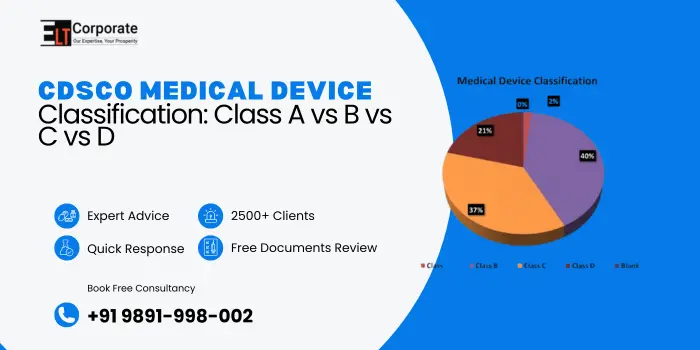
The most essential thing to do before applying for any registration or licence in India is to learn about the CDSCO medical device classification. There are four classifications of medical devices according to CDSCO: Class A, Class B, Class C, and Class D. Each class has a different amount of danger and a different level of government oversight. If you choose the incorrect class, your registration might be denied, delayed, or flagged for rectification. This is why businesses need to know exactly how CDSCO classifies medical devices and how to choose the right risk class. This page uses simple language to describe the differences between Class A, Class B, Class C, and Class D, what each class means, examples, risk levels, and how manufacturers may tell what class their device is in.
Table of Contents
ToggleWhat is the CDSCO Medical Device Classification?
The Central Drugs Standard Control Organisation (CDSCO) uses a risk-based method called CDSCO medical device categorisation to figure out how much regulation a medical device supplied in India needs. CDSCO looks at how dangerous the device is for users and patients and then puts it into one of these groups:
Class A (Low Risk)
Class B (Low to Moderate Risk)
Class C (Moderate to High Risk)
Class D (Very High Risk)
The more dangerous something is, the more rules there are to follow. To finish any license or registration, you must know how to classify medical devices with CDSCO.
What is CDSCO medical device classification so important?
The CDSCO medical device categorisation says:
- What kind of licence form do you need to fill out
- If you require an audit by a Notified Body
- Fees from the government
- Documents that are needed
- Requirements for compliance
- Length of the procedure for getting permission
You can’t apply for a manufacturer or import permit if you don’t know your class.
The Risk-Based Approach Used by CDSCO to Classify Medical Devices
The reasoning behind CDSCO’s medical device categorisation is straightforward. It checks:
- How important the device is
- If it touches the body
- It enters the body
- Whether it helps or keeps life going
- If it is utilised in an emergency
- If it can be implanted
- Whether it is electrically active or sterile
Putting the equipment in the right class is based on these considerations.
Class A Medical Devices (Not Very Risky)
Devices in class A are not very dangerous. These are easy, don’t hurt, and don’t have a big effect on the body.
- Class A Devices Examples
- Thermometers that aren’t digital
- Stethoscope
- Bandages
- Wheelchairs that work mechanically
- Bedpans
- Non-sterile examination gloves, class A, and sterile surgical gloves, class B
- Important Points
- Minimal regulatory oversight
- Basic paperwork
- No audit by a Notified Body for devices that aren’t sterile
The CDSCO medical device categorisation says that Class A devices are the simplest.
Class B Medical Devices (Low to Moderate Risk)
Devices in Class B have a little greater danger. They could be intrusive for a short period or entail electrical functioning.
Class B Devices:
- Thermometers that are digital
- Monitors for blood pressure
- Syringes and needles
- Nebulisers
- Bandages that are clean
- Pumps that suck
- Important Points
- More paperwork than Class A
- Class B manufacturers must have an audit by a Notified Body.
- Need more quality control
In the CDSCO medical device categorisation, a lot of gadgets fit into this group.
Class C Medical Devices (Moderate to High Risk)
Devices in Class C are at a moderate to high risk. They are used to find out what’s wrong or to help those who are really sick.
Class C Devices:
- machines for ECG
- Machines that use ultrasound
- Pumps for insulin
- Equipment for dialysis
- Anaesthesia workstations – Class C or Class D (based on life-support function)
- Main Points
- Needs good technical documents
- Evidence of a quality management system is necessary.
- There are rigorous rules for importing and making things.
Class C devices need a better grasp of CDSCO medical device categorisation since CDSCO checks them more closely.
Class D Medical Devices (Very Risky)
The most dangerous equipment are in Class D. They help or keep life going, go into the bloodstream, or can be put in the body.
Class D Devices Examples
- Valves in the heart
- Pacemakers
- Defibrillators that can be implanted
- Cement for bones
- Blood bags – usually Class C (may be Class D if drug-coated)
- Tools used in ICUs for critical care
- Main Points
- Most strict oversight by the government
- Strongest paperwork
- Foreign approvals (FDA/CE) are not mandatory but may support the technical evaluation.
- CDSCO may conduct inspections.
In the CDSCO medical device categorisation, these are the most sensitive gadgets.
How to Figure Out What Kind of Device You Have?
Here are the actions that manufacturers and importers may take:
Step 1: Look at the official list of devices from CDSCO.
- The CDSCO puts out a list of all the devices that have been reported and their classifications.
Step 2: Know what you want to do with it
The class is based on how the gadget interacts with the body.
Step 3: Check to see whether the device is:
- Able to be implanted
- Supporting life
- Diagnosis
- Sterile or non-sterile
- Active with electricity
Used by both experts and the general public
Step 4: Look at the characteristics of other gadgets and compare them.
- You may find out what class your product belongs to if it is comparable to another gadget that has already been classed.
Step 5: Get professional advice
This makes sure that the CDSCO medical device categorisation is correct and that it won’t be turned down.
Requirements for Registration and Licensing for Each Class Class A
- Class A (non-sterile, non-measuring) devices follow a simplified online registration route, but registration is still mandatory.
Class B
- Notified Body audit is needed
- More safety paperwork
- Classes C and D
- Technical data that are quite detailed
- Clinical proof
- The Site Master File and the Device Master File
- Longer time to review
- Most safety compliance
Under the CDSCO medical device categorisation, the application must be more thorough for higher classes.
Mistakes People Make When Picking a Device Class
Manufacturers routinely make mistakes like these:
- Choosing Class A over Class B
- Choosing a lesser class to cut down on paperwork
- Not understanding the difference between intrusive and non-invasive rules
- Mixing together diagnostic tools with treatment tools
If you get the wrong class, your CDSCO medical device certification will be denied, which would postpone the introduction by months.
Why It’s Important to Classify Things Correctly for Market Success?
Correctly classifying medical devices by the CDSCO makes sure that:
- Easier to get permission
- No rejection or need for further information
- Faster entrance into the market
- No legal issues
- No legal or licensing complications
It makes CDSCO trust you and gets your gadget to the Indian market quicker.
End
The CDSCO medical device categorisation system is the basis for how medical devices are regulated in India. Manufacturers can figure out which risk class to use, fill out the necessary paperwork, and apply for the relevant CDSCO licence if they know the difference between Class A, B, C, and D.
The first step to getting clearance and following the rules is to correctly classify.
What does the CDSCO medical device categorisation mean?
It is a system based on risk that puts gadgets into four groups: Class A, B, C, and D.
Which class needs to follow the rules the most?
The most rigorous rules should be in place for Class D.
Is it possible for a manufacturer to pick the class on their own?
Yes, however, they have to follow CDSCO standards to prevent making errors.
Where can I find out what kind of device I have?
Look at CDSCO’s official list of medical devices that have been reported.
What happens if the incorrect class is chosen?
CDSCO usually raises queries for correction. Rejection happens only if deficiencies are not resolved.
Comments are closed